
A patient reports painful swelling beneath the tongue when eating, and the dentist suspects a calcified stone in the submandibular salivary duct. Which intraoral digital projection best localizes this stone in the floor of the mouth?
Select an answer to reveal the explanation.
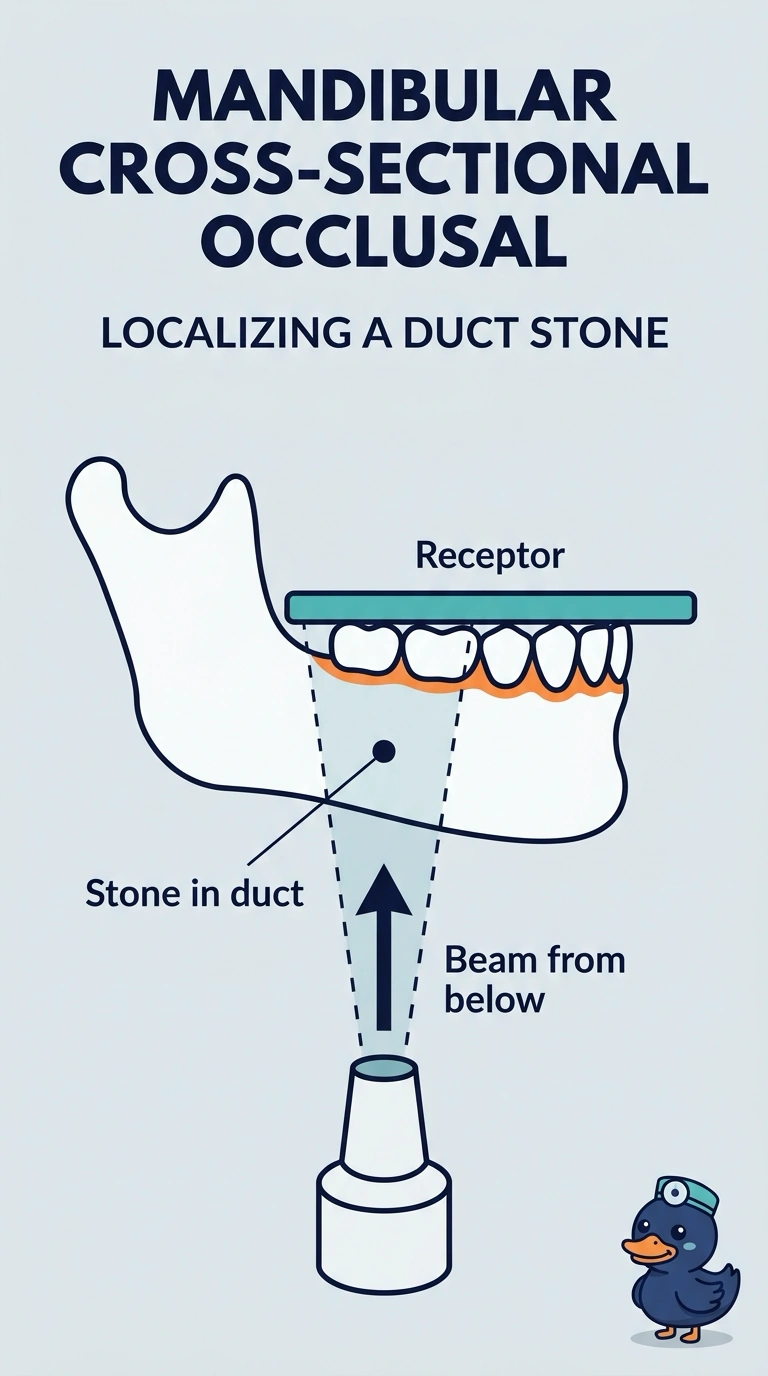
Short Explanation
When you suspect a salivary stone hiding beneath the tongue, you need a top-down view instead of a side profile. A mandibular cross-sectional occlusal projection aims the beam straight through the floor of the mouth so calcified stones stand out clearly. The trap is choosing a standard periapical or bitewing that hides medial stones behind the jawbone.
Full Explanation
To localize a suspected sialolith in the submandibular duct, A mandibular cross-sectional occlusal projection directs the central X-ray beam perpendicular to the receptor from beneath the chin. This true inferior-to-superior geometry separates the soft tissues of the floor of the mouth from the dense cortical bone of the mandible, making calcified salivary stones and buccolingual displacements easy to identify. Choosing A mandibular molar periapical projection is ineffective because its facial-lingual beam path either misses stones located medially in the floor of the mouth or superimposes them over the mandibular body. Selecting A vertical posterior bitewing projection fails because bitewings only capture the crowns and crestal alveolar bone of opposing posterior teeth, never the submandibular soft tissue. Using A mandibular anterior topographic occlusal projection is also incorrect because its angled beam is designed to evaluate the anterior teeth and symphysis rather than provide a perpendicular view of the floor of the mouth. As a caveat, radiolucent or poorly calcified stones may not appear on any plain radiograph. For an operational check, seat the patient with the head tipped back so the occlusal plane is perpendicular to the floor and center the position-indicating device beneath the chin.
Prefer to study offline? Printable PDF study book + test engine ($7.50, unofficial). These questions stay free here.