
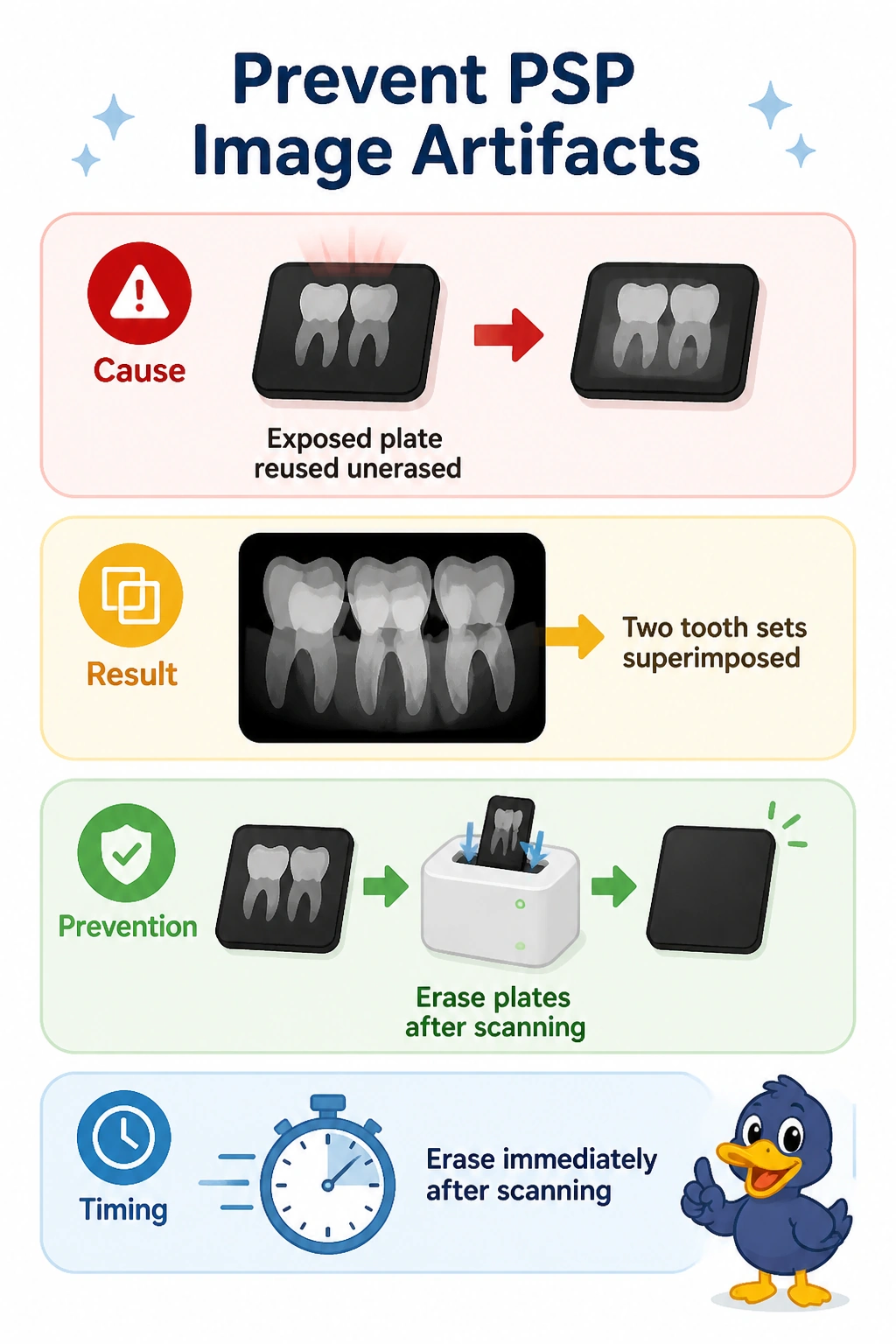
While viewing a newly scanned digital periapical image from a photostimulable phosphor (PSP) plate, you see two completely different sets of teeth superimposed on the same image. What caused this artifact, and how is it prevented?
Select an answer to reveal the explanation.
Short Explanation
Think of a PSP plate like an Etch A Sketch: if you do not clear the old drawing, the next picture lands right on top of it. Seeing two sets of teeth on one scan means you reused an unerased plate, which is prevented by erasing plates immediately after scanning. The trap is blaming plate bending, which leaves a crease rather than a second set of teeth.
Full Explanation
Photostimulable phosphor (PSP) plates capture a latent X-ray image in phosphor crystals and retain residual energy until cleared by bright light inside the scanner or a dedicated erasing unit. When An exposed plate was not erased before reuse, which is prevented by erasing plates immediately after scanning, the new patient exposure superimposes directly over the leftover latent image, creating a diagnostic double exposure with two overlapping sets of teeth. By contrast, if The plate was bent in the mouth, which is prevented by using a rigid backing card, the resulting artifact appears as a dark radiolucent crease line or curved geometric distortion, not a second unrelated set of teeth. Claiming that The scanner laser drifted, which is prevented by recalibrating the unit weekly does not explain two distinct anatomical exposures recorded on one plate. Likewise, The sensor cable loosened, which is prevented by locking the USB port latch applies to wired solid-state sensors rather than wireless PSP plates, and a loose cable causes connection dropouts rather than double anatomy. As a caveat, leaving erased PSP plates exposed to bright room light for extended periods before use can degrade the latent image quality. As an operational check, confirm the scanner's automatic erase cycle completes before returning any PSP plate to the clean storage box.
Prefer to study offline? Printable PDF study book + test engine ($7.50, unofficial). These questions stay free here.