
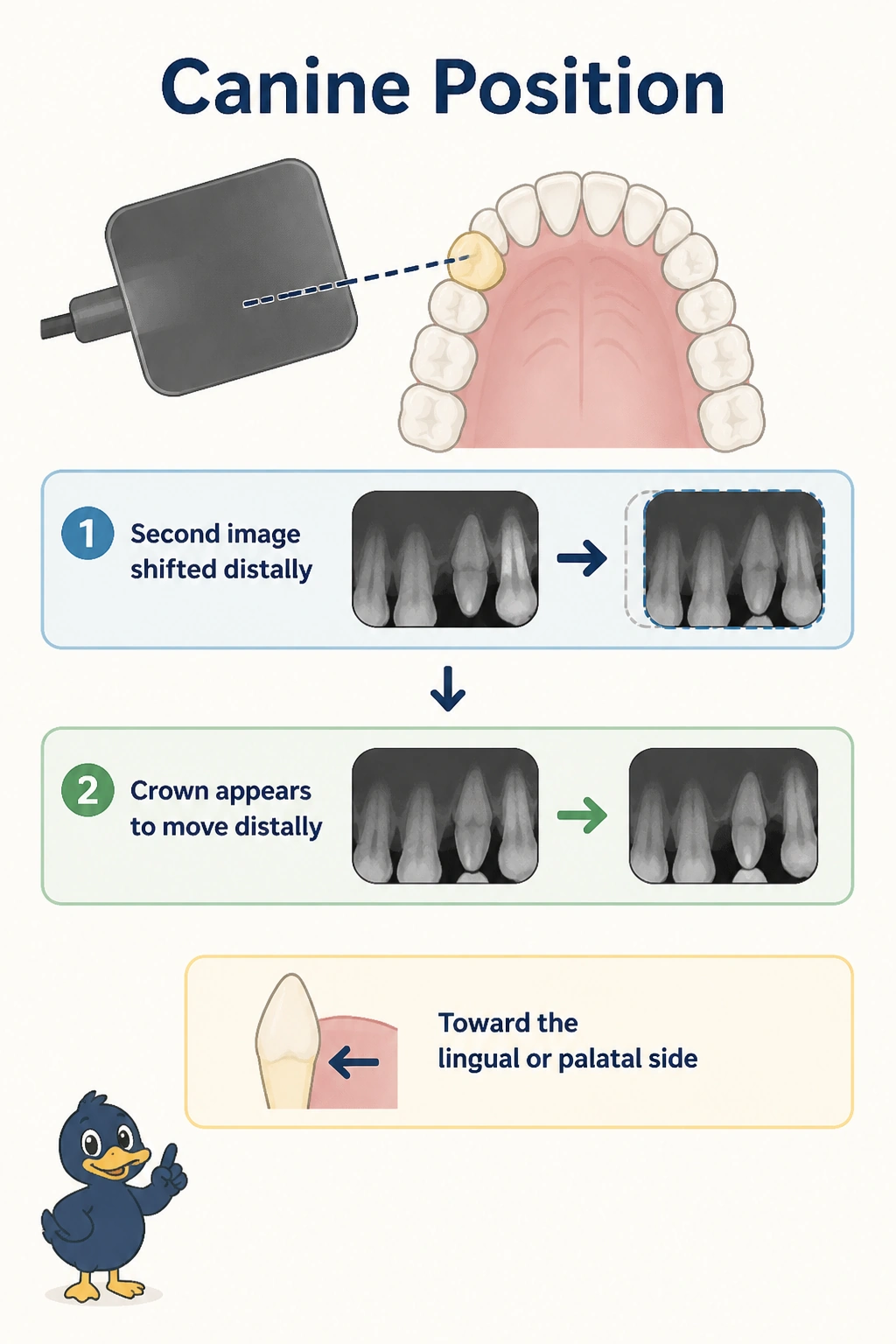
You take two periapical images of an impacted maxillary canine: the first is centered normally, and the second is shifted distally in horizontal angulation. On the second image, the impacted crown appears to move distally relative to the lateral incisor root. Where is the impacted canine located?
Select an answer to reveal the explanation.
Short Explanation
Remember the SLOB rule—Same Lingual, Opposite Buccal—whenever you try to pinpoint a hidden tooth in 3D space from flat images. Because the impacted canine moved in the same direction as your tubehead shift, it sits on the palatal side.
Full Explanation
The buccal object rule, commonly remembered by the mnemonic SLOB (Same Lingual, Opposite Buccal), determines the buccolingual position of an object using two images taken at different horizontal or vertical tubehead angles. Because the tubehead shifted distally and the impacted canine crown also shifted distally relative to the reference lateral incisor, it moved in the same direction and therefore lies Toward the lingual or palatal side. Choosing Toward the facial or buccal side would apply only if the canine had appeared to move mesially, opposite the distal tubehead shift. Selecting Directly at the occlusal plane level describes vertical height rather than buccolingual depth and is not what horizontal tube shifting determines. Choosing Centered in the alveolus without buccolingual displacement would require no apparent movement between the two exposures, which contradicts the observed distal shift that confirms palatal displacement. As a clinical caveat, keep the receptor in the exact same position between the two exposures and vary only the horizontal or vertical tubehead angle so the reference teeth remain comparable. For an operational check, confirm the direction the PID moved between exposures and verify the apparent shift of the object against a stable anatomical landmark such as an adjacent root.
Prefer to study offline? Printable PDF study book + test engine ($7.50, unofficial). These questions stay free here.