
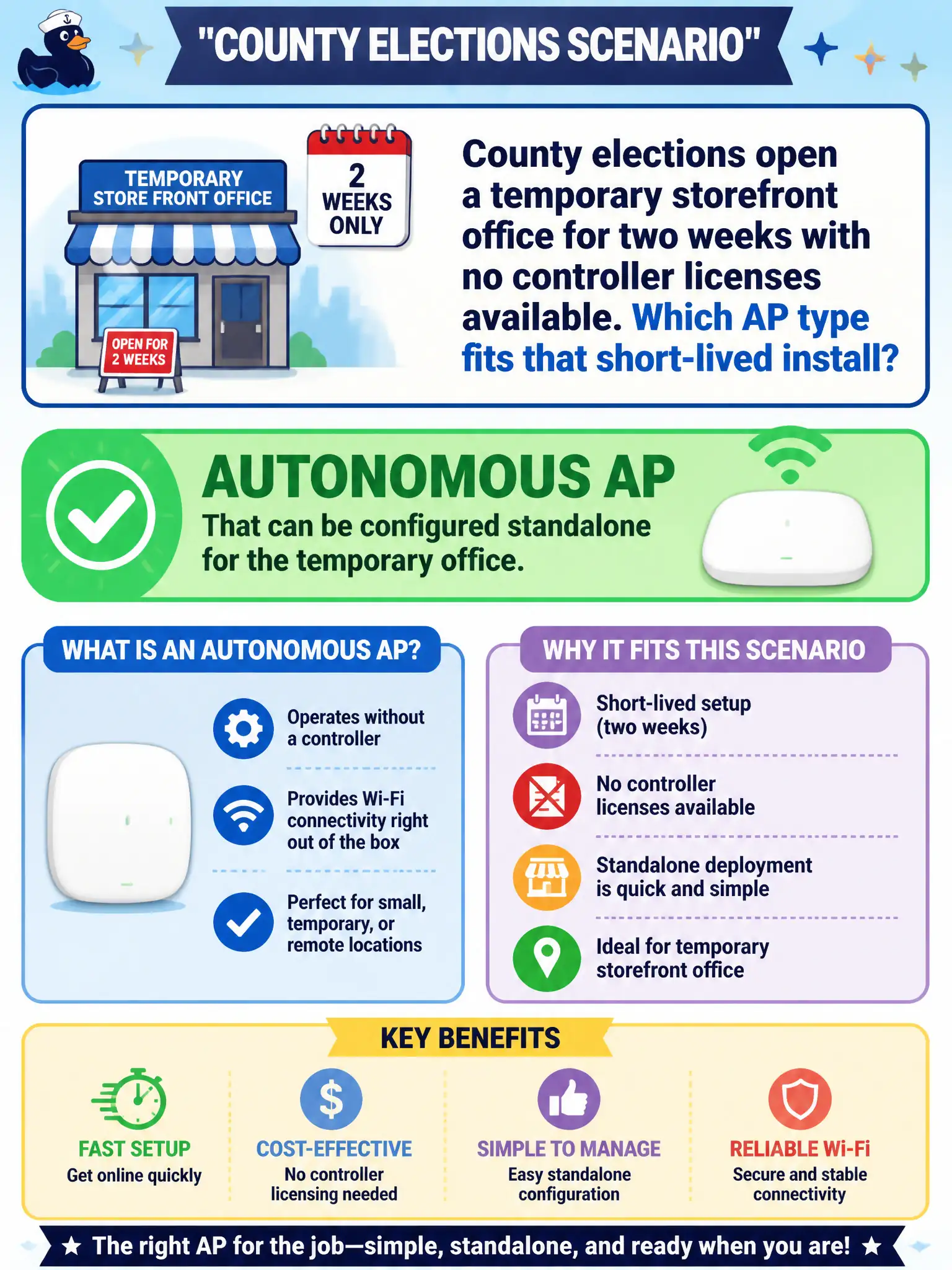
County elections open a temporary storefront office for two weeks with no controller licenses available. Which AP type fits that short-lived install?
Select an answer to reveal the explanation.
Short Explanation
Temporary offices love simple: plug in, set SSID and security, done. Autonomous APs do that without hunting for controller licenses that will not land before the polls close.
Full Explanation
County elections opening a temporary storefront office for two weeks with no controller licenses available fit an autonomous AP that can be configured standalone for the temporary office. Autonomous mode avoids waiting on WLC licensing and suits short-lived municipal pop-up sites. Local configuration can be stood up quickly for election staff and public devices under approved SSIDs.
A controller-based AP waiting on license purchase that will not arrive until after election day fails the schedule. A campus-wide mesh root that requires fiber back to the elections warehouse overcomplicates a two-week storefront. A WIPS sensor appliance with no client SSID support does not provide the needed client access.
Exam caveat: temporary sites without licenses often map to autonomous APs on technician exams. Operational check: configure the storefront autonomous AP with election SSIDs and security, document the temporary admin password, verify staff association, and schedule decommission and credential retirement after election day. Label the temporary storefront AP chassis with decommission date so it is not accidentally left serving after elections close. Confirm success with a second client on the same civic SSID before closing the ticket.