
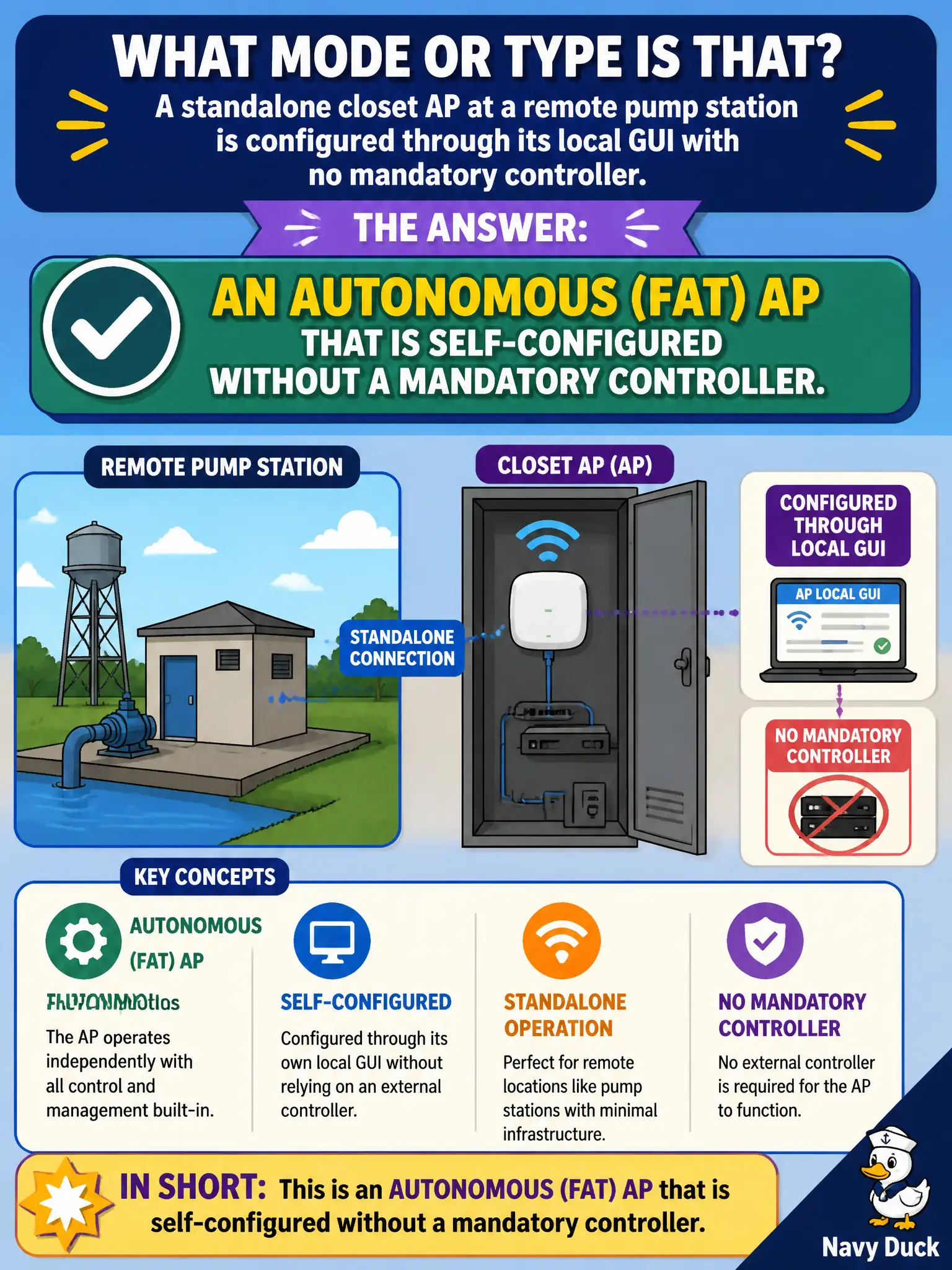
A standalone closet AP at a remote pump station is configured through its local GUI with no mandatory controller. What mode or type is that?
Select an answer to reveal the explanation.
Short Explanation
Autonomous APs are the independent operators—they keep their own brain and local GUI. No controller required to bring up the pump-station WLAN. If you are clicking around on the AP itself for the whole config, you are in autonomous territory.
Full Explanation
A standalone closet AP at a remote pump station configured through its local GUI with no mandatory controller is an autonomous (fat) AP that is self-configured without a mandatory controller. Autonomous APs store configuration locally and suit small or isolated municipal sites where controller dependency is undesirable or unreachable. Local GUI or CLI management is the expected operational pattern for that mode at pump stations and similar facilities.
Controller-based thin AP operation only contradicts the no-mandatory-controller local GUI scenario. Cloud AP operation that forbids any local login is not what the stem describes. A distributed antenna system with no Wi-Fi radio of its own is a different RF distribution approach, not an autonomous AP type.
Exam caveat: local GUI, standalone configuration, and no required controller equal autonomous/fat AP selection on CWT items. Operational check: connect to the pump-station AP's local management interface, set SSID and security without a WLC join, save configuration to local storage, and verify persistence after a reboot at the site. Export or photograph the final local config for the pump-station AP and store it with the site runbook in case the unit must be replaced quickly.