
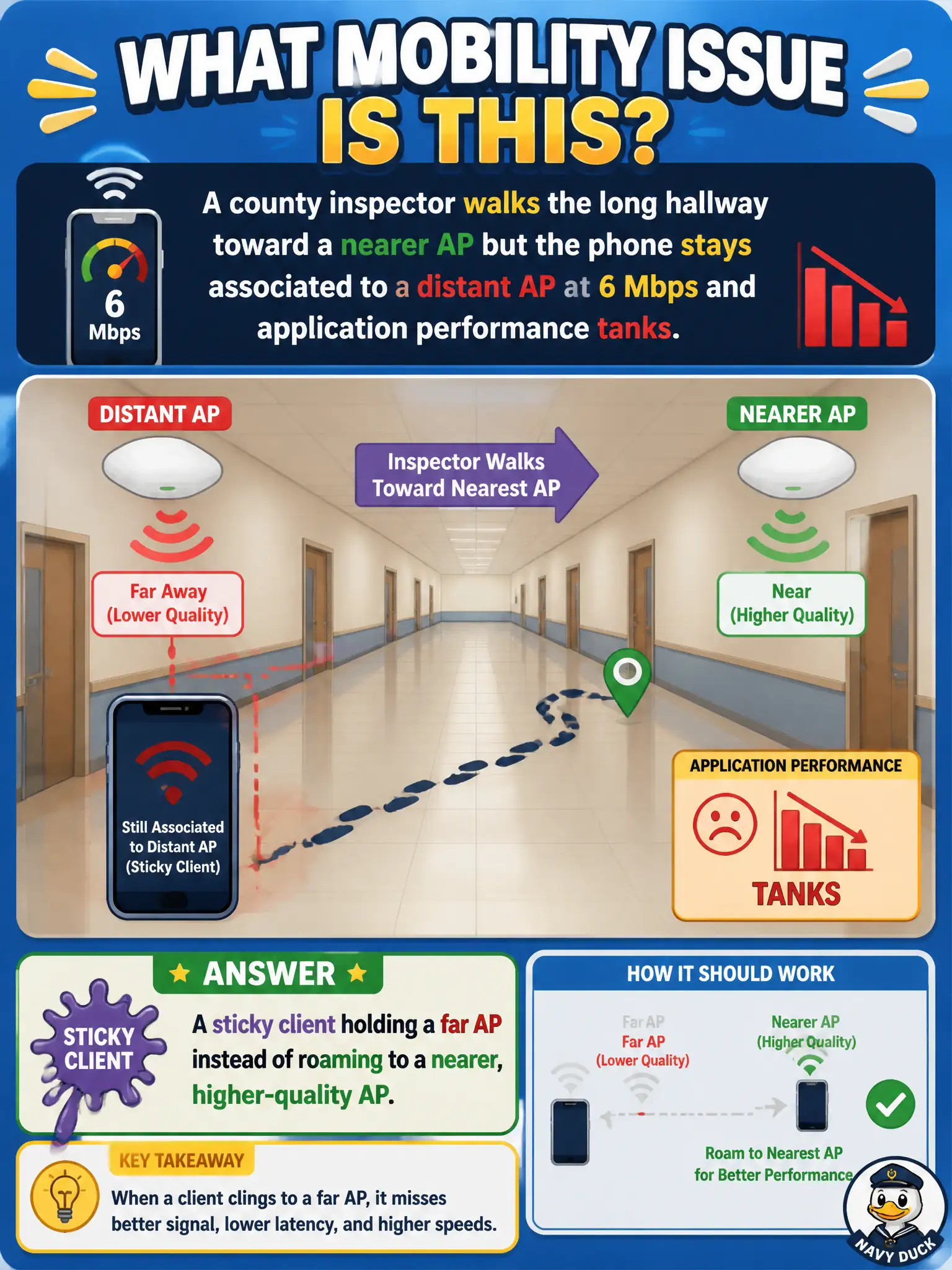
A county inspector walks the long hallway toward a nearer AP but the phone stays associated to a distant AP at 6 Mbps and application performance tanks. What mobility issue is this?
Select an answer to reveal the explanation.
Short Explanation
Sticky clients cling to the old AP like gum on a shoe—even when a better AP is right there. That leaves you stuck at low rates far away. Mobility troubleshooting targets stickiness, not passphrase expiry myths.
Full Explanation
A county inspector who walks a long hallway toward a nearer AP but whose phone stays associated to a distant AP at 6 Mbps with tanking application performance is exhibiting sticky-client behavior: holding a far AP instead of roaming to a nearer, higher-quality AP. Stickiness is a mobility performance problem. Low rate on a distant BSS explains the app failure despite remaining “connected.”
Normal behavior that clients must never roam while any distant AP still shows non-zero RSSI fails modern roaming expectations and freezes clients on bad BSSs. Proof that WPA3-Personal passphrases expire every time a user walks more than ten meters fails by concept: PSKs do not expire from walking. Evidence that PoE injectors renegotiate power class during every hallway roam attempt fails without PoE symptoms and mislabels stickiness.
Exam caveat: connected to far AP at low rate while nearer AP exists ⇒ sticky client mobility issue.
Operational check: observe BSSID and rate during the walk; adjust client roam aggressiveness and/or restore AP power boundaries per design; confirm the phone roams to the nearer higher-SNR AP; retest apps. Combine sticky-client roam aggressiveness changes with design-compliant AP power so hallway inspectors see clear cell edges instead of a single distant high-power BSSID at 6 Mbps.