
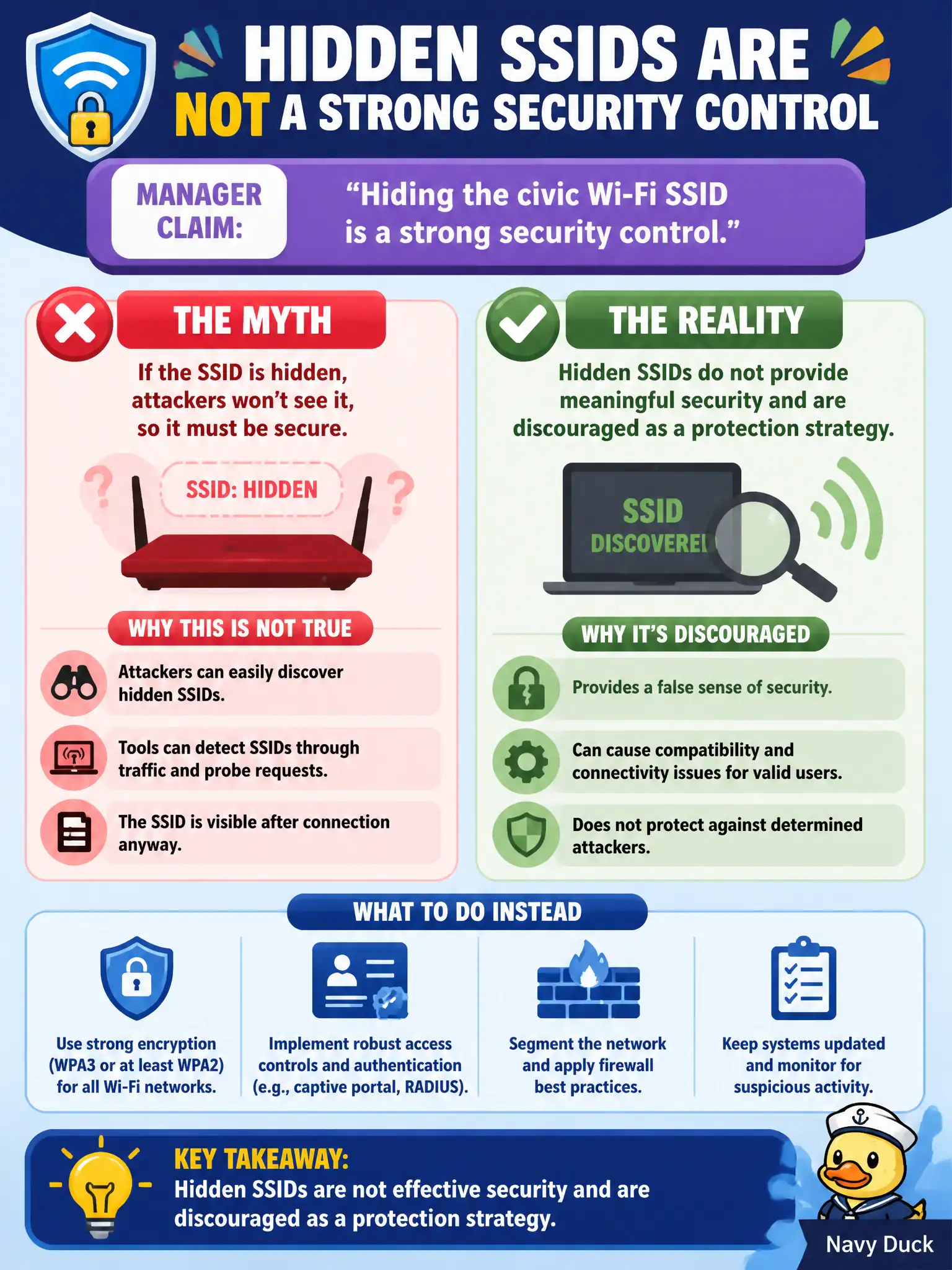
A manager claims hiding the civic Wi-Fi SSID is a strong security control. How should the technician respond?
Select an answer to reveal the explanation.
Short Explanation
Hiding the SSID is security cosplay—probes and determined clients still find it. Do not sell obscurity as protection, and do not skip real encryption because the name is cloaked. Treat hidden SSID as a legacy bad habit for 'security,' not a control.
Full Explanation
Managers sometimes claim hiding the civic Wi-Fi SSID is a strong security control. The technician should explain that hidden SSIDs are not effective security and are discouraged as a protection strategy. Probe behavior still reveals network names, clients can be harder to configure, and confidentiality still depends on modern encryption—not beacon obscurity. Municipal policy should not treat cloaking as a substitute for WPA2/WPA3.
Agreeing that hidden SSIDs replace the need for WPA2/WPA3 fails completely: obscurity is not encryption. Hiding the SSID and also enabling WEP layers two weak practices. Requiring hidden SSIDs on all staff and guest networks by policy institutionalizes a discouraged control without buying real confidentiality.
Exam caveat: hidden SSID ≠ security control. Exam answers favor modern encryption suites and explicitly reject cloaking-as-security narratives.
Operational check: keep SSIDs visible per design best practice, ensure WPA2/WPA3 is correctly configured, educate the manager with a short risk note, and remove any policy language that equates cloaking with encryption. Municipal technicians document the verified setting in the as-built packet so the next shift inherits a known-good civic configuration rather than tribal knowledge.