
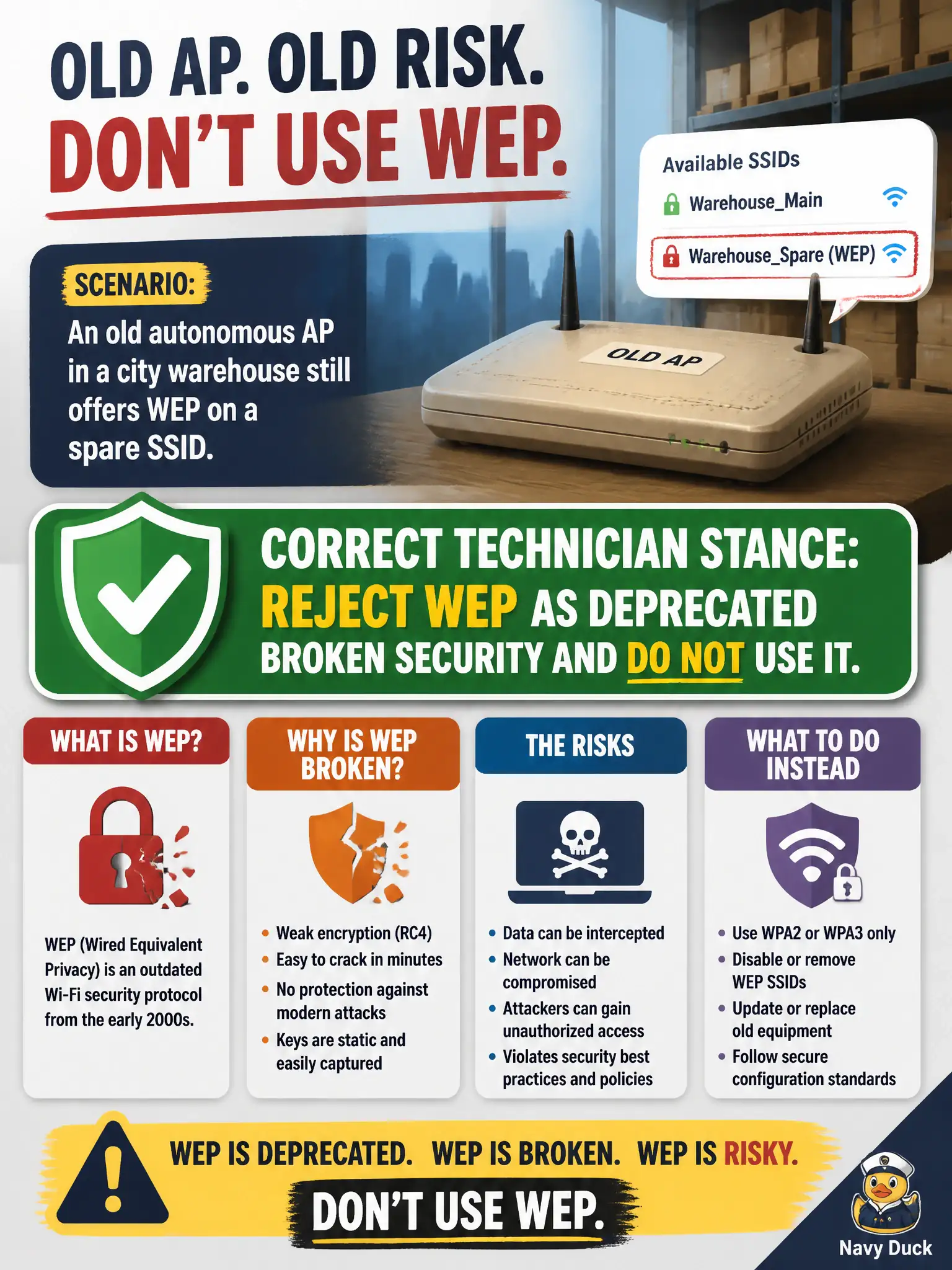
An old autonomous AP in a city warehouse still offers WEP on a spare SSID. What is the correct technician stance?
Select an answer to reveal the explanation.
Short Explanation
WEP is the rusty padlock everybody still recognizes and nobody should trust. If an old AP still offers it, shut that door—do not use WEP. Shorter keys and hiding the SSID do not make broken crypto okay.
Full Explanation
An old autonomous AP in a city warehouse that still offers WEP on a spare SSID must be treated as a security defect. The correct technician stance is to reject WEP as deprecated broken security and do not use it. WEP’s cryptographic weaknesses and practical key-recovery attacks make it unsuitable for any municipal WLAN, including “spare” or IoT convenience SSIDs that still touch city airtime and often bridge toward useful networks.
Preferring WEP over WPA3 because keys are shorter to type elevates typing comfort over confidentiality. Keeping WEP indefinitely for IoT compatibility alongside modern SSIDs maintains an easy attack foothold. Using WEP only when the SSID is hidden adds obscurity without fixing broken cryptography.
Exam caveat: there is no legitimate CWTS justification to keep WEP enabled on civic APs. Hidden SSIDs and IoT excuses do not rehabilitate WEP.
Operational check: disable and remove WEP SSIDs on the warehouse AP, migrate devices to a WPA2/WPA3 suite per design, verify no WEP cipher remains in the security list, and record remediation for audit. Municipal technicians document the verified setting in the as-built packet so the next shift inherits a known-good civic configuration rather than tribal knowledge.