
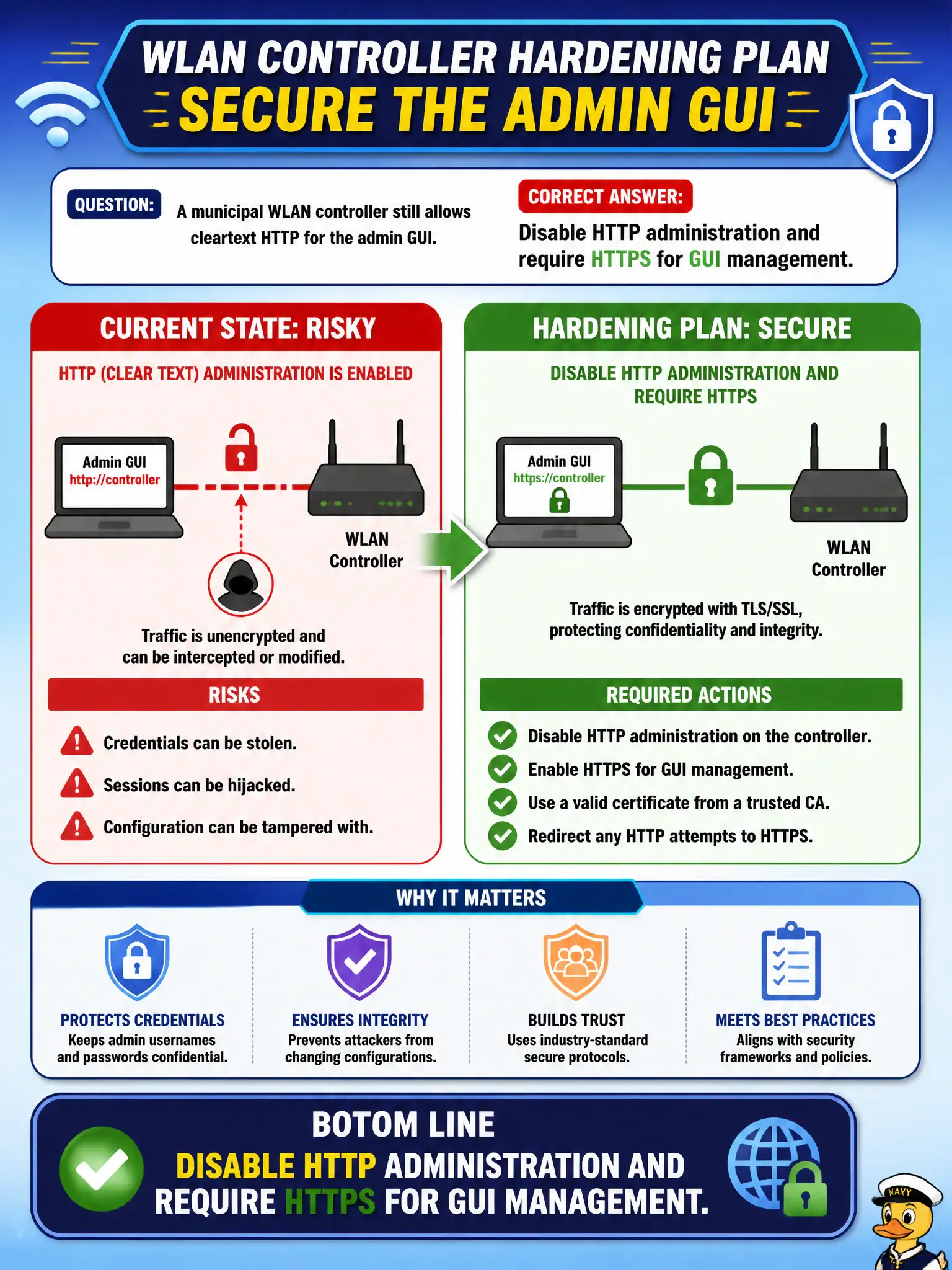
A municipal WLAN controller still allows cleartext HTTP for the admin GUI. What should the hardening plan require?
Select an answer to reveal the explanation.
Short Explanation
HTTP admin is like shouting the controller password across the break room. Flip the service to HTTPS and shut the cleartext door—do not park the admin GUI on the guest network.
Full Explanation
Disabling HTTP administration and mandating HTTPS for GUI management on municipal WLAN controllers is a fundamental security hardening measure. HTTP transmits administrative credentials and configuration data in cleartext, making them vulnerable to interception, session hijacking, and man-in-the-middle attacks. In a municipal WLAN environment, where administrative access controls the entire network infrastructure, such exposure can lead to unauthorized changes, data breaches, or network downtime. HTTPS, by contrast, encrypts the communication channel using TLS, ensuring confidentiality and integrity of management traffic. This encryption prevents attackers from eavesdropping or injecting malicious commands during configuration sessions. Opting to prefer HTTP simply to avoid the operational overhead of managing expiring certificates sacrifices essential security guarantees for convenience, which is unacceptable in civic networks that must protect public data and services. Exposing HTTP-based administrative interfaces on guest SSIDs is a critical misconfiguration, as guest networks are designed for untrusted users; allowing them access to management functions bypasses segmentation and can lead to privilege escalation or network compromise. Replacing HTTPS with Telnet banners misunderstands protocol roles: Telnet is a legacy CLI protocol that transmits data unencrypted and is unsuitable for GUI management, while banners are informational messages that do not provide any encryption or authentication. The hardening plan must include configuring controllers to disable all insecure management protocols, enforce HTTPS with strong cipher suites, and implement proper certificate lifecycle management to avoid service disruptions. Administrators should operationally verify that all management interfaces reject HTTP connections, that HTTPS is enforced with valid certificates, and that guest or other untrusted SSIDs do not expose any administrative access points. This approach ensures that municipal WLAN controllers maintain a robust security posture against common network management threats.