
A county parks department is hardening free public Wi-Fi. Which guest design best layers public-access controls?
Select an answer to reveal the explanation.
Short Explanation
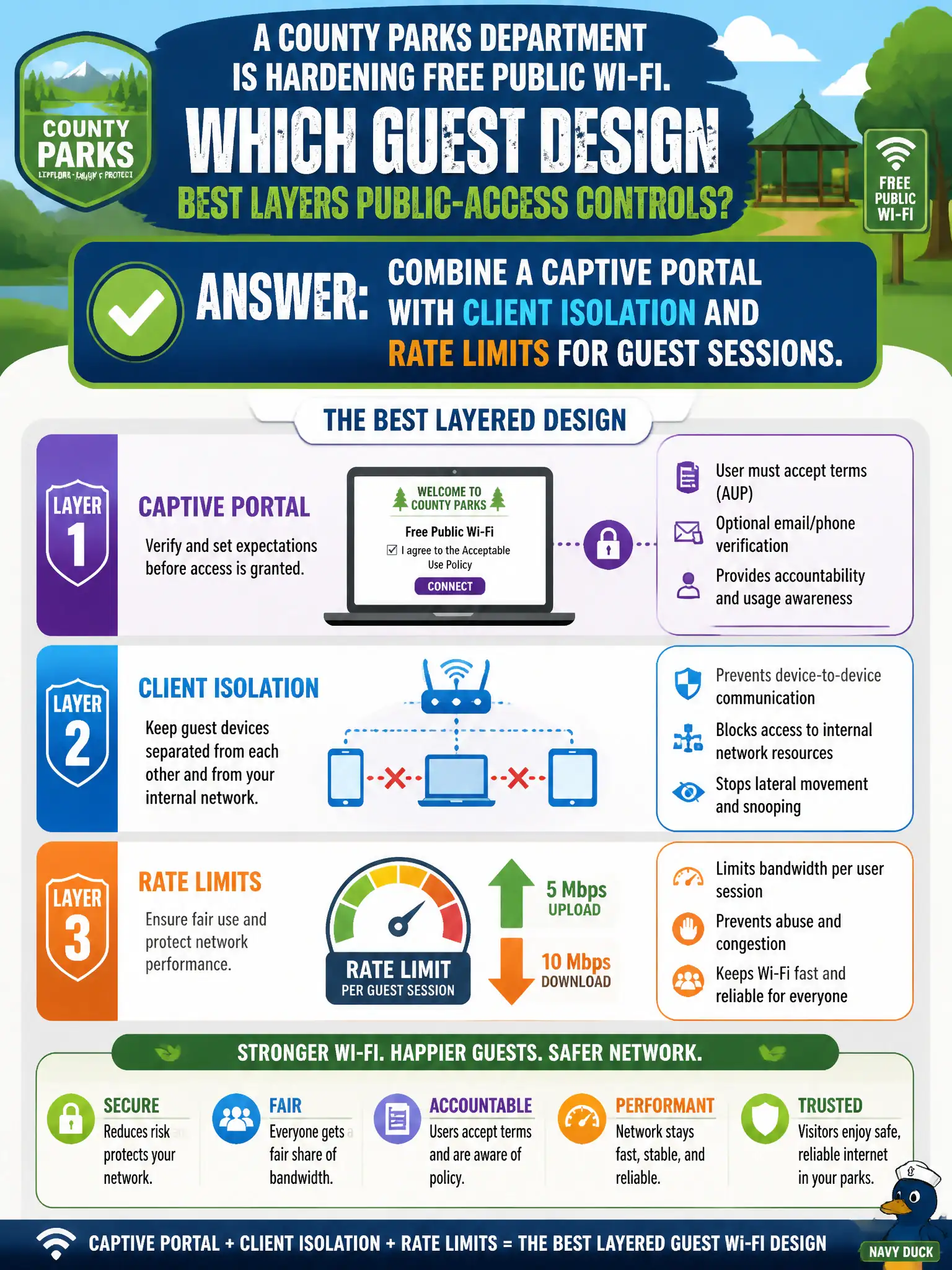
Guest Wi-Fi needs more than one latch: the portal is the front desk, isolation stops guests poking each other’s devices, and rate limits keep one tablet from eating the whole picnic bandwidth. A staff PSK for the public is mixing the keys to city hall with the park bench.
Full Explanation
Combining a captive portal with client isolation and rate limits for guest sessions provides a layered approach to hardening free public Wi-Fi in a county parks department. The captive portal enforces policy acceptance and controls initial access, client isolation prevents direct communication between guest devices to reduce malware spread and privacy risks, and rate limits prevent any single user from monopolizing bandwidth, ensuring fair access. Using one shared staff PSK for guests without isolation exposes sensitive devices like printers to potential compromise and allows lateral attacks between guests. Employing only a captive portal with guest-to-guest bridging and unlimited bandwidth removes critical protections against peer attacks and resource abuse. Disabling logging and monitoring eliminates visibility into network activity, hindering incident detection and response. While layered controls improve security, they must be balanced with usability and resource constraints. Operationally, administrators should verify that client isolation is enabled at the access point level, captive portal triggers correctly, and bandwidth limits are enforced per session to maintain service quality and security.