
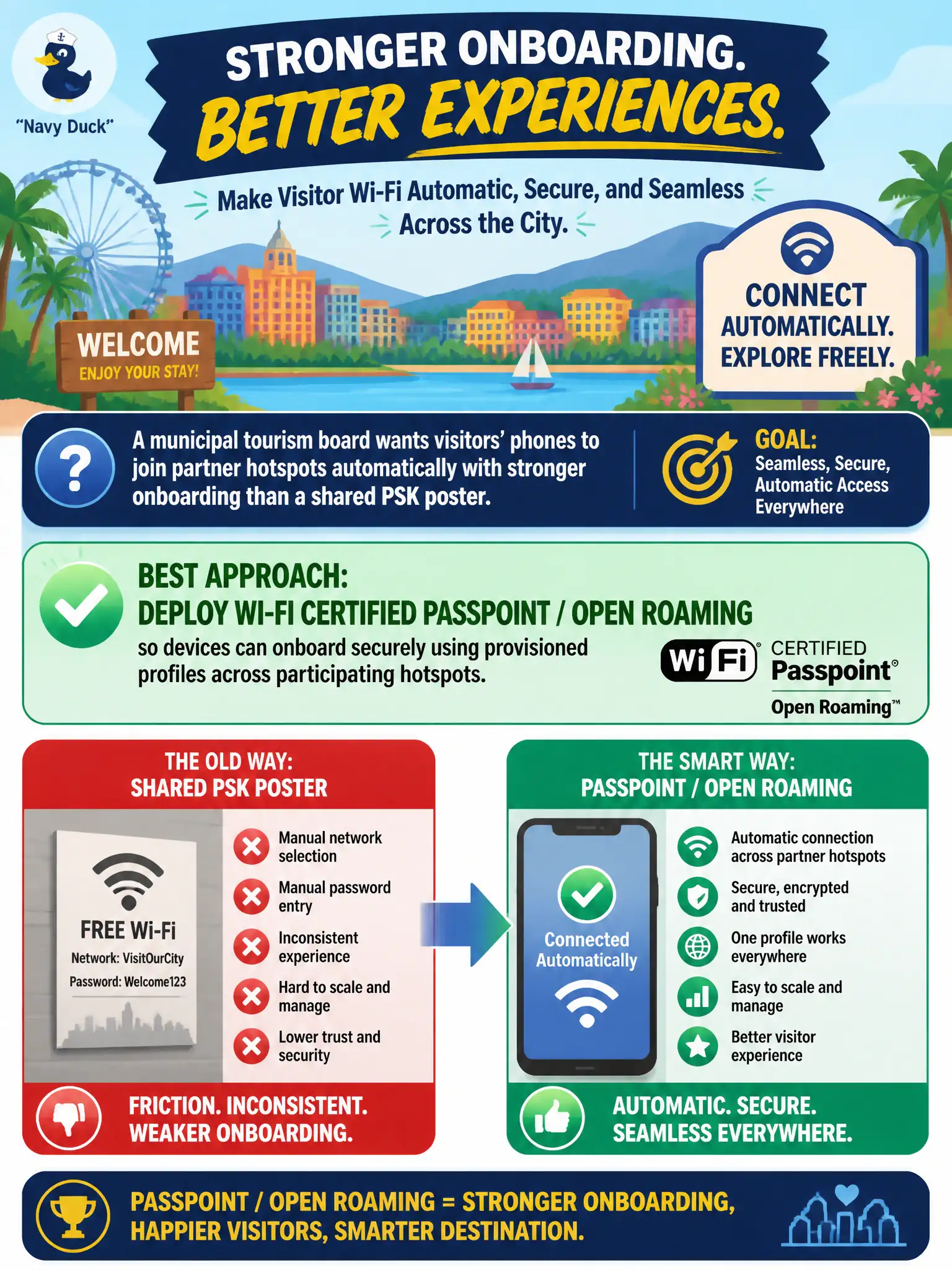
A municipal tourism board wants visitors’ phones to join partner hotspots automatically with stronger onboarding than a shared PSK poster. Which approach best matches that goal?
Select an answer to reveal the explanation.
Short Explanation
Passpoint is the ‘tap your transit card once’ model for public Wi-Fi: the phone already holds a trusted profile and can join participating hotspots without hunting for a PSK on a poster. Shared WEP or open air is the opposite of secure automatic onboarding.
Full Explanation
Deploying Wi-Fi Certified Passpoint (also known as Hotspot 2.0) or Open Roaming is the optimal approach for a municipal tourism board seeking stronger, automatic onboarding across partner hotspots. Passpoint uses device provisioning profiles and secure authentication protocols (such as EAP-TLS) to enable seamless, secure connections to participating networks without user intervention after initial setup. This federation of hotspots allows visitors’ devices to roam automatically with enterprise-grade security, eliminating the need for shared passphrases. Printing a citywide WEP key on visitor maps is insecure and outdated; WEP is vulnerable to trivial attacks and does not support automatic secure onboarding. Disabling all encryption removes confidentiality and exposes users to eavesdropping, which is unacceptable in public networks. Forcing each tourist through different static WPA2-Personal passphrases at each kiosk lacks federation and creates user friction, defeating the goal of automatic, seamless connection. A caveat is that Passpoint adoption depends on device support and proper backend infrastructure, so planners should verify compatibility and coverage. Administrators should test that devices provision profiles correctly and roam between hotspots without manual intervention.