
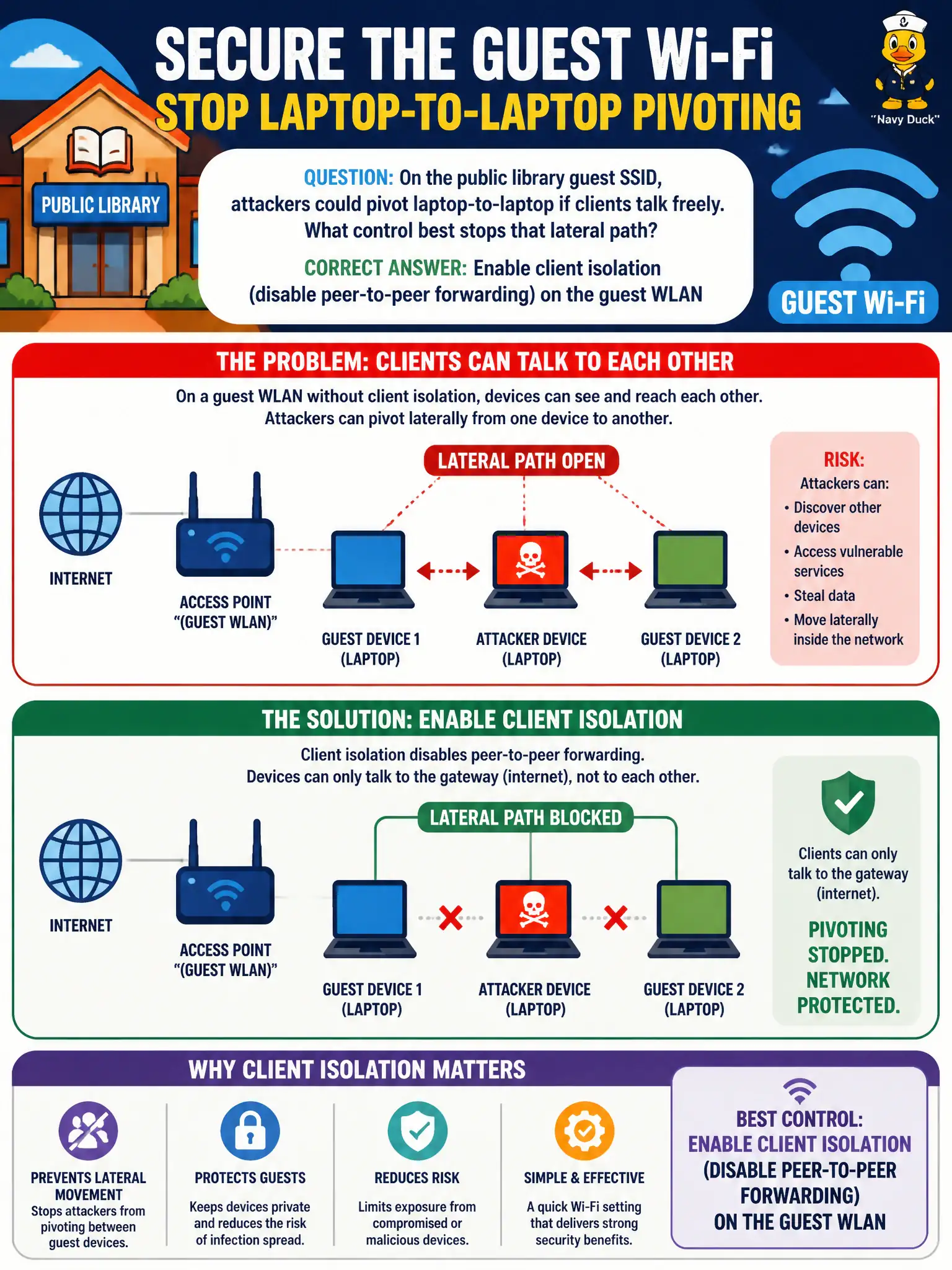
On the public library guest SSID, attackers could pivot laptop-to-laptop if clients talk freely. What control best stops that lateral path?
Select an answer to reveal the explanation.
Short Explanation
Client isolation is the library rule that patrons cannot whisper file-share packets to the next table. Turn off peer-to-peer forwarding on guest Wi-Fi so lateral attacks stall. Staff VLANs and public MAC lists help the wrong people.
Full Explanation
In the public library's guest SSID environment, preventing attacker pivoting between client devices requires enabling client isolation, also known as disabling peer-to-peer forwarding. This control prevents wireless clients connected to the same SSID from directly communicating with each other, thereby blocking lateral movement that attackers could exploit to compromise multiple devices. Client isolation ensures that each client only communicates with the AP and not with other clients, significantly reducing the attack surface. Simply increasing the beacon interval does not affect client-to-client communication and thus fails to mitigate lateral attacks. Publishing client MAC addresses publicly offers no security benefit and may aid attackers in reconnaissance. Assigning guests to the staff VLAN for easier printing exposes internal resources to untrusted users, violating network segmentation principles. It is important to note that client isolation may impact legitimate peer-to-peer applications, such as local file sharing or device pairing, so administrators should balance security needs with user functionality. To confirm effectiveness, network operators can perform client-to-client ping tests on the guest SSID to ensure isolation is enforced.