
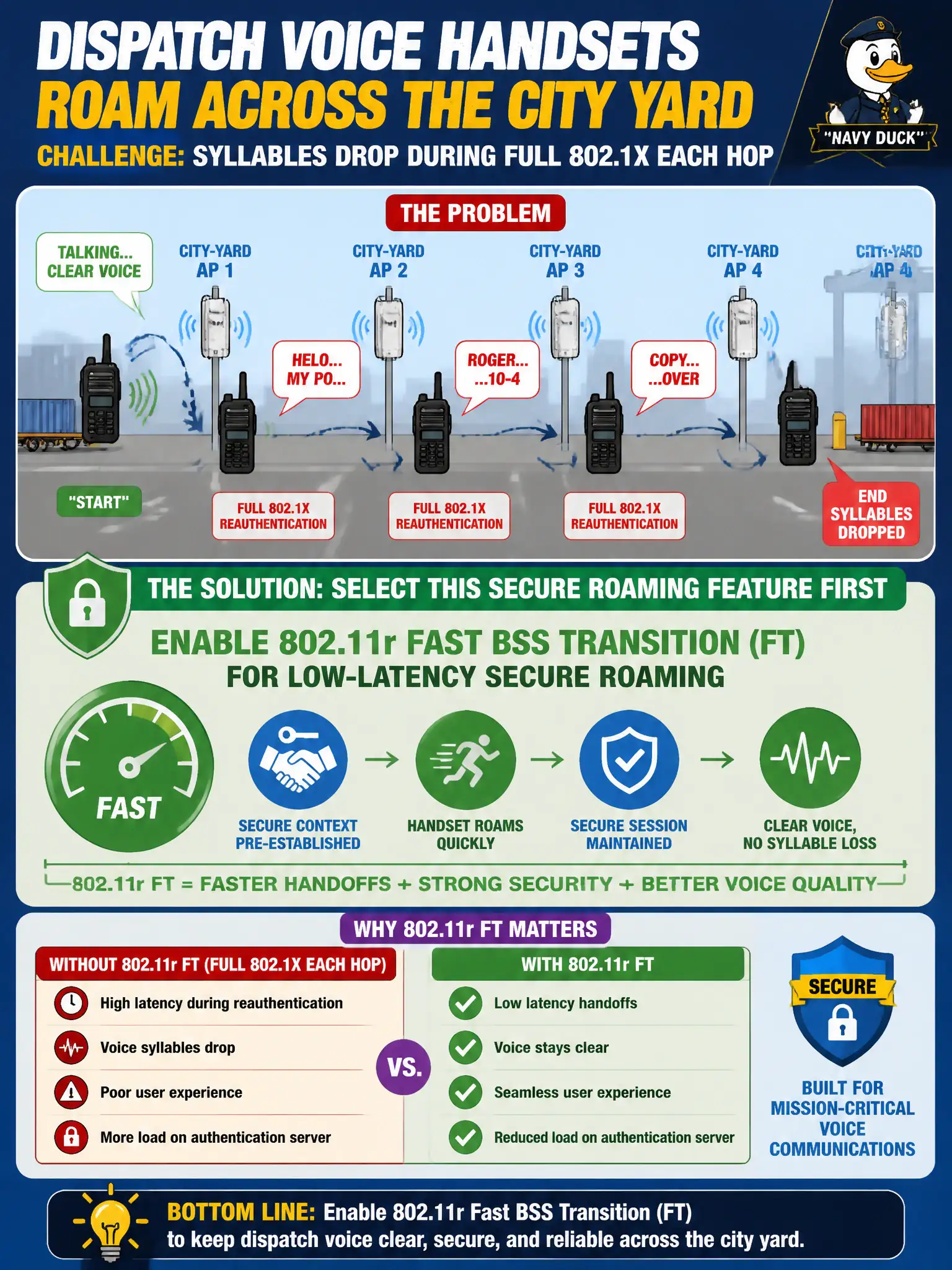
Dispatch voice handsets roam across city-yard APs and drop syllables during full 802.1X each hop. Which secure roaming feature should the design select first?
Select an answer to reveal the explanation.
Short Explanation
Full 802.1X on every AP hop is like re-badging at every doorway while talking on the radio—calls stutter. 802.11r FT keeps security but speeds the handoff for voice. Open SSIDs and WEP are the wrong shortcuts.
Full Explanation
For dispatch voice handsets roaming across multiple city-yard access points, maintaining call quality without syllable drops during secure authentication is essential. The appropriate design choice is enabling 802.11r Fast BSS Transition (FT), which facilitates low-latency secure roaming. 802.11r allows handsets to cache key material and perform a streamlined handshake when moving between APs, significantly reducing the time needed for re-authentication compared to a full 802.1X process at each hop. This fast transition minimizes voice packet loss and latency, preserving call clarity. Disabling all encryption on the voice SSID during business hours is insecure and exposes sensitive communications to interception. Forcing every roam to require a new captive-portal login introduces unacceptable delays and user friction, unsuitable for mission-critical voice communication. Replacing WPA3 with WEP to shorten handshake time is both insecure and obsolete, as WEP is vulnerable to attacks and does not support modern fast roaming features. It is important to verify that both the infrastructure and client devices support 802.11r to achieve the desired performance benefits. Operationally, testing voice handsets roaming between APs with 802.11r enabled should show seamless handoff without audio degradation.