
Headless IoT meters in city facilities cannot run 802.1X clients. What onboarding approach best improves accountability versus one shared PSK?
Select an answer to reveal the explanation.
Short Explanation
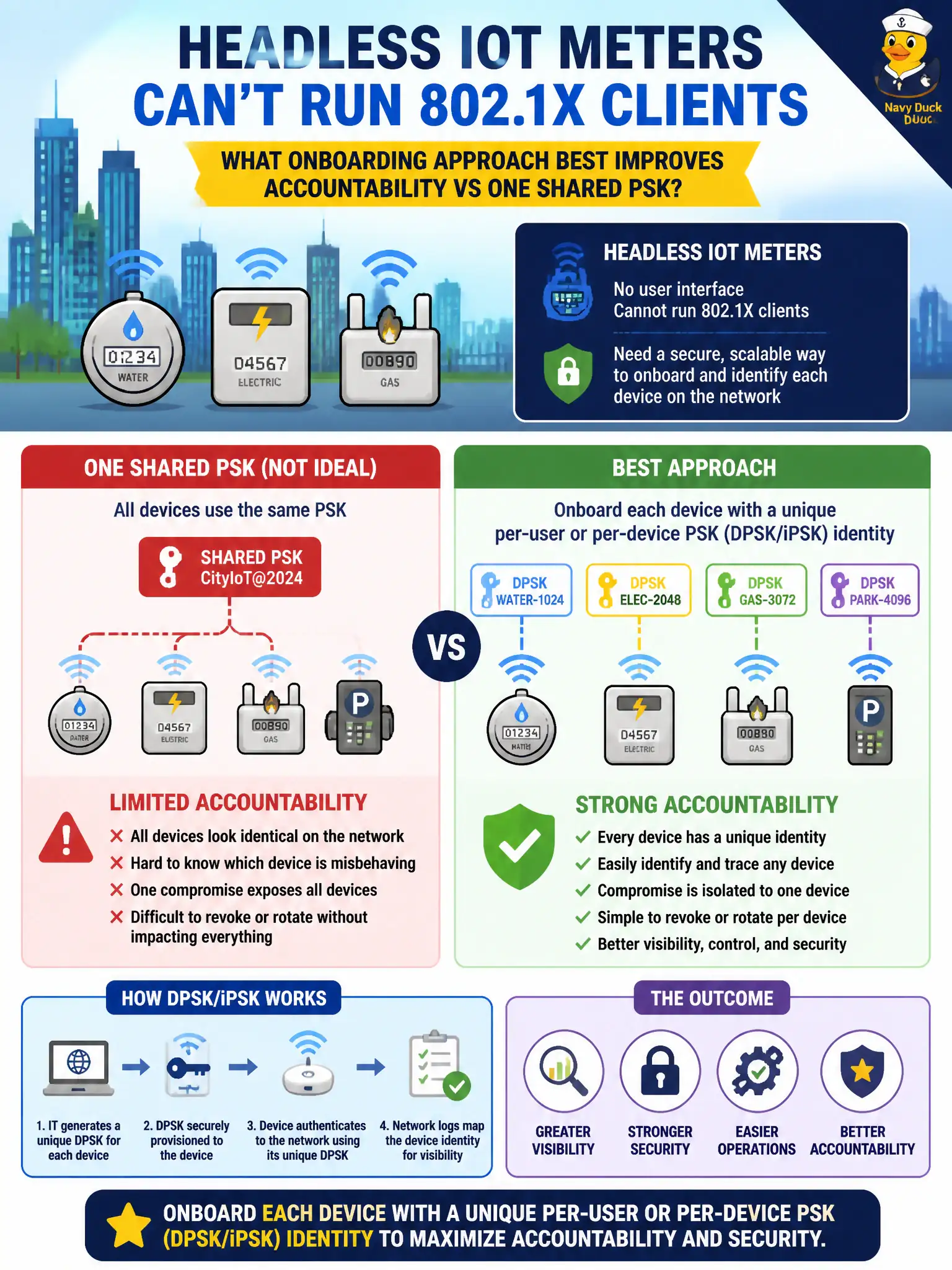
One shared PSK is a single master key under every doormat. Unique DPSK/iPSK identities give each meter its own key so you can revoke one without rekeying the whole city. Open SSIDs and finance VLAN free rides are non-starters.
Full Explanation
In municipal WLAN deployments, headless IoT meters installed in city facilities often lack the capability to run 802.1X supplicants, which complicates secure onboarding. Utilizing a unique per-device or per-user pre-shared key (DPSK or iPSK) for each meter is the most effective method to enhance accountability compared to relying on a single shared PSK. This approach assigns individualized credentials to each device, enabling precise identification and tracking on the network. If a device’s key is compromised, that specific credential can be revoked without impacting other devices, thereby limiting the scope of security breaches. Moreover, unique keys facilitate detailed logging and auditing, which are essential for municipal security policies and regulatory compliance. Conversely, printing one global PSK on every meter enclosure is inherently risky because the exposure of any single device’s key compromises the entire network segment. This lack of granularity prevents isolating compromised devices and undermines the principle of least privilege. Leaving meters on an open SSID entirely removes access control, allowing any nearby actor to connect and potentially launch attacks or intercept sensitive data. Such an approach violates basic security hygiene and is unsuitable for critical city infrastructure. Bridging meters onto sensitive VLANs like finance without authentication bypasses network segmentation and access control, increasing the risk of unauthorized data access and lateral movement within the network. While DPSK/iPSK solutions require a management framework to securely distribute, rotate, and revoke keys, their benefits in accountability and security far outweigh this overhead. Operationally, administrators should verify that each IoT meter authenticates using its unique key and that network monitoring tools can associate connections with individual credentials. This setup enables swift incident response and effective enforcement of access policies, ensuring the integrity of municipal WLAN deployments.