
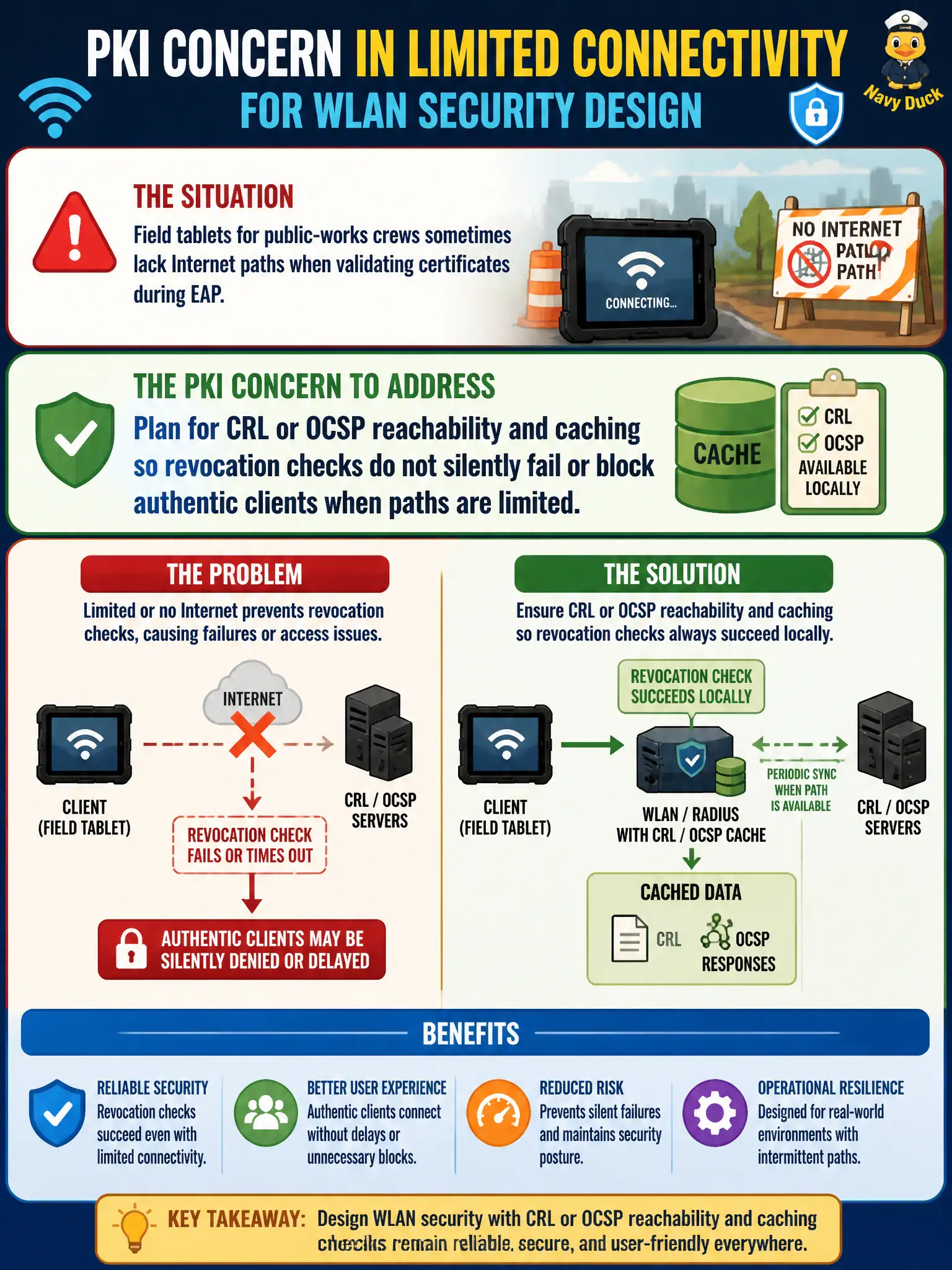
Field tablets for public-works crews sometimes lack Internet paths when validating certificates during EAP. What PKI concern should the WLAN security design address?
Select an answer to reveal the explanation.
Short Explanation
Revocation checks are like calling the DMV to see if a license is still good—if the phone has no signal, the check stalls. Designs need reachable CRL/OCSP or sensible caching so outdoor crews are not stranded and revoked certs are not ignored forever. Hiding the SSID or falling back to WEP is not a PKI answer.
Full Explanation
For public-works field tablets that sometimes lack Internet connectivity during EAP certificate validation, WLAN security design must address PKI concerns by planning for Certificate Revocation List (CRL) or Online Certificate Status Protocol (OCSP) reachability and caching. This ensures that revocation checks do not silently fail or block legitimate clients when network paths to certificate authorities are limited or intermittent. Caching revocation data locally on devices or within the network allows validation to proceed without constant Internet access, maintaining security without sacrificing usability. Replacing every client certificate weekly to avoid revocation lists is operationally impractical and does not eliminate the need for revocation checks, which remain critical for security. Using WEP because certificates do not apply outdoors is insecure and outdated; WEP is vulnerable and should never be used. Disabling TLS and relying on SSID hiding is ineffective because SSID hiding offers minimal security and TLS is essential for protecting authentication exchanges. The scope of this design consideration is particularly relevant for mobile or remote municipal workers with intermittent connectivity. To verify, simulate certificate validation with limited Internet access and confirm that cached CRLs or OCSP responses allow successful authentication without compromising revocation enforcement.