
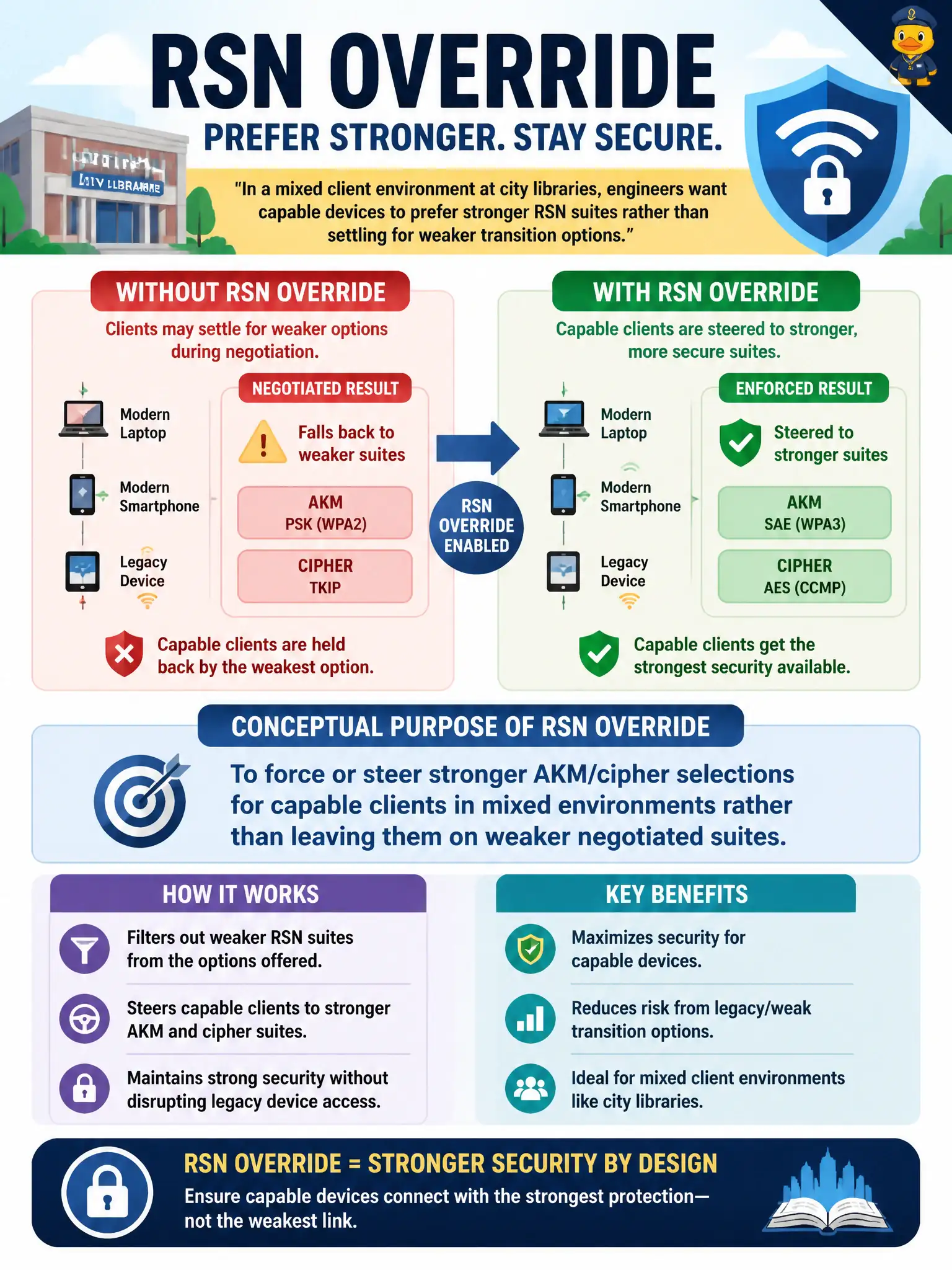
In a mixed client environment at city libraries, engineers want capable devices to prefer stronger RSN suites rather than settling for weaker transition options. What is the conceptual purpose of RSN Override in that design?
Select an answer to reveal the explanation.
Short Explanation
RSN Override is the librarian’s firm sticker on the new books: capable clients should grab the stronger security suite, not the dusty paperback still on the transition shelf. It’s about steering strength in a mixed room.
Full Explanation
In mixed client environments at city libraries, RSN Override’s conceptual purpose is to force or steer stronger AKM and cipher selections for capable clients rather than leaving them on weaker negotiated suites that remain present for legacy devices. It is a migration-hardening idea: keep the room mixed if you must, but do not let modern patrons unnecessarily pick the dusty transition option when a stronger suite is available and intended by policy. Library architects use that steering so capable devices inherit the security baseline leadership thinks they already bought. RSN Override is not a tool to convert every SSID into pure open mode while preserving historical WEP beacons for scanners. It does not replace RADIUS with local PSK files stored on each AP’s USB console port. It is not merely a beacon-interval trick that only FT over-the-DS clients can discover the BSS. Exam caveat: steering behavior is vendor-specific—validate with real library client samples, because a knob name on a datasheet does not guarantee every operating system will honor the preferred suite. Operational check: enable the override or steering approach on a library pilot SSID, associate both a modern and a legacy test client, and record which AKM and cipher each negotiated compared with the baseline transition advertisement before approving wider rollout.