
In the city’s RSN design guide, what does Authentication and Key Management (AKM) define for an 802.11 Robust Security Network?
Select an answer to reveal the explanation.
Short Explanation
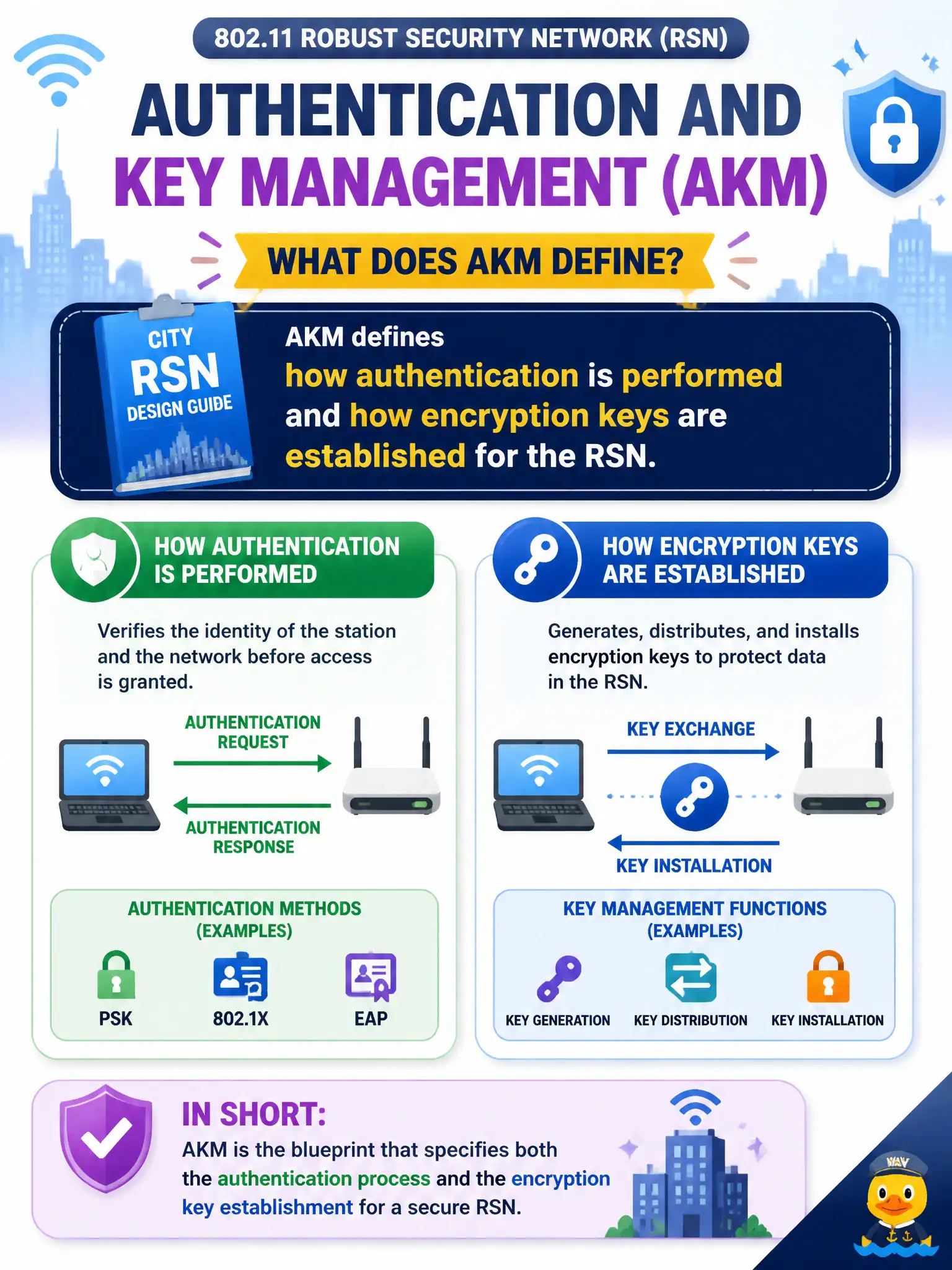
AKM is the rulebook for “who are you” and “how do we create the keys” on a secure Wi-Fi network—the heart of an RSN. It is not the SSID art, the Cat cable grade, or the DHCP timer. Get AKM right and the rest of the crypto story has a foundation.
Full Explanation
In the city’s RSN design guide, Authentication and Key Management (AKM) defines how authentication is performed and how encryption keys are established for an 802.11 Robust Security Network. AKM suite selectors in the RSN information element tell clients whether a BSS expects SAE, 802.1X, OWE, or other permitted methods and how that process feeds pairwise and group keying. Getting AKM right is the foundation that makes cipher selection and later troubleshooting meaningful for municipal SSIDs. Decorative SSID emoji on client pickers is presentation only and has no AKM meaning. Ethernet cable category between AP and switch is a cabling-plant concern, not authentication or key establishment. DHCP lease time offered to guest devices is an IP addressing policy and does not define RSN authentication behavior. Exam caveat: multiple AKM suites may be advertised during migration—policy should state which suites are permanently allowed versus temporarily tolerated so operations cannot keep weak options forever by habit. Operational check: review the beacon RSN AKM suite list against the city’s written allowlist for that SSID class and remove any suite that is not approved before production rollout and periodic compliance scans.