
Before city-wide rollout, a pilot must prove OWE and SAE handshakes complete as designed on sample APs. Which monitoring activity validates that security design?
Select an answer to reveal the explanation.
Short Explanation
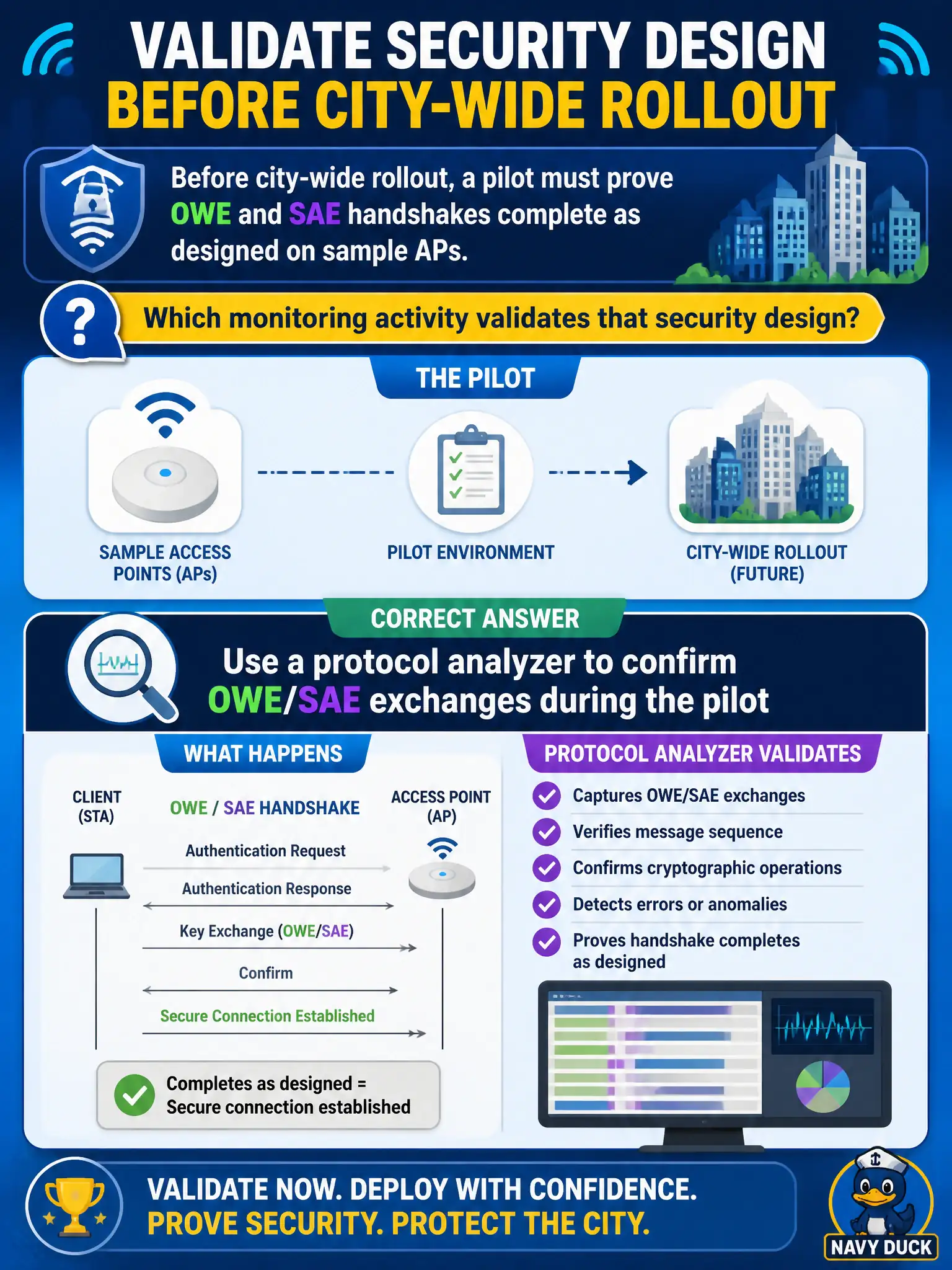
If the design hinges on OWE and SAE, watch those exchanges with a protocol analyzer during the pilot—not just a ping or a pretty logo. Proof lives in the handshake frames. Power draw does not equal crypto success.
Full Explanation
Before city-wide rollout, a pilot that must prove OWE and SAE handshakes complete as designed should use a protocol analyzer to confirm those exchanges on sample APs. Ping success after association, or a captive-portal logo that renders, can hide failed negotiations, unexpected fallbacks, or mis-advertised AKM suites. Packet-level validation ties the security design to observable OWE/SAE and EAPOL behavior rather than to coincident connectivity symptoms that can succeed even when crypto did not meet policy. Validating success solely by gateway reachability ignores whether the intended handshake occurred. Portal logo checks test HTTP reachability and branding, not AKM correctness. Measuring only PoE wattage on the switch port shows the AP is powered, not that cryptography succeeded for municipal visitor or staff profiles. Exam caveat: capture both success cases and intentional failure cases—wrong passphrase, non-OWE client on an OWE-only SSID—so operators recognize healthy versus broken traces during later incidents. Operational check: save annotated pilot captures for successful OWE and SAE associations as acceptance artifacts, require the same analyzer check after major controller or AP code upgrades, and store the traces with the change ticket for audit follow-up.