
While documenting the city council chamber SSID, the architect must explain encryption key roles at a design level. Which statement is accurate?
Select an answer to reveal the explanation.
Short Explanation
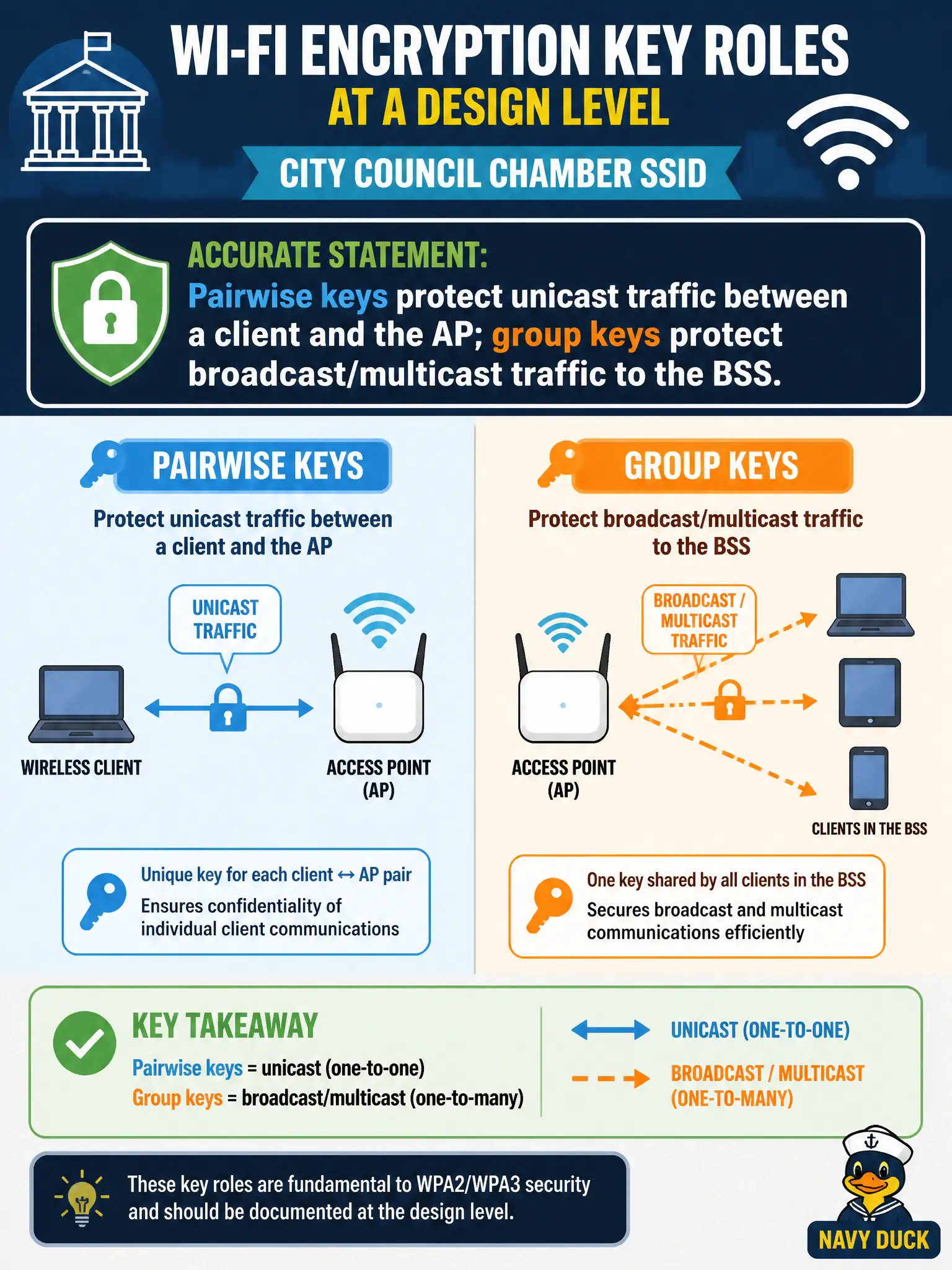
Unicast is a private hallway conversation—that is pairwise keys. Broadcast is the PA system in the chamber—that is the group key. WPA3 does not send you back to one static WEP key for both jobs.
Full Explanation
At design level on a city council chamber SSID, pairwise keys protect unicast traffic between a specific client and the AP, while group keys protect broadcast and multicast traffic delivered to the BSS. That separation lets each station maintain confidential unicast sessions while still receiving group-addressed frames under a shared group key that can be refreshed as membership changes. Documenting both roles prevents operators from treating “the Wi-Fi key” as one static secret reused for every frame type in the chamber. A single static WEP key preferred for both pairwise and group use is obsolete and incompatible with WPA3 design goals for civic meeting spaces. Group keys do not exist to encrypt RADIUS Accounting packets on the wired AAA path; accounting is a different protocol concern. Pairwise keys are not captive-portal cookie mechanisms—portals sit above the 802.11 key hierarchy and do not redefine pairwise confidentiality. Exam caveat: after roaming or rekey events, both PTK and GTK lifecycles matter; fixating only on unicast keys leaves broadcast and multicast failures unexplained during chamber troubleshooting. Operational check: during a chamber pilot, force a GTK rekey from the controller and confirm broadcast or multicast services continue for remaining clients while unicast sessions remain intact under their pairwise keys, then record the expected rekey behavior in the runbook.