
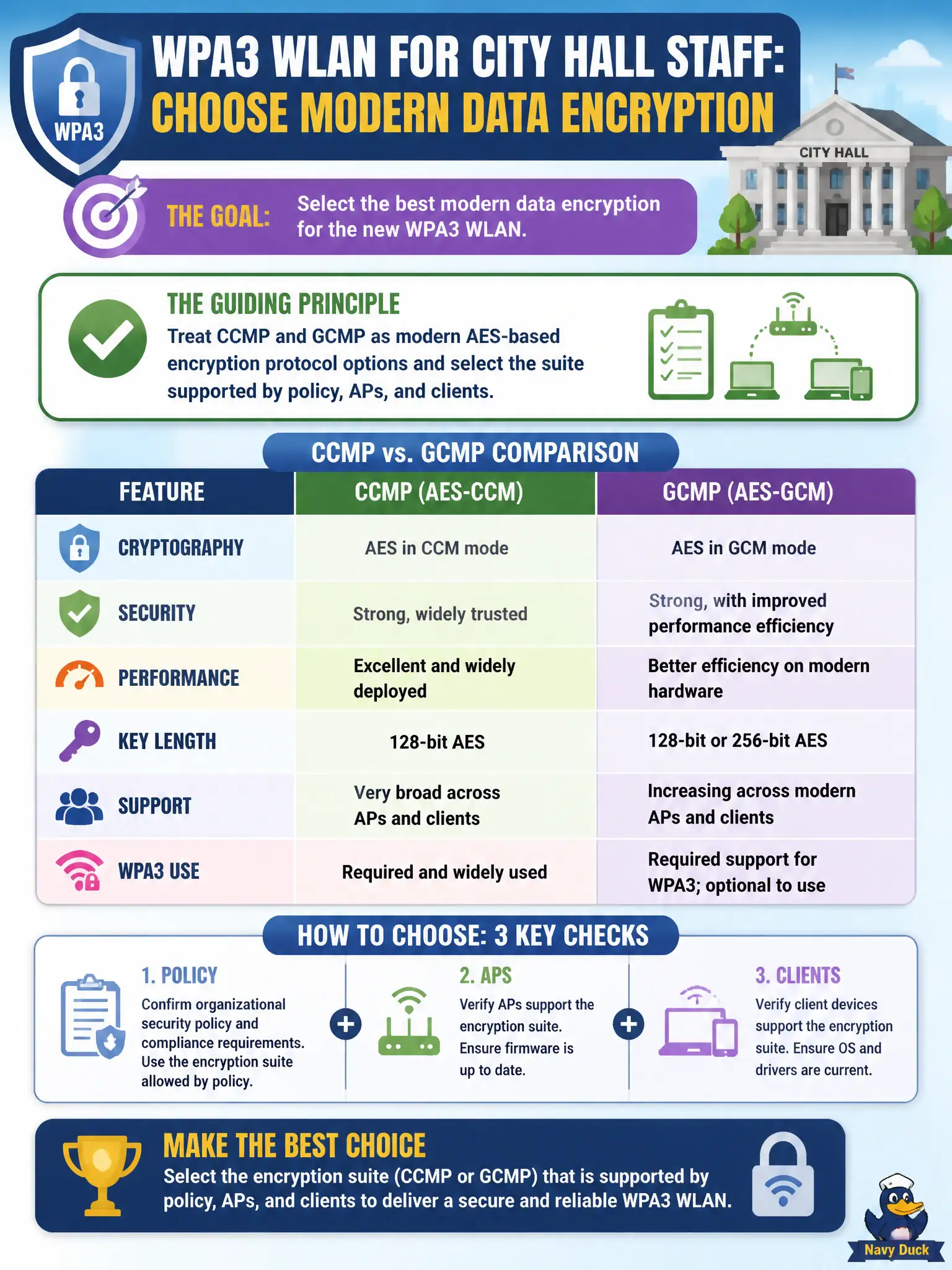
A new WPA3 WLAN for city hall staff must choose modern data encryption. How should the designer compare CCMP and GCMP at selection time?
Select an answer to reveal the explanation.
Short Explanation
CCMP and GCMP are the grown-up AES toolkits for Wi-Fi data—city hall should pick based on what policy and the client fleet actually support. TKIP and WEP are the retired drawer. Portal TLS alone does not replace link-layer cipher selection.
Full Explanation
For a new city-hall WPA3 staff WLAN, CCMP and GCMP are the modern AES-based encryption protocol options to compare at selection time. Designers weigh suite support on APs and controllers, client capability across the staff fleet, throughput needs, and written crypto policy—then select the profile the civic environment can actually negotiate consistently. Both belong in the contemporary toolkit; neither should be confused with retired ciphers or with application-layer TLS alone. Preferring TKIP whenever GCMP appears on a datasheet reintroduces a deprecated interim method that WPA3-era designs should leave behind. Using WEP for broadcast while limiting CCMP to unicast management frames misapplies cipher roles and revives broken cryptography on a government staff network. Avoiding both CCMP and GCMP while trusting only captive-portal TLS leaves 802.11 data confidentiality unaddressed for general staff traffic after the portal hop. Exam caveat: choosing GCMP only because the name sounds newer is insufficient without confirming client and suite support in that hall’s device inventory and controller code train. Operational check: publish an allowed-cipher matrix for city hall, configure representative SSID profiles in a lab, and record which staff device classes successfully negotiate CCMP versus GCMP before locking the production template and disabling deprecated options.