
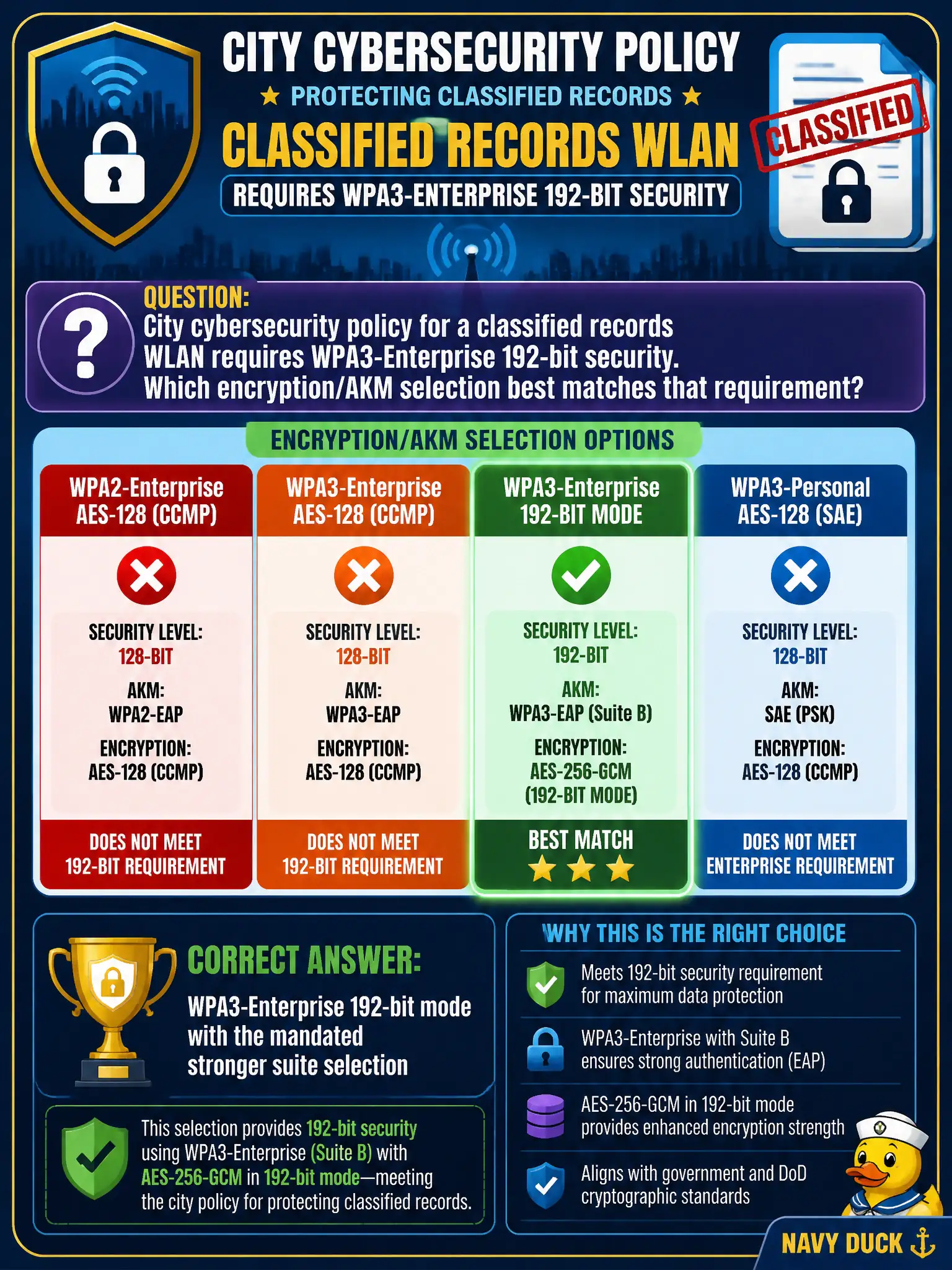
City cybersecurity policy for a classified records WLAN requires WPA3-Enterprise 192-bit security. Which encryption/AKM selection best matches that requirement?
Select an answer to reveal the explanation.
Short Explanation
When city policy stamps “192-bit” on the records SSID, it is asking for the WPA3-Enterprise 192-bit suite—not a longer PSK, a portal, or vintage WEP. Stronger AKM and cipher suites ride together in that mode. Match the profile to the policy, not to marketing numbers that sound close.
Full Explanation
When city cybersecurity policy mandates WPA3-Enterprise 192-bit security for a classified-records WLAN, the matching design choice is enabling WPA3-Enterprise 192-bit mode with its mandated stronger AKM and cipher-suite combination. That mode is a deliberate high-assurance profile, not a marketing synonym for “longer password,” “hidden SSID,” or “any AES somewhere in the stack.” Architecture documents should name the 192-bit Enterprise mode explicitly so operations cannot silently substitute weaker Personal or open patterns on records SSIDs. WPA2-Personal with a long PSK and a hidden SSID fails both the Enterprise identity model and the 192-bit suite requirement; cloaking does not upgrade cryptography or accountability. Open authentication with a splash page and HTTPS only to the portal leaves RF frames unprotected relative to a classified-records mandate. WEP-128 is deprecated and numerically unrelated to WPA3 192-bit suite strength despite the similar-looking key-length branding that sometimes confuses non-specialists. Exam caveat: 192-bit mode also constrains client and RADIUS/EAP capabilities—policy compliance includes fleet and AAA readiness, not only flipping a controller checkbox on the records SSID. Operational check: on a staging SSID, enable 192-bit mode, verify the beacon advertises only the allowed high-assurance suites, and attempt association with a known-capable client versus a legacy client to prove the policy gate behaves as written before cutting over production records traffic.