
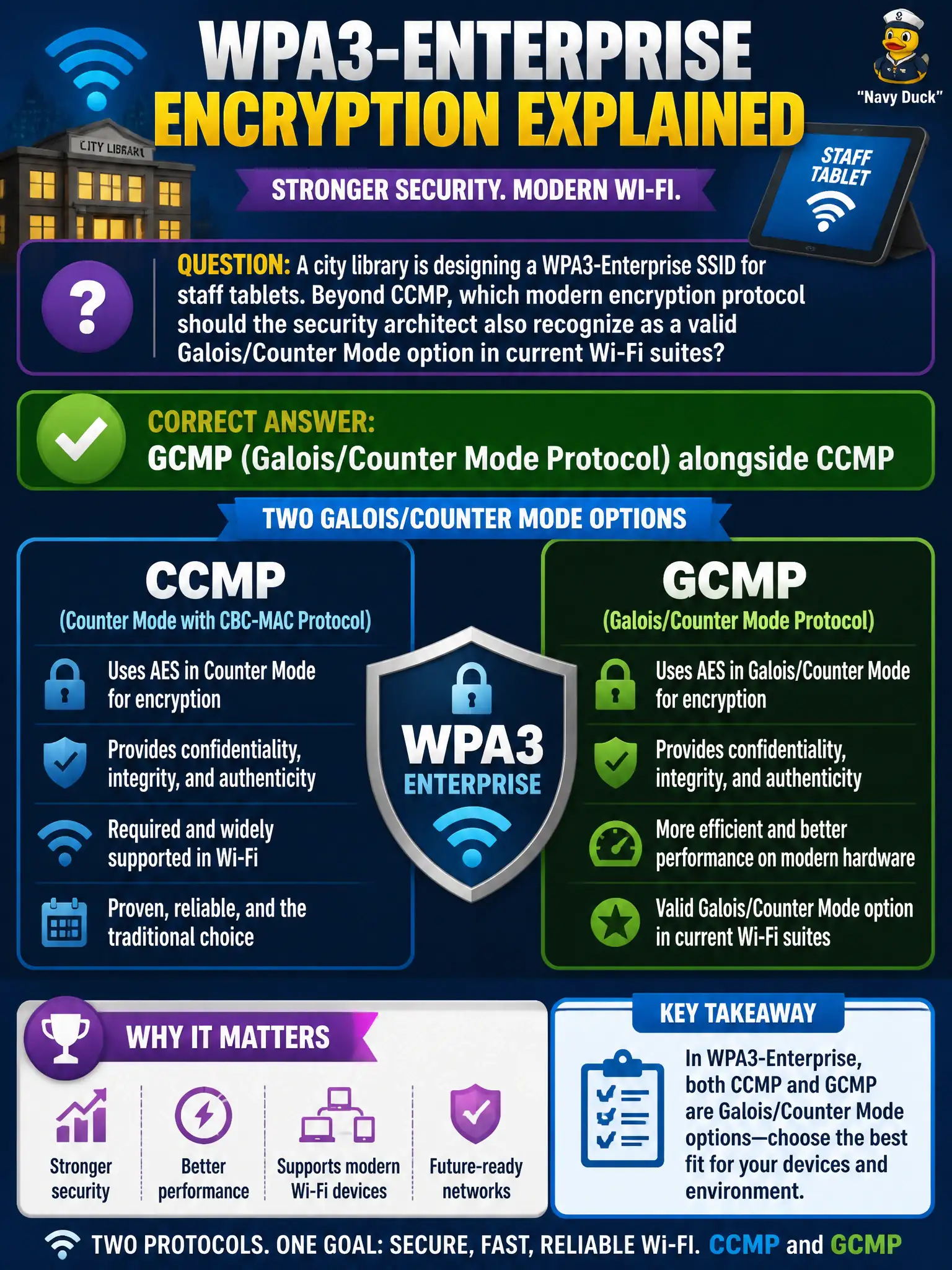
A city library is designing a WPA3-Enterprise SSID for staff tablets. Beyond CCMP, which modern encryption protocol should the security architect also recognize as a valid Galois/Counter Mode option in current Wi-Fi suites?
Select an answer to reveal the explanation.
Short Explanation
Picture the library’s Wi-Fi crypto menu like two solid padlock styles on the same shelf—CCMP you already know, and GCMP is the other modern Galois/Counter Mode lock. WPA3-era designs can use GCMP, not the old WEP/TKIP/RC4 leftovers. Pick GCMP when the suite supports that stronger counter-mode path.
Full Explanation
In Robust Security Network designs for a city library staff SSID, modern pairwise confidentiality is expressed through AES-based protocol constructions rather than through legacy stream ciphers. GCMP (Galois/Counter Mode Protocol) is the contemporary Galois/Counter Mode option that sits alongside CCMP in current WPA3 and high-throughput suites; architects must recognize both as valid data-protection protocols when the infrastructure and client fleet advertise them. Selecting GCMP where policy and hardware support it strengthens confidentiality and integrity for tablet traffic without inventing a new algorithm family outside the RSN model. WEP with a rotating shared key remains cryptographically broken and operationally brittle, so it cannot be treated as a modern Galois/Counter Mode peer to CCMP on any staff library profile. TKIP was an interim integrity wrapper for early WPA and is deprecated for new WPA3 designs; it is not the preferred pairwise cipher on a greenfield Enterprise SSID. Advertising RC4 in the RSN IE likewise points at retired practice and fails CWSP encryption-selection expectations for civic Enterprise WLANs that must protect patron-adjacent staff devices. Exam caveat: GCMP availability depends on AP, controller, and client suite support—especially on higher PHY rates—so recognizing GCMP as valid does not mean every tablet will negotiate it without an inventory and pilot. Operational check: on a pilot AP, capture beacons and probe responses to confirm the RSN cipher list includes GCMP and/or CCMP as intended, then associate a representative staff tablet and verify the negotiated pairwise cipher in client or controller diagnostics before citywide cutover.