
A facilities manager claims hiding the courthouse SSID provides confidentiality for wireless frames. Which statement corrects that misunderstanding?
Select an answer to reveal the explanation.
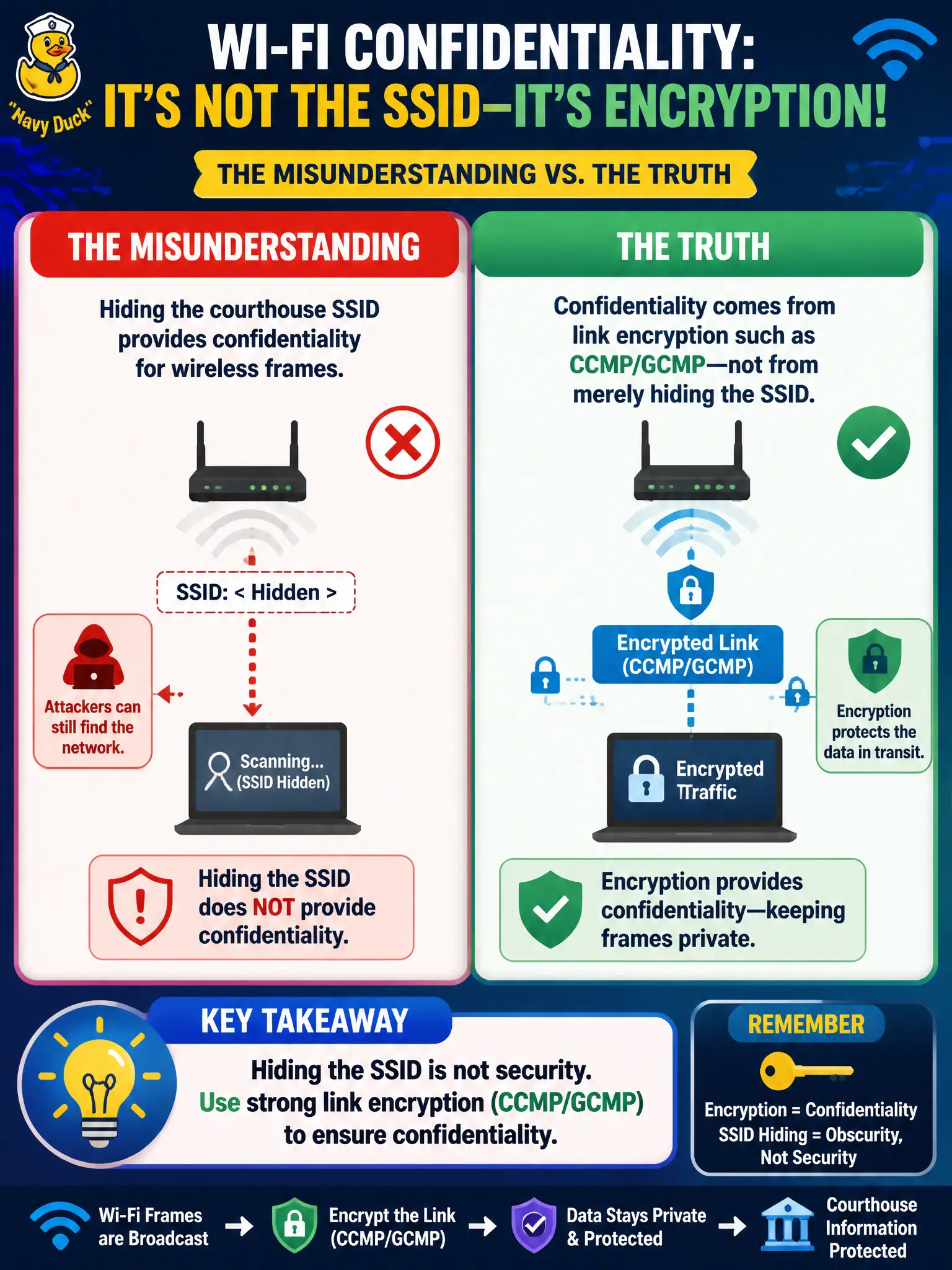
Short Explanation
Hiding the network name is security theater—probes and patience still find it. Real confidentiality is encryption on the link (CCMP/GCMP, etc.), not ‘SSID not in the beacon fancy.’
Full Explanation
Hiding the courthouse SSID does not provide confidentiality for wireless frames. Confidentiality comes from link encryption such as CCMP/GCMP—not from merely suppressing SSID broadcast in beacons. Hidden SSIDs do not encrypt payloads with GCMP automatically, do not replace WPA3 or 802.1X, and are not equivalent to end-to-end application VPN encryption. Cloaking at best slightly obscures casual discovery while probes and other frames still reveal the network to a determined observer. Exam caveat: SSID cloaking is a common false control; exam items expect candidates to separate visibility tricks from cryptographic confidentiality and authentication. Operational check: ensure courthouse staff SSIDs use modern AES-based ciphers and Enterprise AKM regardless of broadcast settings, demonstrate to the facilities manager that a hidden SSID still appears in authorized surveys, and remove cloaking-as-security language from municipal WLAN myths documentation. In municipal WLAN operations, record the rationale in the change ticket so future on-call staff know which control was chosen and which failure modes the rejected options would create for city services. Re-validate after the next maintenance window that the same control still holds under the infrastructure versions and client fleets used by the civic environment.