
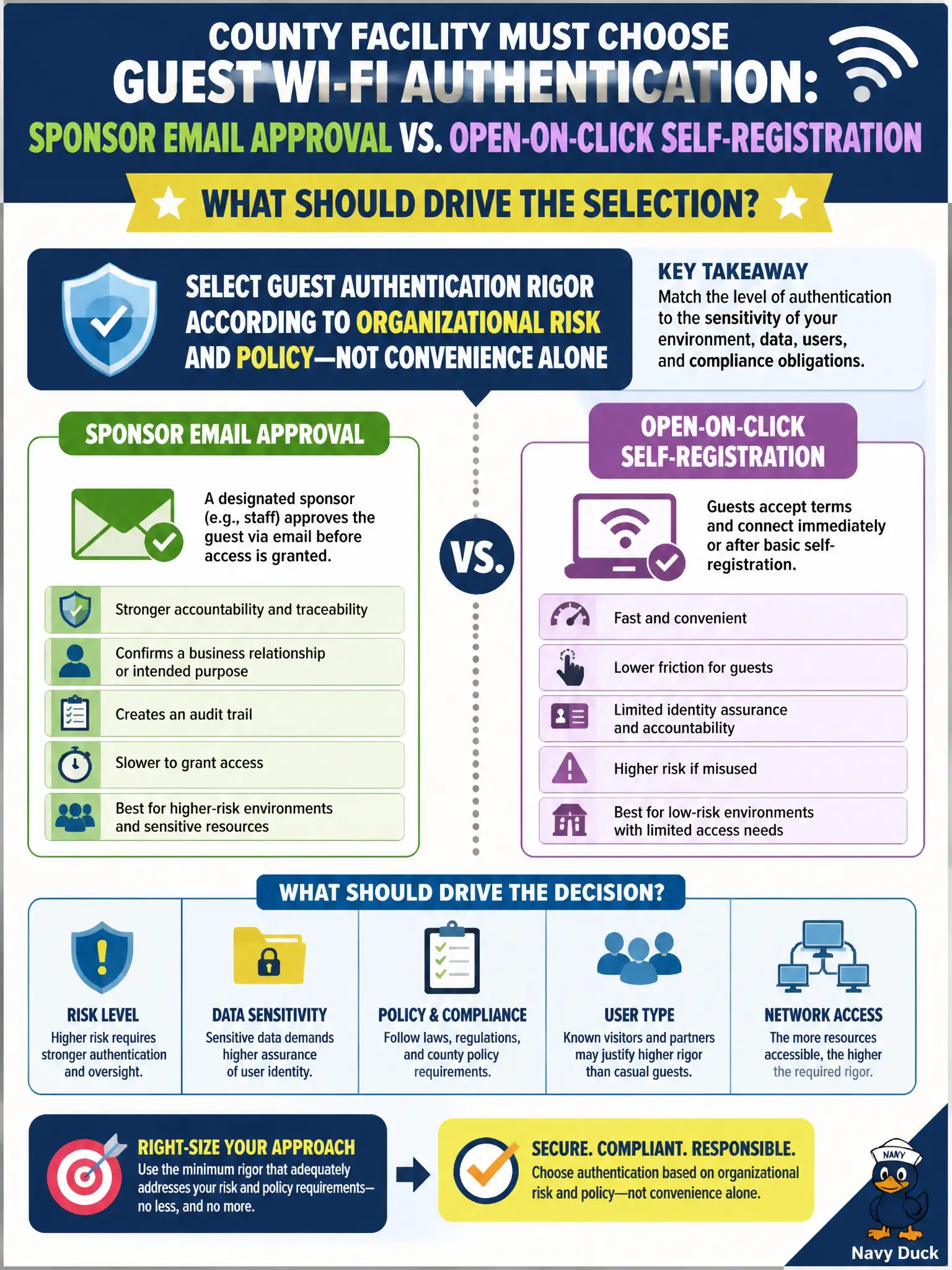
A county facility must choose guest Wi-Fi authentication: sponsor email approval versus open-on-click self-registration. What should drive the selection?
Select an answer to reveal the explanation.
Short Explanation
Guest rigor isn’t one-size-fits-all. High-risk lobbies may want a sponsor; low-risk plazas might allow click-through. Policy and risk pick the lock strength—not ‘guests never matter’ or ‘borrow staff passwords.’
Full Explanation
Choosing guest Wi-Fi authentication—sponsor email approval versus open-on-click self-registration—must follow organizational risk and policy, not convenience alone. Always picking open-on-click because guests never warrant identity controls ignores venues where attribution matters. Always requiring smart-card EAP-TLS for every 10-minute visitor is usually disproportionate. Using staff AD passwords on the guest portal creates phishing and credential-reuse risk. Exam caveat: guest rigor is risk-driven—exam answers that absolutize “always open” or “always smart-card” miss policy-based selection. Operational check: map facility types to guest auth tiers in policy (lobby vs. restricted floors), implement the matching workflow, and review abuse metrics quarterly. Keep the decision matrix in the municipal guest access standard for consistent building deployments. In municipal WLAN operations, record the rationale in the change ticket so future on-call staff know which control was chosen and which failure modes the rejected options would create for city services. Re-validate after the next maintenance window that the same control still holds under the infrastructure versions and client fleets used by the civic environment.