
Before a WLAN penetration test of county buildings, what must the team establish first?
Select an answer to reveal the explanation.
Short Explanation
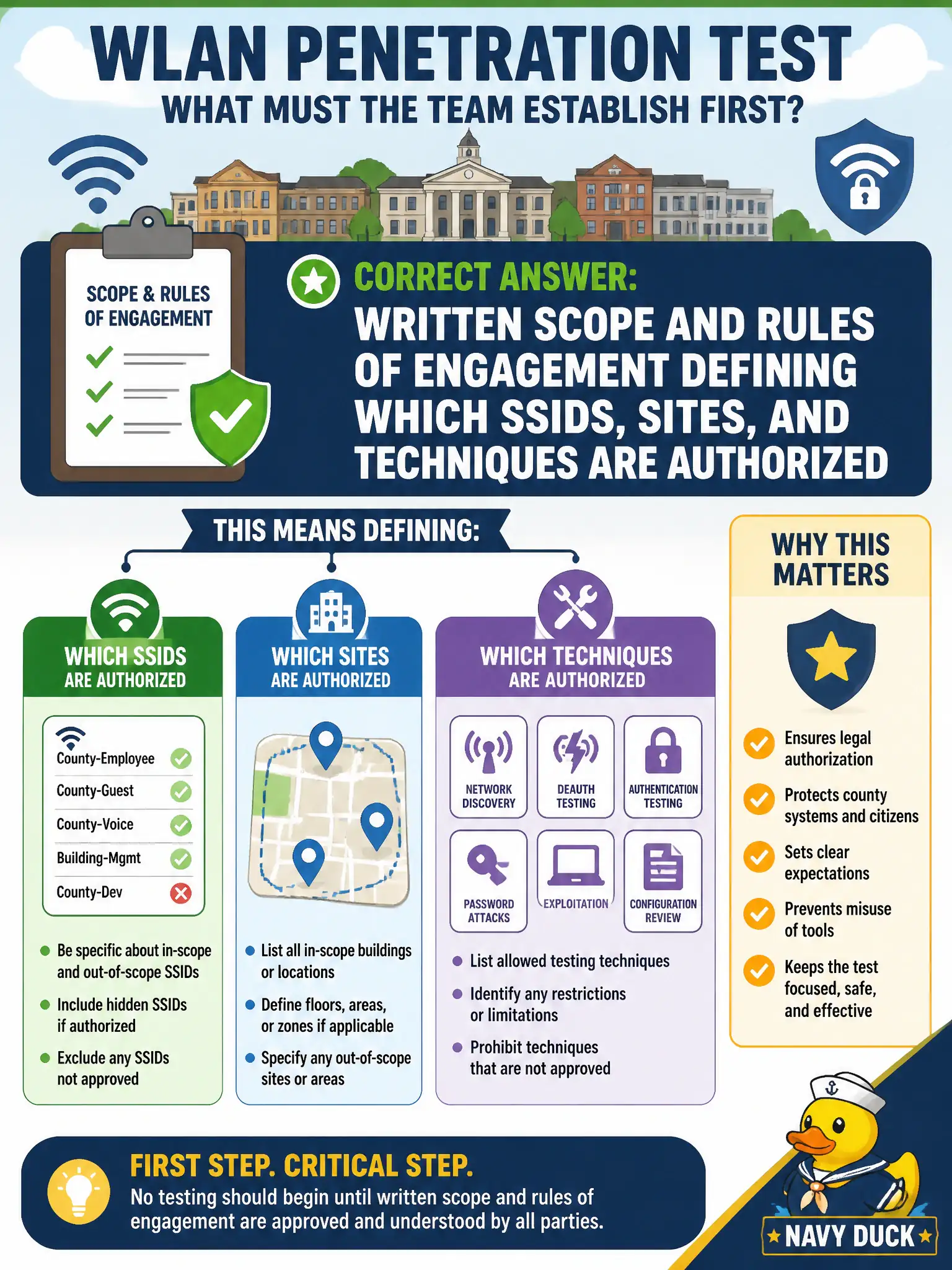
Pen testing without a written scope is just freestyle mayhem with a fancy title. Lock down which buildings, SSIDs, and tricks are in bounds before anyone fires up the wireless toolkit.
Full Explanation
Professional WLAN penetration testing of county buildings begins with written scope and rules of engagement that define which SSIDs, sites, techniques, and time windows are authorized. That paperwork keeps testing legal, targeted, and reviewable, and it protects both the municipality and the testers. Unlimited permission to crack every neighboring business PSK near county campuses exceeds civic authority and risks attacking third parties. Promising to skip documentation so findings stay informal defeats the purpose of a security test and leaves remediations unowned. Authority to disable production WIPS permanently for a calendar year is not a normal pretest prerequisite and creates lasting defensive gaps. Exam caveat: CWSP security-testing objectives emphasize process phases—scope, information gathering, scanning, attack, documentation—not unsupervised tool use; authorization is the gate before any active technique. Operational check: obtain signed rules of engagement naming in-scope BSSIDs and buildings, file them with the change/security ticket, brief responders so WIPS alerts during the window are expected, and refuse any verbal expansion into adjacent networks. Close the engagement only when findings are documented with evidence and remediation owners for county IT.