
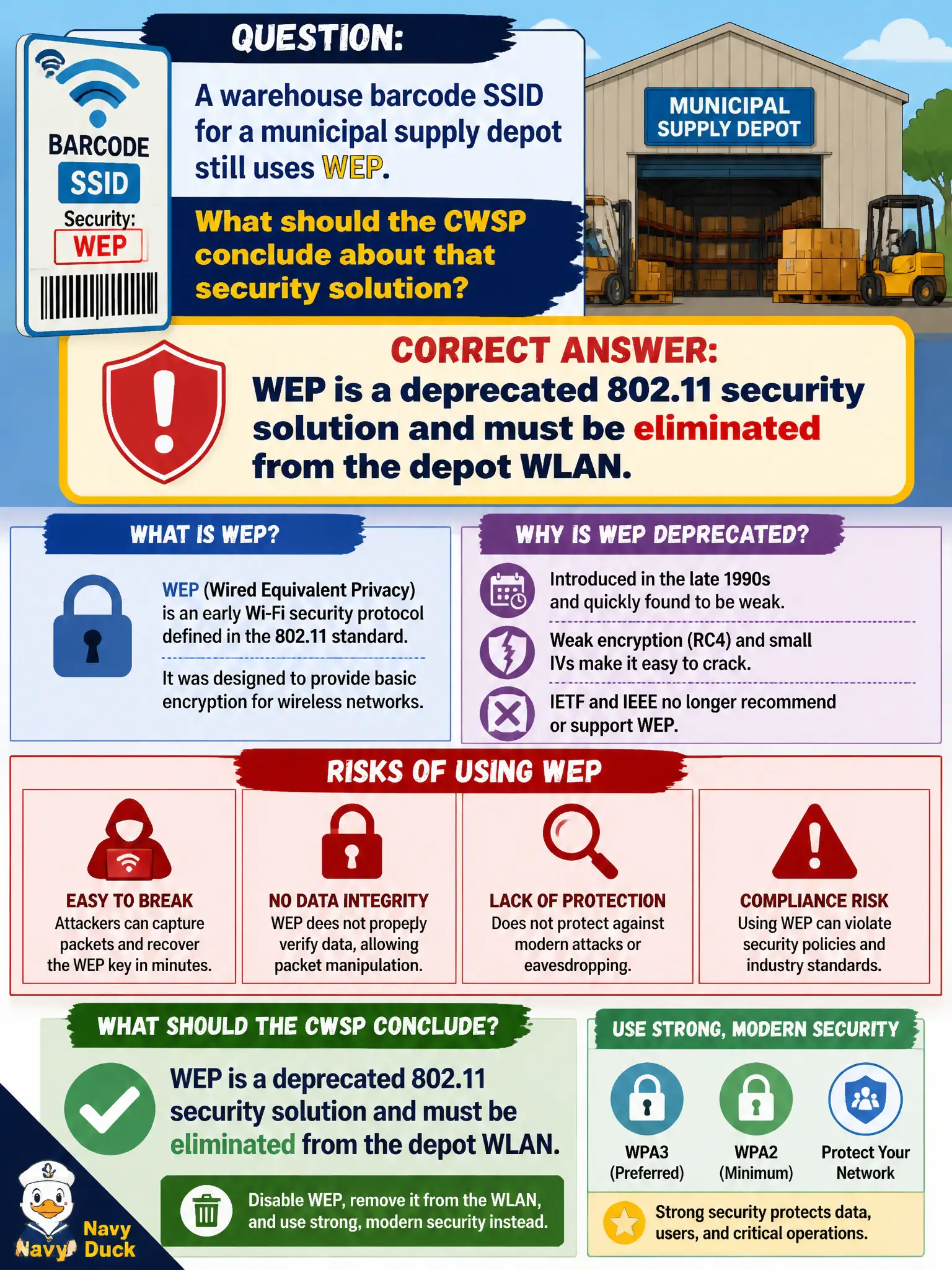
A warehouse barcode SSID for a municipal supply depot still uses WEP. What should the CWSP conclude about that security solution?
Select an answer to reveal the explanation.
Short Explanation
WEP is the rusted padlock from the dial-up era—everyone with a weekend toolkit can pop it. On a city warehouse SSID it is not 'legacy charm'; it is deprecated and has to go.
Full Explanation
WEP is an explicitly deprecated 802.11 / Wi-Fi Alliance security solution and provides inadequate confidentiality against modern key-recovery attacks. On a municipal supply-depot barcode SSID, the CWSP should conclude that WEP must be eliminated—migrate scanners to modern AES-based WPA2/WPA3 security or isolate and replace the workflow—not retained under cosmetic excuses. Hiding the SSID and rotating a WEP key annually do not repair WEP's cryptographic design failures. Preferring WEP over WPA3-Enterprise for battery life confuses power anecdotes with security requirements. Claiming WEP only matters for PCI retail auditors ignores that deprecated crypto is unacceptable for civic warehouse operations regardless of cardholder scope. Exam caveat: CWSP deprecated-solutions objectives treat WEP, original WPA, TKIP, and RC4 as legacy to remove; sector exceptions and SSID cloaking are not accepted mitigations on the exam or in professional practice. Operational check: inventory every depot SSID still advertising WEP, schedule scanner firmware or hardware upgrades, place any interim WEP devices on an isolated VLAN with compensating monitoring, and verify post-migration that CCMP/GCMP (or equivalent modern suites) appear in WLAN audit scans. Record residual-risk acceptance only if temporary isolation is executive-approved with an end date.