
After a transit-yard shared PSK appears in a public paste site, which remediation best restores WLAN credential hygiene?
Select an answer to reveal the explanation.
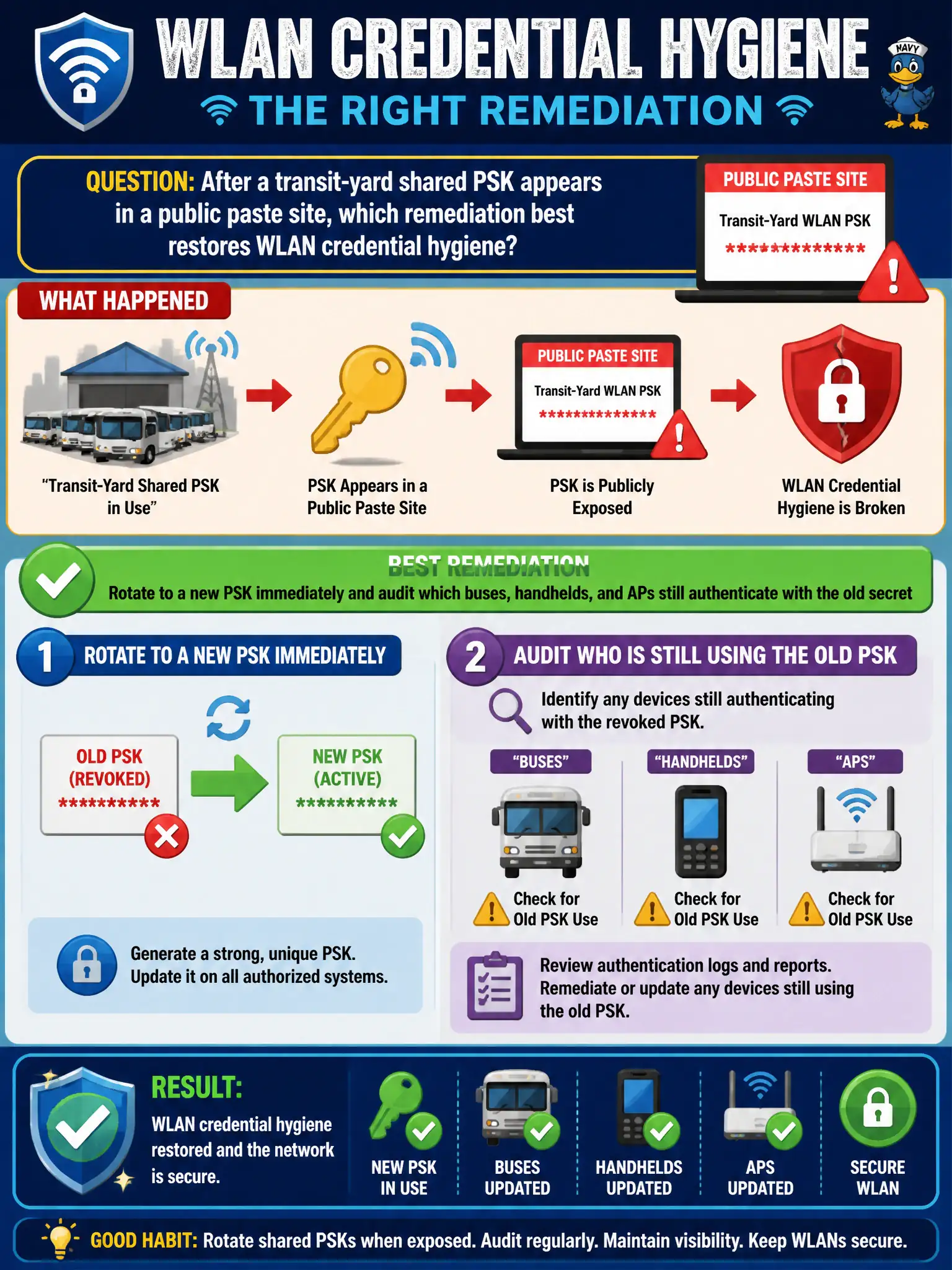
Short Explanation
A leaked PSK is a lost house key—you do not leave the locks the same and hope nobody notices. Change the secret now, then walk the fleet and gear list to see who is still using the old one.
Full Explanation
When a transit-yard shared PSK appears on a public paste site, the secret must be treated as fully compromised for every bus, handheld, and AP still configured with it. Immediate remediation is to rotate to a new PSK and systematically audit which endpoints and infrastructure profiles still authenticate with the old string, removing or updating each occurrence until the leaked credential has zero remaining useful life. Keeping the leaked PSK while hiding the SSID does not revoke attacker access; cloaking is not credential rotation. Republishing the same PSK on the intranet homepage extends exposure. Disabling encryption until a committee finishes next quarter leaves air traffic unprotected for an indefinite window and is not hygiene restoration. Exam caveat: PSK rotation without device inventory leaves stragglers on the old secret; Enterprise authentication avoids this class of shared-secret paste-site incidents for staff fleets when feasible. Operational check: generate a high-entropy replacement, push it through the MDM/AP templates for the yard SSID, force reauthentication, search configs and scripts for the old passphrase, and watch RADIUS or association logs for residual use of the compromised credential. Close the municipal incident ticket only after that audit returns clean.