
The wireless security lead for a county clinic WLAN must mitigate eavesdropping against sensitive traffic. Which mitigation best matches CWSP guidance?
Select an answer to reveal the explanation.
Short Explanation
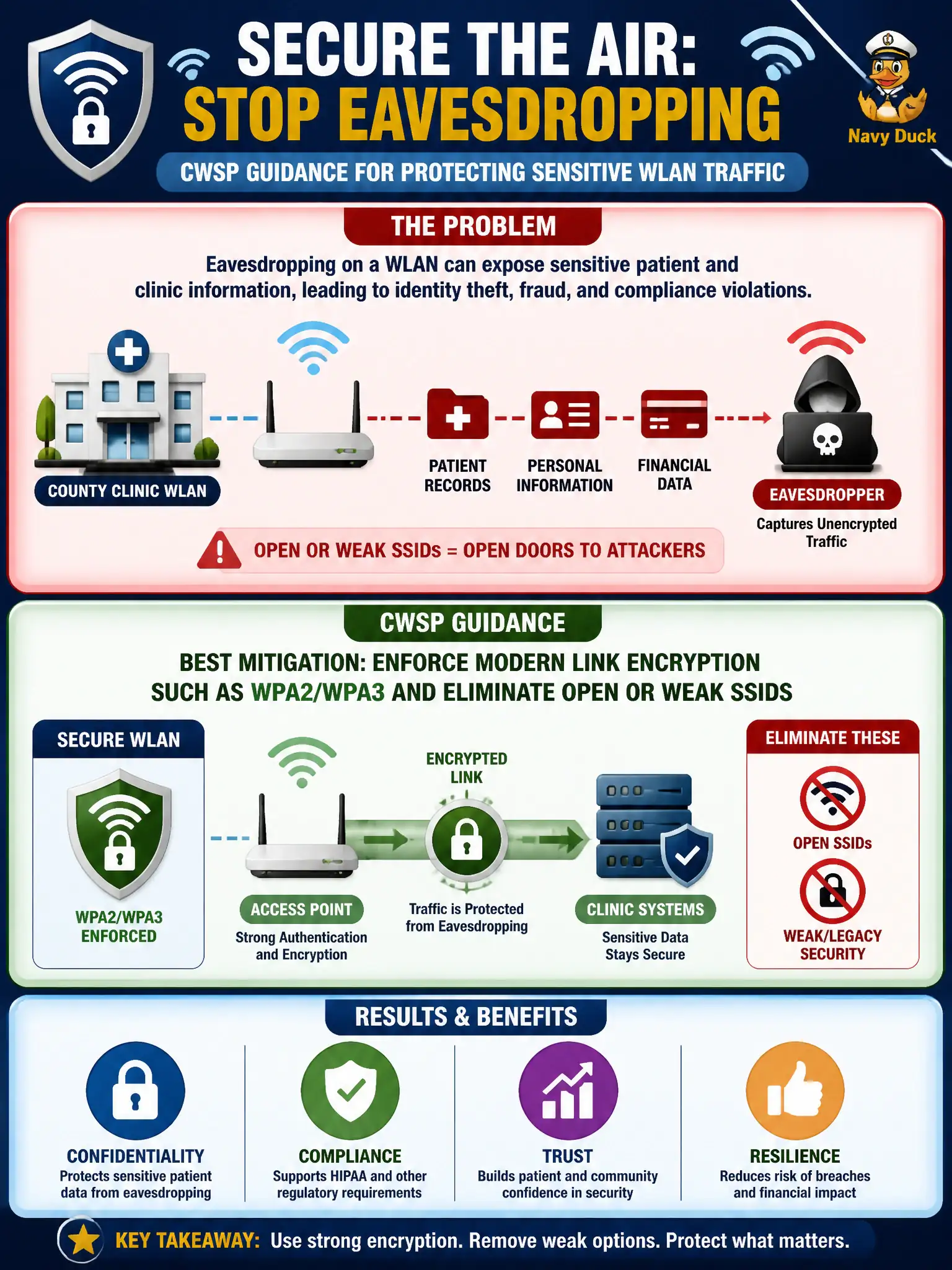
Stop talking in the clear—put real WPA2/WPA3 locks on clinic Wi-Fi and kill open/weak SSIDs for anything sensitive. MAC lists on an open door still leave the conversation audible. Encryption is the eavesdropping antidote.
Full Explanation
The wireless security lead for a county clinic WLAN mitigating eavesdropping against sensitive traffic should enforce modern link encryption such as WPA2/WPA3 and eliminate open or weak SSIDs for sensitive use. Strong link encryption is the primary wireless mitigation for passive eavesdropping on clinical and administrative traffic that may include ePHI. Keeping open SSIDs for clinical apps and relying only on MAC allow-lists leaves payloads observable and MACs spoofable. Mandating WEP for backward compatibility with decade-old scanners reintroduces broken cryptography. Disabling all monitoring so attackers cannot see WIPS alerts removes detection without protecting confidentiality. Clinic WLANs should place sensitive applications only on encrypted, authenticated SSIDs with segmentation from guest access. Exam caveat: application-layer TLS remains valuable but does not replace WLAN link encryption and proper SSID hygiene for clinic environments. Operational check: inventory clinic SSIDs, remove open/weak profiles from clinical use, enforce WPA2/WPA3 enterprise or appropriate strong Personal only where justified, validate no ePHI workflows remain on open Wi-Fi, and confirm monitoring still covers the clinical SSID.