
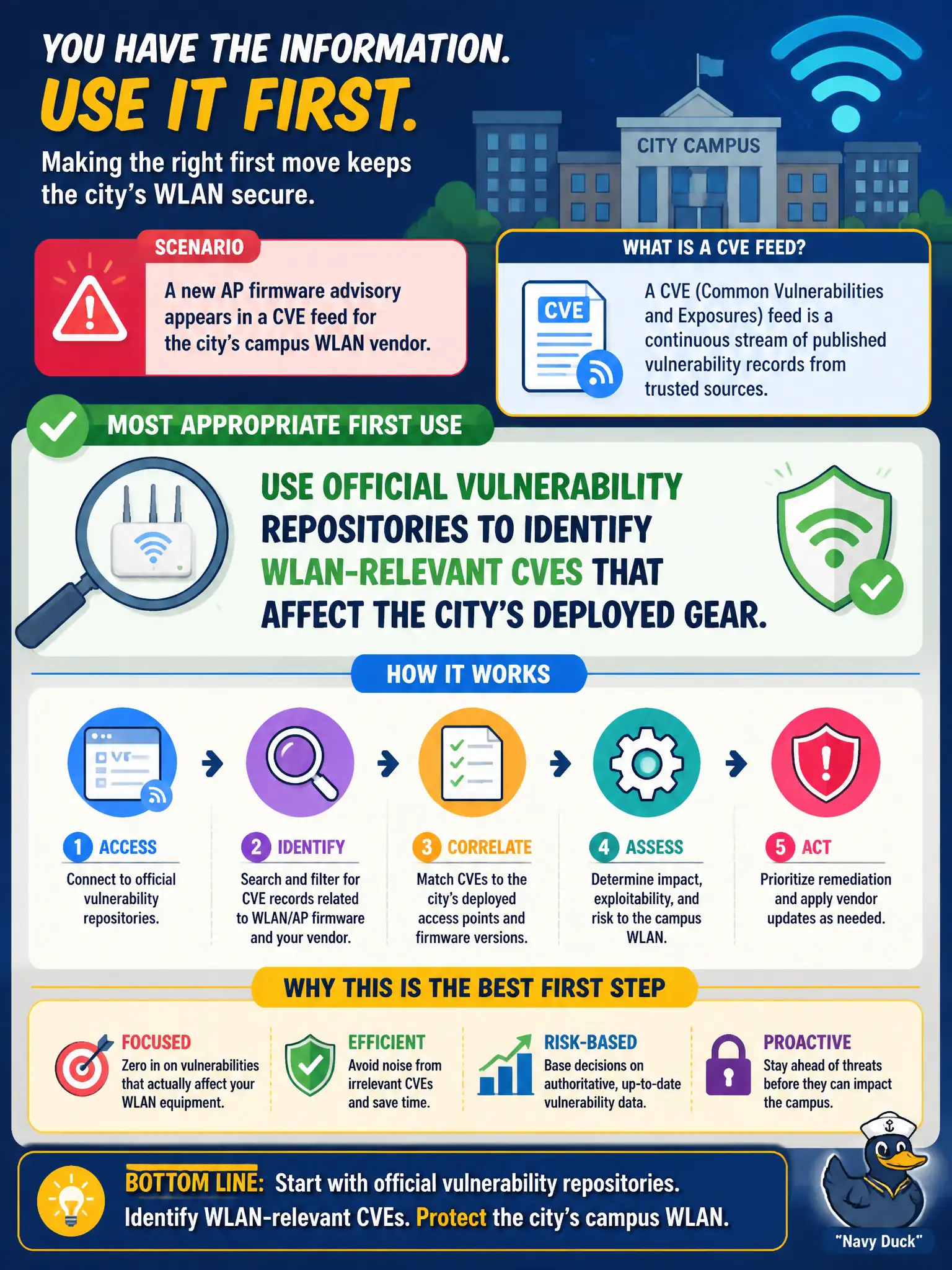
A new AP firmware advisory appears in a CVE feed for the city's campus WLAN vendor. What is the most appropriate first use of that information source?
Select an answer to reveal the explanation.
Short Explanation
CVE feeds are the official bulletin board, not background noise. Match the advisory to the APs you actually run for the city before you panic-change encryption or tear down SSIDs.
Full Explanation
When a new AP firmware advisory appears in a CVE feed for the city's campus WLAN vendor, the most appropriate first use of that information source is to identify WLAN-relevant CVEs that affect the city's deployed gear. Official vulnerability repositories help security teams discover issues early, map them to inventory, and prioritize response. Ignoring CVE repositories and waiting for a local newspaper to summarize the issue delays mitigation and depends on non-authoritative coverage. Treating every CVE as immediate proof that the SSID encryption algorithm must be replaced confuses an infrastructure vulnerability with a protocol redesign and may be unnecessary. Deleting the affected SSIDs overnight without checking whether the deployed firmware is listed causes avoidable outage and may miss the real vulnerable versions. The civic operational pattern is: ingest CVE → map to inventory → assess exposure → patch or compensate. Exam caveat: CVE feeds are inputs to vulnerability management, not automatic change tickets to redesign cryptography or shut down service without version correlation. Operational check: subscribe to vendor and NVD/CVE sources for the campus AP and controller families, match CVE affected versions to the inventory, open a tracked risk item for hits, and schedule patching or compensating controls with change approval.