
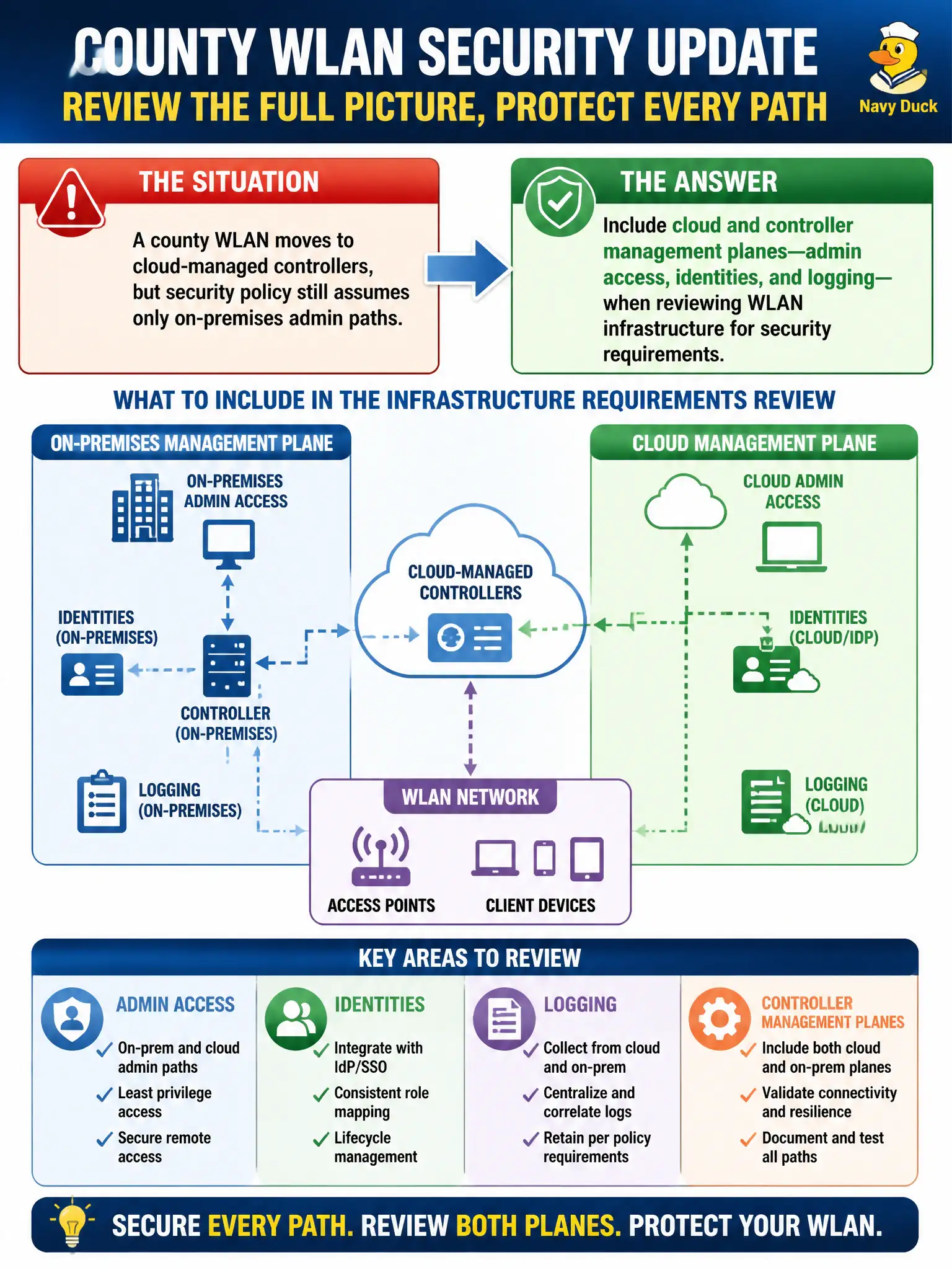
A county WLAN moves to cloud-managed controllers, but security policy still assumes only on-premises admin paths. What should the infrastructure requirements review update?
Select an answer to reveal the explanation.
Short Explanation
If the brains of the WLAN moved to the cloud, policy can't still pretend admins only log into a rack in the basement. Review the cloud management plane—who gets in, how, and what gets logged.
Full Explanation
When a county WLAN moves to cloud-managed controllers but security policy still assumes only on-premises admin paths, the infrastructure requirements review must be updated to include cloud and controller management planes—admin access, identities, and logging. The privilege to change SSIDs, push firmware, and alter AAA profiles often now lives in a cloud identity boundary; leaving that path out of policy creates a blind spot larger than any single AP. Ignoring management planes because "cloud is always out of scope" is incorrect for WLAN security requirements. Deleting all admin accounts and managing APs only via serial console forever is not viable for a multi-site county estate. Treating captive-portal HTML as the only management interface that matters confuses guest experience content with infrastructure administration. Policy and requirements should address SSO/MFA for admins, role design, break-glass accounts, and export of cloud audit logs into county monitoring. Exam caveat: cloud WLAN changes where admin identity and logs live; it does not remove the obligation to review the management plane. Operational check: inventory cloud admin roles and IdP groups, enforce MFA, forward management audit logs to the county SIEM or equivalent, restrict and monitor break-glass credentials, and revise policy language so cloud admin paths are explicitly in scope.