
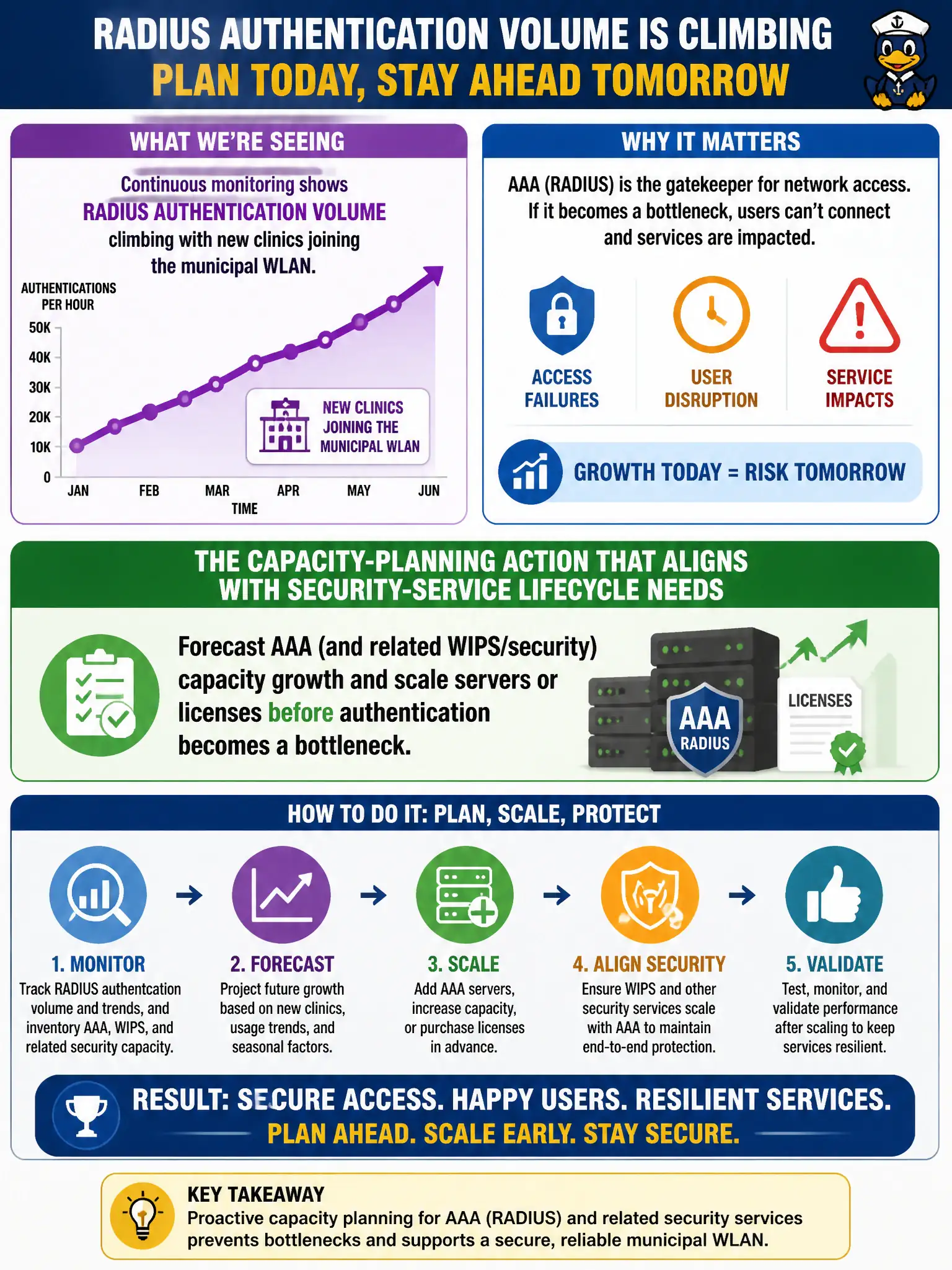
Continuous monitoring shows RADIUS authentication volume climbing with new clinics joining the municipal WLAN. What capacity-planning action aligns with security-service lifecycle needs?
Select an answer to reveal the explanation.
Short Explanation
More clinics means more EAP dances—watch AAA load and grow it before the door sticks shut. Deleting logs or fleeing to a citywide PSK is not capacity planning.
Full Explanation
Continuous monitoring showing RADIUS authentication volume climbing as new clinics join the municipal WLAN should drive forecasting of AAA—and related WIPS/security—capacity growth, then scale servers or licenses before authentication becomes a bottleneck. Security services are part of the WLAN lifecycle; they saturate under success as much as under attack. Civic healthcare expansions that ignore AAA capacity create join failures that look like RF problems.
Freezing new clinic onboarding forever so RADIUS CPU stays under five percent rejects the business need instead of engineering for it. Deleting historical auth logs whenever CPU exceeds fifty percent destroys detection and compliance evidence. Replacing RADIUS with a single shared WPA2-Personal PSK to eliminate AAA load is a major security regression.
Exam caveat: capacity plans should include peak EAPTLS/OCSP/CRL chattiness and geographic redundancy, not only average CPU. Operational check: trend AAA authentications vs CPU/latency, set scale thresholds, load-test the projected clinic growth, and schedule scale-out before the next clinic cutover. In municipal WLAN programs, capture the decision in the wireless standard and re-check it at change review so the next project inherits the same control bar instead of rediscovering the failure during an outage.