
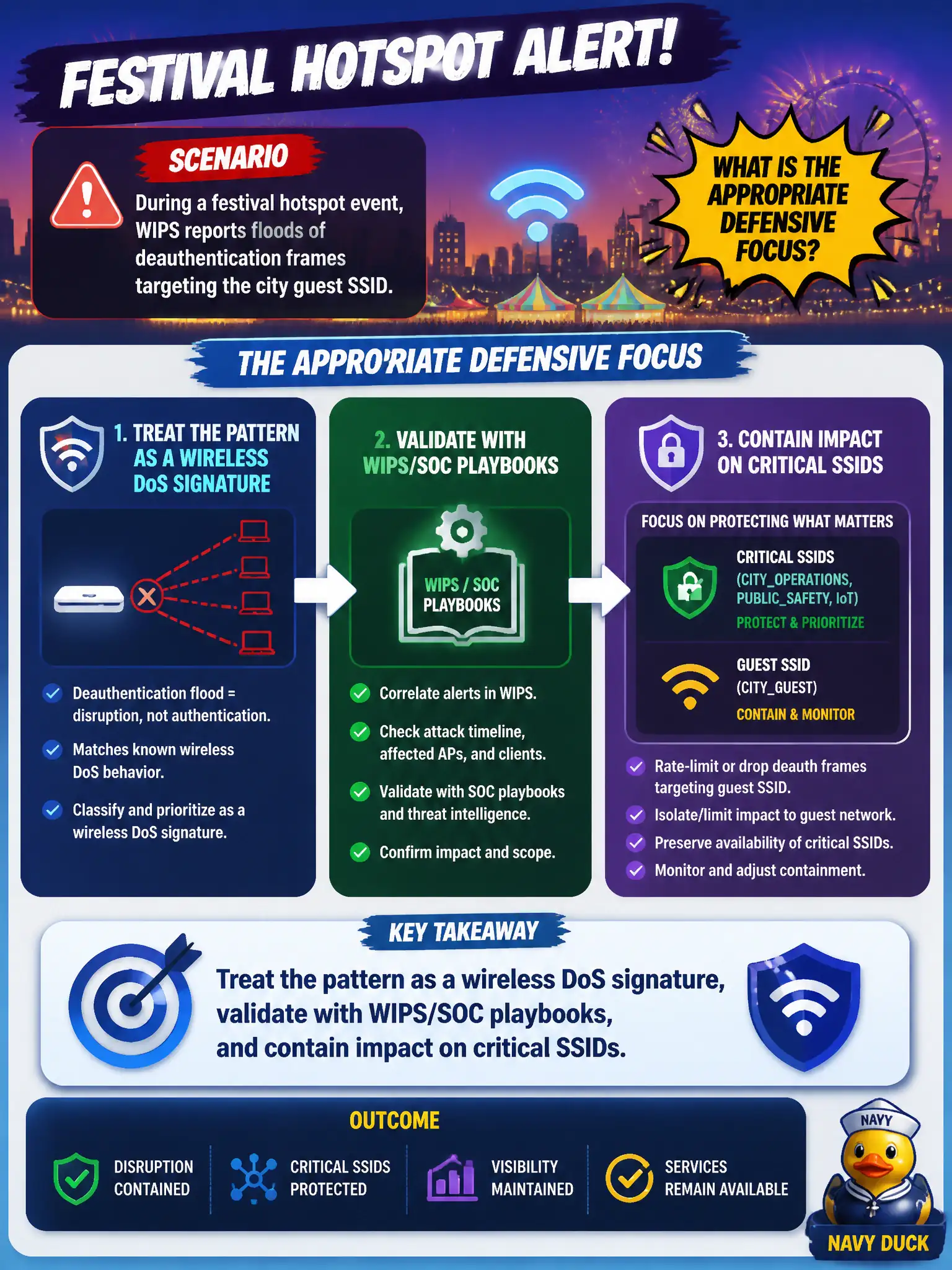
During a festival hotspot event, WIPS reports floods of deauthentication frames targeting the city guest SSID. What is the appropriate defensive focus?
Select an answer to reveal the explanation.
Short Explanation
Deauth floods are a classic wireless DoS tantrum. Let WIPS call it, validate it, and protect the SSIDs that matter. Turning WIPS off or cranking WEP is not a response plan.
Full Explanation
During a festival hotspot event, WIPS reports of deauthentication frame floods against the city guest SSID should be treated as a wireless DoS signature: validate with WIPS/SOC playbooks and contain impact on critical SSIDs. Festivals create both RF congestion and opportunistic attack cover; operators need a playbook rather than improvisation. Protecting public-safety and staff SSIDs from collateral impact matters as much as restoring guest Wi-Fi.
Increasing beacon rates until deauth frames are overwritten in airtime is not a coherent defense and may worsen airtime use. Disabling WIPS so operators are not distracted by festival noise blinds the city during elevated risk. Converting the guest SSID to WEP to ignore management-frame floods is obsolete and irrelevant.
Exam caveat: management frame protection (PMF) and vendor mitigations help where clients support them, but incident validation and containment still come first. Operational check: declare the WIPS signature against the playbook, notify SOC, verify critical SSIDs remain stable, and preserve evidence if the flood is malicious rather than tool misconfiguration. In municipal WLAN programs, capture the decision in the wireless standard and re-check it at change review so the next project inherits the same control bar instead of rediscovering the failure during an outage.