
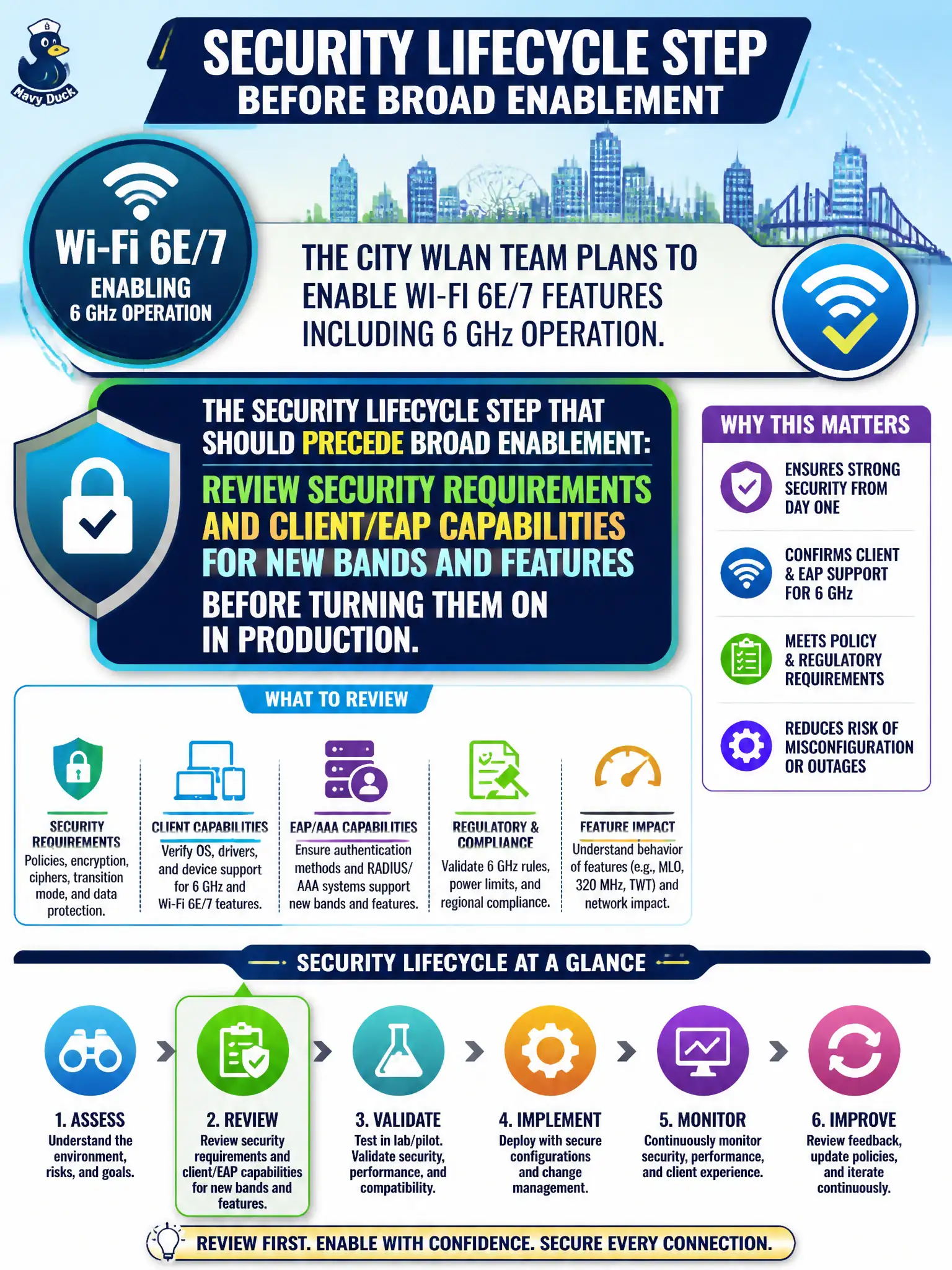
The city WLAN team plans to enable Wi-Fi 6E/7 features including 6 GHz operation. What security lifecycle step should precede broad enablement?
Select an answer to reveal the explanation.
Short Explanation
New bands and PHY toys change the threat and client map. Do a security requirements pass before flipping 6E/7 on citywide. Quiet logs and public PSKs are not a readiness checklist.
Full Explanation
Before broadly enabling Wi-Fi 6E/7 features including 6 GHz operation on the city WLAN, review security requirements and client/EAP capabilities for new bands and features. New spectrum does not automatically inherit old SSID security assumptions; PMF, WPA3 expectations, and client readiness should be validated first. Civic pilots that flip 6 GHz on without a security checklist create uneven protection and support chaos.
Disabling all logging for 6 GHz to reduce SIEM volume during the pilot blinds detection on the new band. Forcing every IoT sensor onto 6 GHz regardless of driver support breaks devices. Publishing the WPA3 Transition Mode PSK on social media to accelerate adoption spreads secrets.
Exam caveat: 6 GHz generally expects modern security such as WPA3; do not plan a WEP/TKIP fantasy on new bands. Operational check: run a security checklist for 6 GHz SSIDs covering AKM, PMF, logging, and client inventory, pilot with known-good devices, and only then expand production enablement. In municipal WLAN programs, capture the decision in the wireless standard and re-check it at change review so the next project inherits the same control bar instead of rediscovering the failure during an outage. In municipal WLAN programs, capture the decision in the wireless standard and re-check it at change review so the next project inherits the same control bar instead of rediscovering the failure during an outage.