
County sheriff deputies' laptops sometimes join a neighboring agency's SSID that overlaps City Hall's RF footprint. Beyond reminding staff of the acceptable-use policy, which combined approach best reduces misassociation risk?
Select an answer to reveal the explanation.
Short Explanation
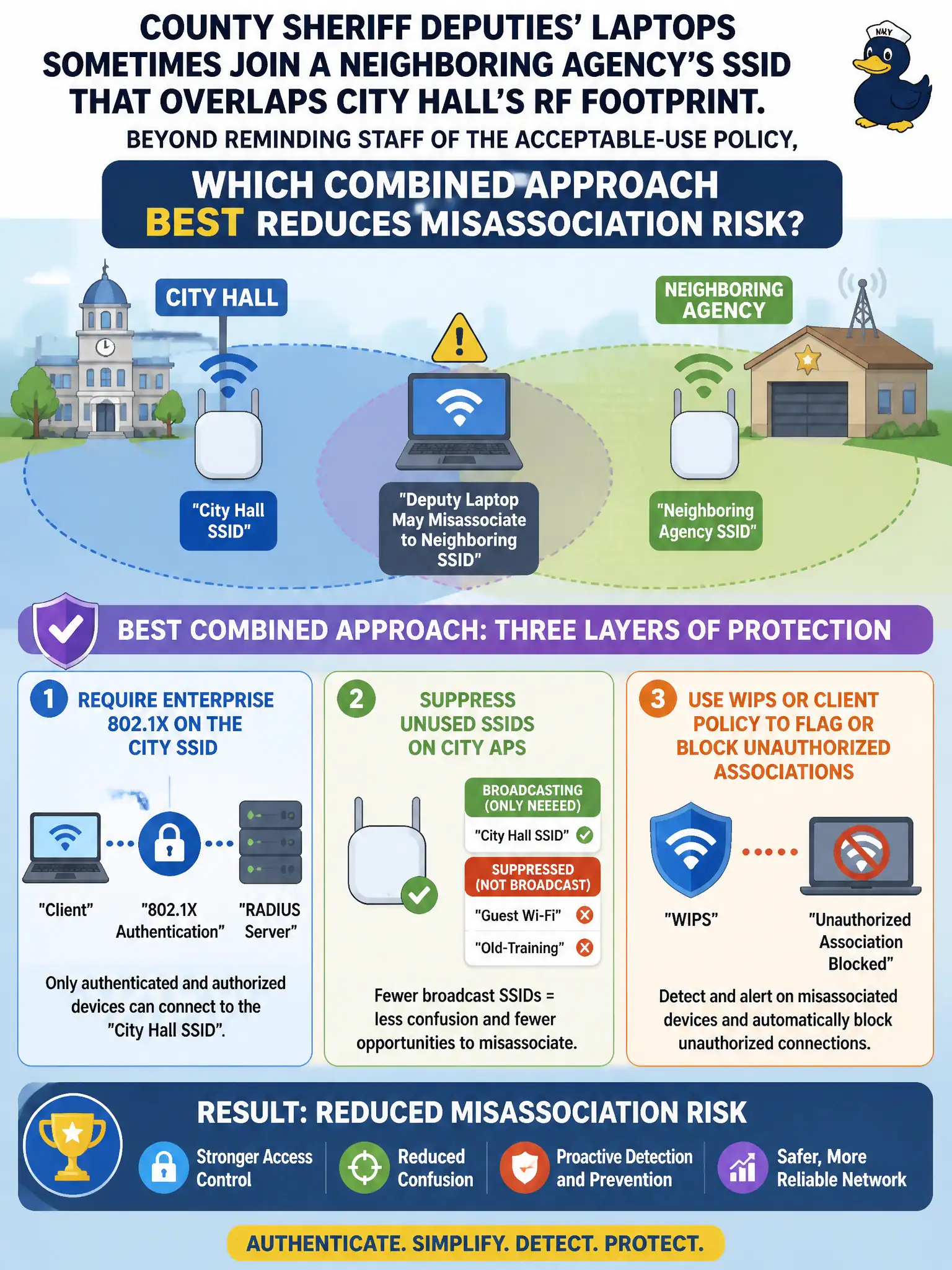
Misassociation is half policy and half RF/security plumbing. Lock the city SSID to 802.1X, keep junk SSIDs off the air, and let WIPS or MDM catch strays. Reminding people is fine; hoping they never see the wrong SSID is not a control.
Full Explanation
County sheriff deputies’ laptops sometimes joining a neighboring agency’s SSID that overlaps City Hall’s RF footprint is a misassociation risk. Beyond AUP reminders, require enterprise 802.1X on the city SSID, suppress unused SSIDs on city APs, and use WIPS or client policy to flag or block unauthorized associations. Layered technical controls reduce accidental or casual joins to foreign networks in dense civic RF environments.
Broadcasting an open city SSID with a stronger beacon interval so clients prefer it over the neighbor weakens security to chase preference. Disabling all encryption on the city SSID so misassociated clients fail TCP checksums is nonsensical and harmful. Lowering city AP transmit power to zero when the neighboring agency is on duty abandons coverage.
Exam caveat: neighboring agency coordination may also be needed when official roaming is intended—misassociation controls differ from deliberate shared-service design. Operational check: verify city employee SSID requires 802.1X, unused SSIDs are disabled on city APs, and a test client association to an unauthorized SSID triggers WIPS or endpoint policy response. In municipal WLAN programs, capture the decision in the wireless standard and re-check it at change review so the next project inherits the same control bar instead of rediscovering the failure during an outage.