
An engineer reviewing RSN settings for a WPA3 civic SSID must distinguish modern pairwise ciphers. Which statement is accurate?
Select an answer to reveal the explanation.
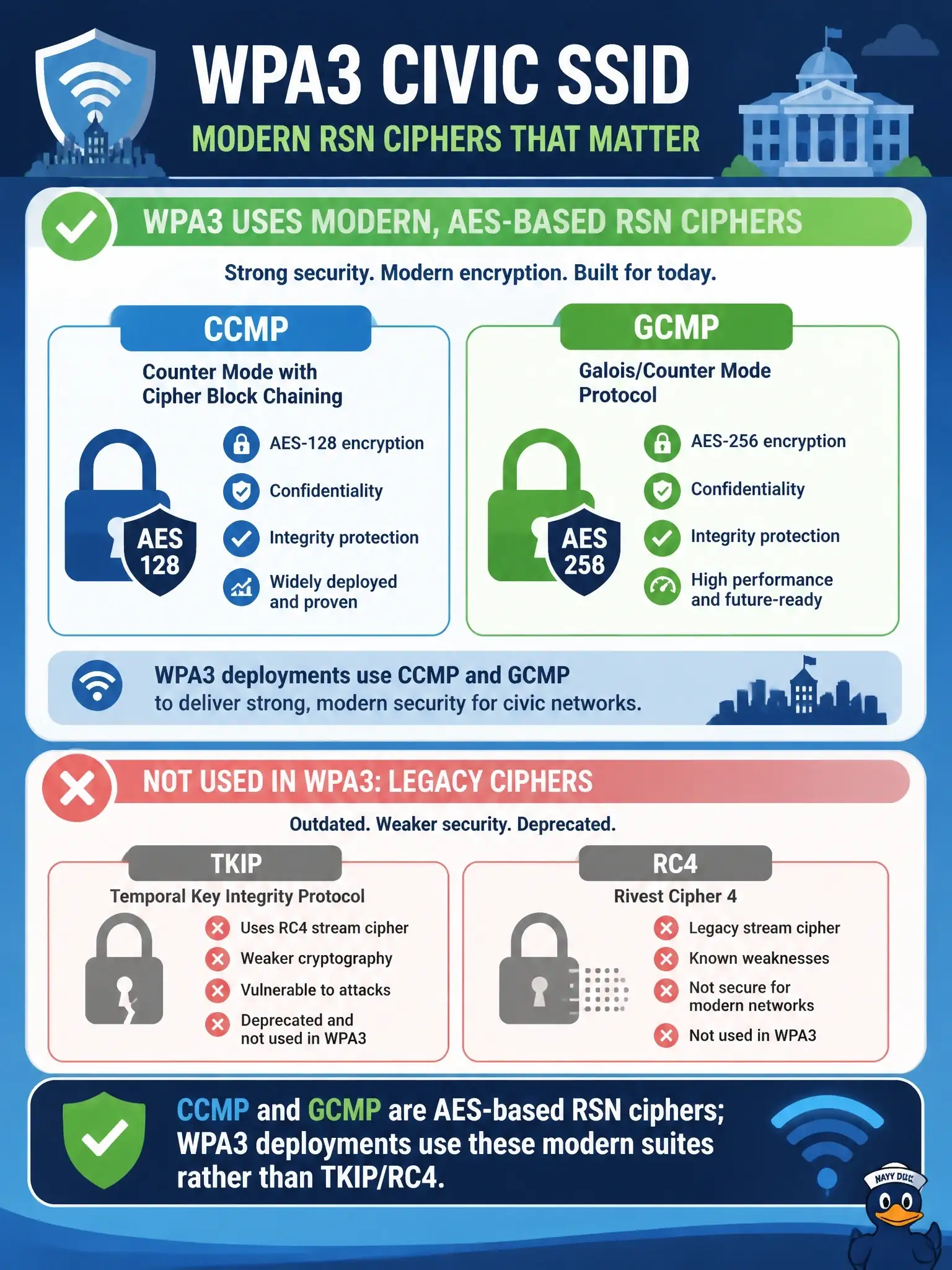
Short Explanation
Think AES toolbox, not 1990s stream-cipher antiques. You want CCMP and GCMP as the modern RSN locks WPA3 expects. Leave TKIP, WEP, and RC4 in the museum.
Full Explanation
The accurate statement is that CCMP and GCMP are AES-based RSN ciphers, and WPA3 deployments use these modern suites rather than TKIP or RC4. Accurate RSN review for a WPA3 civic SSID starts from that fact, and WPA3 also rejects WEP-era constructs. Engineers validating high-security municipal profiles should confirm the advertised RSN information elements negotiate those modern ciphers and that deprecated suites are not left enabled for compatibility theater. That distinction matches sound WLAN security practice and the item’s short explanation teaching intent.
The statement that TKIP remains the preferred pairwise cipher for all WPA3-Enterprise deployments contradicts WPA3’s rejection of TKIP. The statement requiring WEP-104 whenever GCMP is advertised in the RSN information element reverses history—WEP is obsolete, not a GCMP prerequisite. The statement that only RC4 stream ciphers are valid under WPA3-Personal SAE is false; SAE belongs with modern AEAD ciphers, not RC4.
Exam caveat: transition modes and legacy SSIDs may still show older suites elsewhere in the estate—do not confuse a temporary exception SSID with the WPA3 profile under review. Operational check: capture or export the WPA3 SSID’s RSN cipher suites from controller or over-the-air observation and confirm CCMP and/or GCMP without TKIP/WEP/RC4 enabled for that basic service set. In municipal WLAN programs, write the control into standards and verify it during change review so the next project inherits the same bar rather than rediscovering the failure mode under outage pressure.