
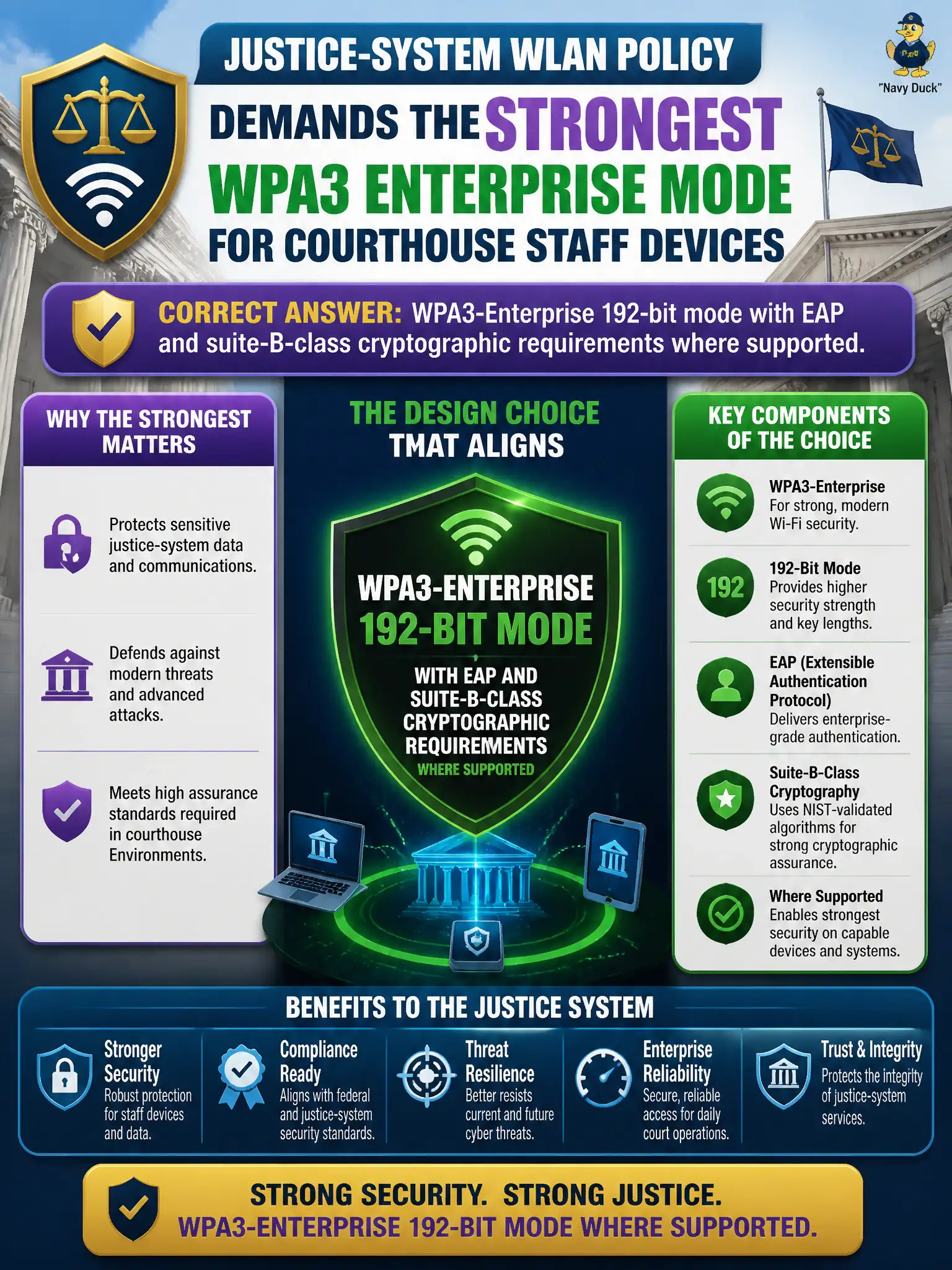
Justice-system WLAN policy demands the strongest WPA3 enterprise mode for courthouse staff devices. Which design choice aligns?
Select an answer to reveal the explanation.
Short Explanation
Courthouse Wi-Fi is not the coffee-shop free-for-all. When policy says high-assurance enterprise crypto, WPA3-Enterprise 192-bit is the grown-up choice. Shared hallway passwords and WEP cosplay do not belong next to case data.
Full Explanation
Justice-system WLAN policy that demands the strongest WPA3 enterprise mode for courthouse staff devices aligns with WPA3-Enterprise 192-bit mode using EAP and suite-B-class cryptographic requirements where supported. Courthouse staff devices handle sensitive case and identity workflows; AKM and cipher strength should match that vertical risk rather than hallway convenience or shared passwords. Client and infrastructure capability still gate whether 192-bit mode is universally deployable across every courtroom tablet.
WPA2-Personal with a shared hallway passphrase posted at the clerk’s desk is the opposite of high-assurance enterprise security. An open SSID with MAC filtering alone for courtroom tablets provides trivial-to-spoof identity and no useful confidentiality. WEP plus captive portal for legacy scanners reintroduces broken crypto under a justice policy banner.
Exam caveat: 192-bit mode requires capable clients and EAP methods—inventory before mandating building-wide, or plan phased exceptions with compensating controls and dates. Operational check: validate controller SSID configuration for WPA3-Enterprise 192-bit where required, test a known-good staff device join, and document any non-capable devices on a timed exception list.