
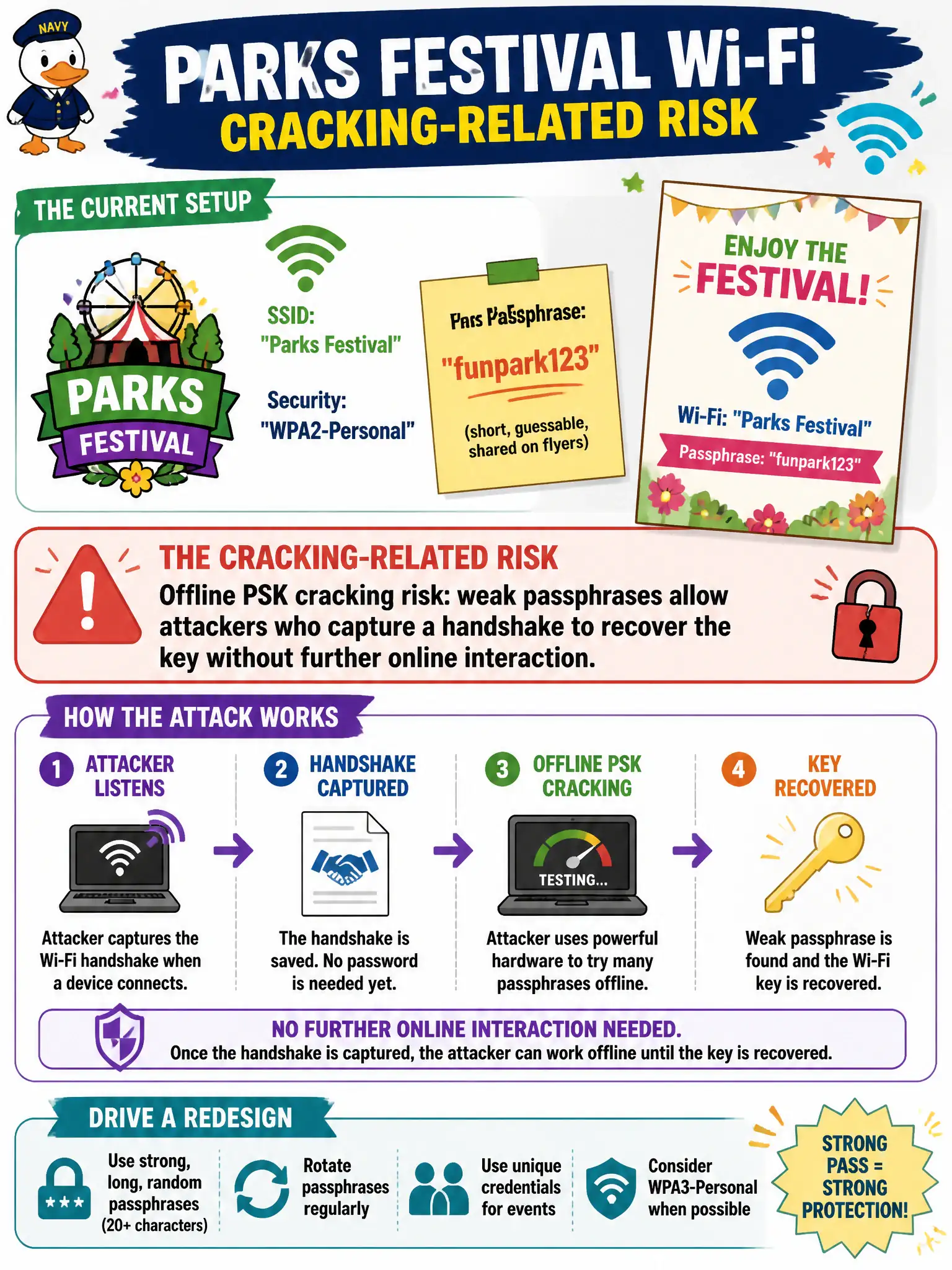
A parks festival SSID uses WPA2-Personal with a short, guessable passphrase shared on flyers. What cracking-related risk should drive a redesign?
Select an answer to reveal the explanation.
Short Explanation
A weak festival Wi-Fi password is a padlock made of cardboard—grab one handshake and attackers can try dictionaries at home. Use strong secrets or, better, move events to architectures that don’t hinge on a flyer PSK. Printing the password louder doesn’t make it safer.
Full Explanation
A parks festival SSID using WPA2-Personal with a short, guessable passphrase printed on flyers creates offline PSK cracking risk that is easy to demonstrate and hard to spin politically after the fact. Attackers who capture a handshake can attempt dictionary or brute-force recovery of the key without further online interaction, then decrypt traffic or join at will for the event duration. Civic event Wi-Fi that prioritizes easy flyer passwords therefore needs stronger PSK hygiene, rotation, or a different onboarding model.
Claiming WPA2-Personal is immune to offline dictionary attacks after handshake capture is false. Asserting that only WEP handshakes can be attacked offline so WPA2 needs no passphrase strength is historically and technically wrong. Printing the PSK publicly does not eliminate cracking risk—it removes secrecy entirely and still leaves poorly managed event networks open to abuse.
Exam caveat: long random PSKs reduce offline cracking practicality but shared event PSKs still lack per-user accountability; consider time-bounded credentials or better onboarding for recurring festivals. Operational check: assess passphrase entropy and distribution method, demonstrate offline attack feasibility to stakeholders in a lab, and redesign onboarding before the next event.