
During a stakeholder workshop for civic guest Wi-Fi, IT security and the communications office disagree about Acceptable Use. What should the session establish?
Select an answer to reveal the explanation.
Short Explanation
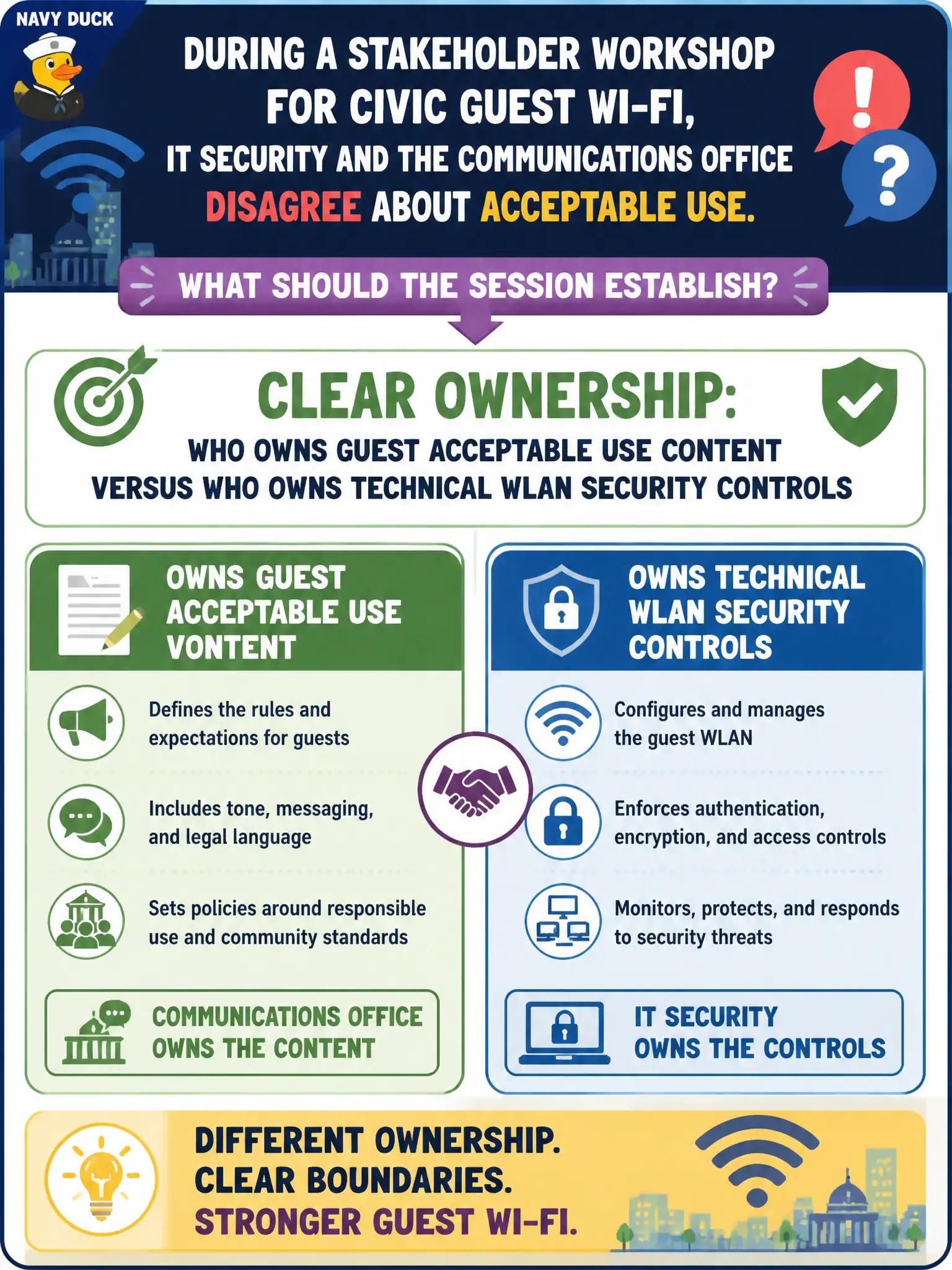
Somebody has to own the guest rules and somebody has to own the locks on the door—and they might not be the same desk. Nail down AUP ownership versus IT security ownership in the workshop so tickets don’t bounce forever. “Everyone and no one” is how guest Wi-Fi becomes a free-for-all.
Full Explanation
Stakeholder workshops for civic guest Wi-Fi often stall when IT security and communications disagree about Acceptable Use. The session should establish clear ownership: who owns guest Acceptable Use content and citizen-facing language versus who owns technical WLAN security controls such as encryption, isolation, and logging. Splitting those responsibilities prevents marketing copy from silently becoming the security architecture and prevents engineers from drafting legalistic AUP text without business review.
Claiming guest Wi-Fi needs no owner because it is open to the public abandons accountability for abuse and liability messaging. Letting network engineers alone write AUP language without business input often yields unreadable or unenforceable terms. Treating Acceptable Use as purely a marketing brochure decision ignores technical controls that actually limit guest risk.
Exam caveat: ownership clarity does not remove the need for joint review—it defines who drafts, who approves, and who operates each control. Operational check: publish a RACI for guest WLAN covering AUP content, portal UX, encryption/isolation, and incident response, then confirm the next portal change request follows that ownership path.