
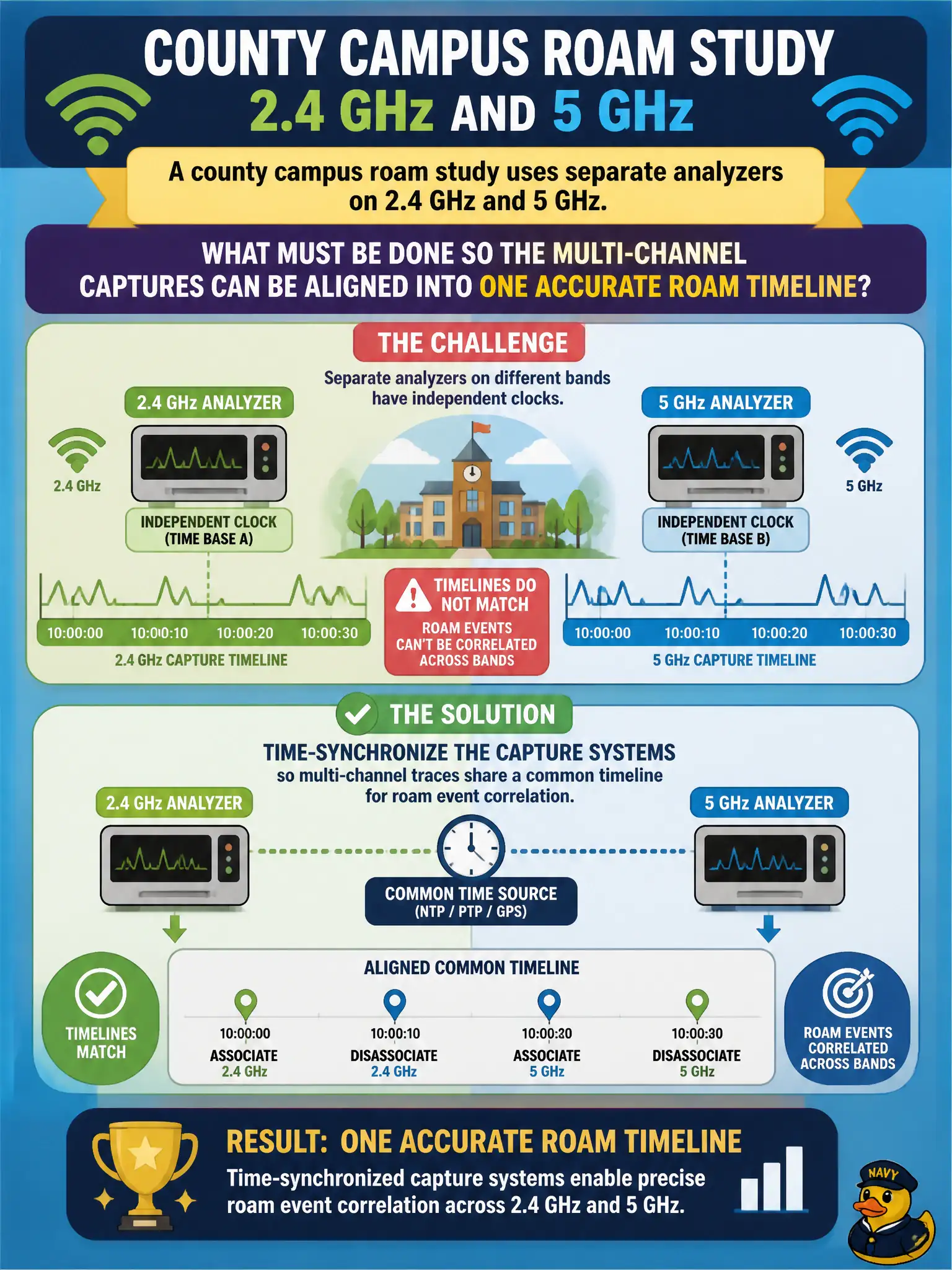
A county campus roam study uses separate analyzers on 2.4 GHz and 5 GHz. What must be done so the multi-channel captures can be aligned into one accurate roam timeline?
Select an answer to reveal the explanation.
Short Explanation
Roam timelines fall apart when one laptop’s clock is three seconds ahead of the other—like comparing race photos from unsynced cameras. Sync the analyzers so both bands share one timeline before you judge roam latency. One-channel-only redesign or tossing Radiotap timestamps just throws away evidence.
Full Explanation
Multi-channel roam studies only yield an accurate timeline when capture systems share synchronized time. For a county campus roam study using separate analyzers on 2.4 GHz and 5 GHz, the captures must be time-synchronized so multi-channel traces share a common timeline for roam event correlation. Without that, probe, reassociation, and EAPOL events cannot be ordered across bands with forensic confidence.
Relying only on each file's local wall-clock start time without verifying clock skew fails by concept: unsynchronized laptops drift and mis-order roam stages. Deleting Radiotap timestamps and rebuilding timing from Beacon SSI fields alone fails by concept: discarding precise timestamps and depending solely on coarse Beacon timing degrades multi-adapter correlation. Forcing every AP onto one channel so a single file suffices fails by concept: that destroys the dual-band roam behavior under study and is not an analysis substitute for sync.
Exam caveat: CWNE multi-adapter methodology treats time sync as a prerequisite, not an optional convenience, for campus roam timelines.
Operational check: NTP-sync or GPS-sync both campus analyzers before the roam walk, verify skew under a few milliseconds, capture 2.4/5 GHz simultaneously, and merge events on the common timeline before reporting roam latency.