
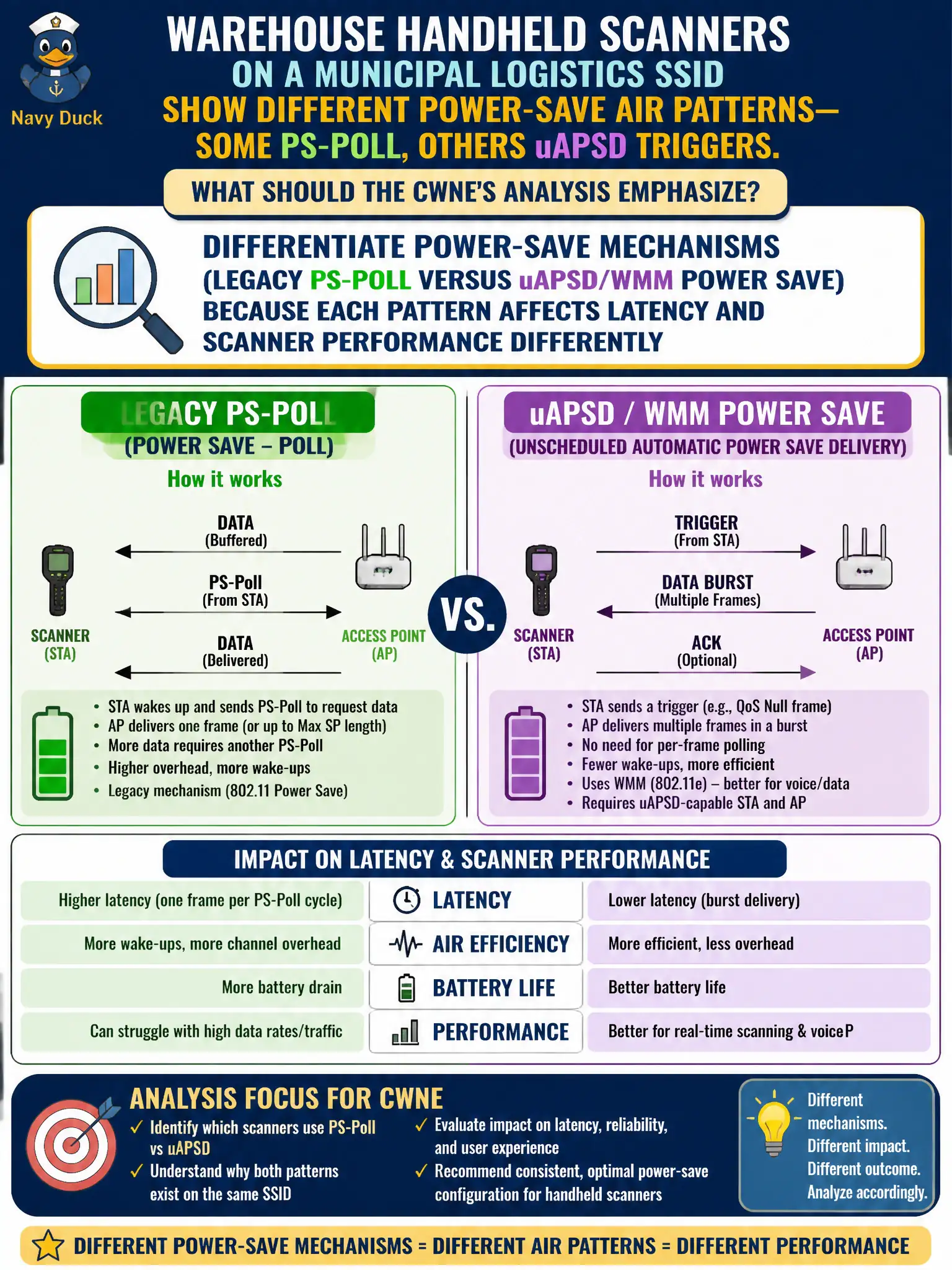
Warehouse handheld scanners on a municipal logistics SSID show different power-save air patterns—some PS-Poll, others uAPSD triggers. What should the CWNE's analysis emphasize?
Select an answer to reveal the explanation.
Short Explanation
PS-Poll is knocking on the AP's door for one buffered letter; uAPSD is more like scheduled pickup. Warehouse scanners feel the difference in lag—so name the power-save dialect before you tune.
Full Explanation
Legacy PS-Poll and uAPSD/WMM power save are different mechanisms for retrieving buffered downlink while conserving battery. Warehouse handheld scanners on a municipal logistics SSID that show some PS-Poll and others uAPSD triggers require analysis that differentiates those power-save mechanisms because each pattern affects latency and scanner performance differently. Treating them as cosmetics hides why one scanner class feels snappier than another under the same SSID.
Claiming PS-Poll and uAPSD are identical frames with only vendor naming differences fails by concept: they are distinct power-save retrieval models with different trigger and latency behaviors. Mandating PS-Poll exclusively because uAPSD is deprecated on Wi-Fi 6 fails by concept: WMM power save/uAPSD-style triggering remains relevant; blanket deprecation claims misguide municipal device policy. Declaring power-save illegal on WPA3 so either pattern indicates a rogue fails by concept: power-save is legitimate on modern secured SSIDs and is not a rogue signature.
Exam caveat: CWNE IoT/handheld items expect mechanism-level power-save literacy—PS-Poll versus uAPSD—tied to application latency, not security panic.
Operational check: Classify logistics scanners by power-save pattern in the capture, measure downlink latency after each trigger type during scan bursts, and align WMM/APSDsettings with the latency budget for each handheld fleet.