
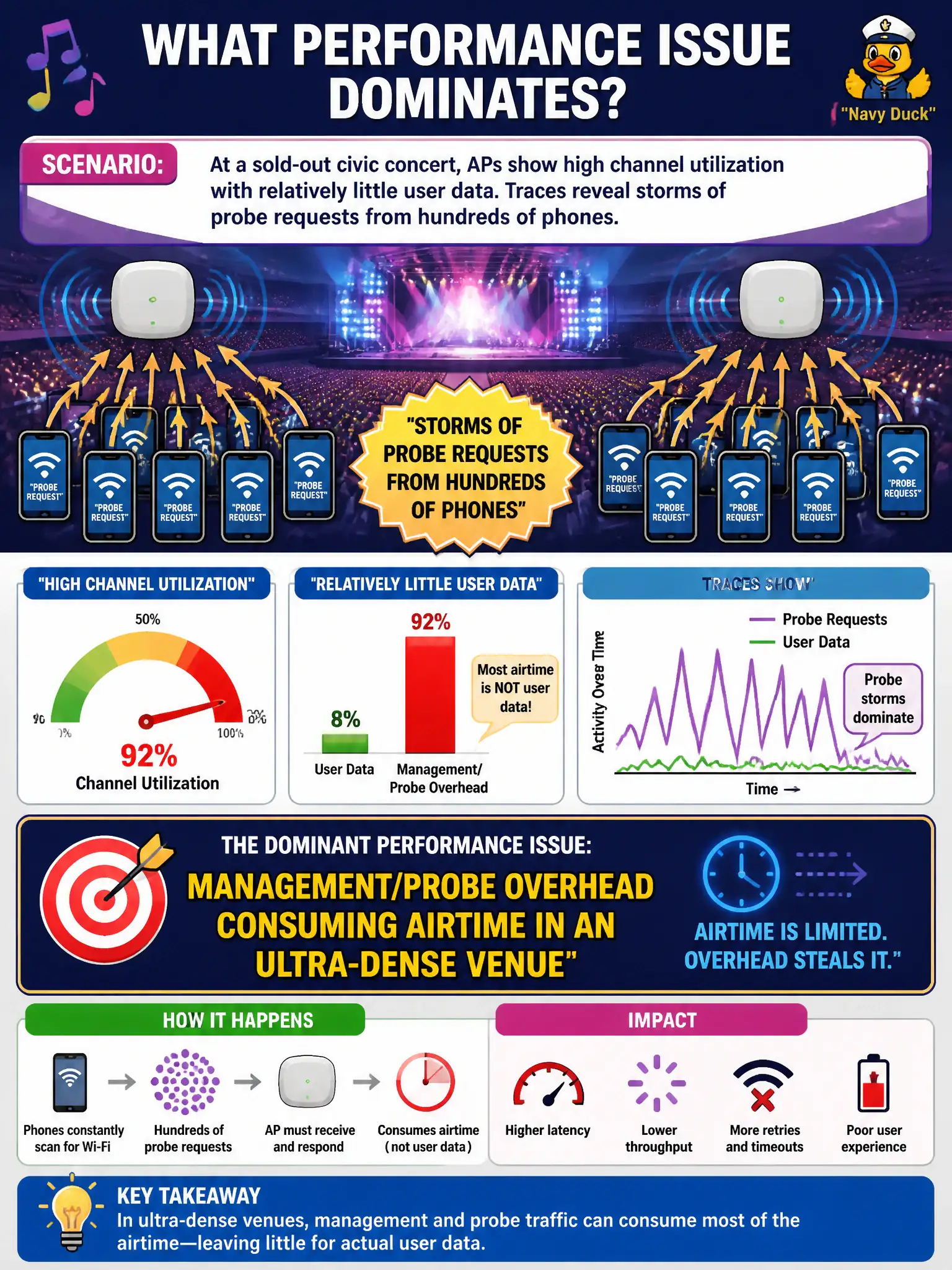
At a sold-out civic concert, APs show high channel utilization with relatively little user data. Traces reveal storms of probe requests from hundreds of phones. What performance issue dominates?
Select an answer to reveal the explanation.
Short Explanation
Hundreds of phones shouting “anyone there?” can fill the air before a single song lyric downloads. Probe and management overhead is a classic ultra-dense tax. Design for that control-plane noise, not just user data rates.
Full Explanation
In an ultra-dense civic venue, management and probe overhead can consume a large share of airtime even before useful data frames run—probe requests, responses, beacons, and other management traffic scale with SSIDs, clients, and scan behavior. Capacity design must budget that overhead, reduce unnecessary SSIDs and low basic rates, and use high-density features appropriately. DHCP NAK storms from a misconfigured DNS suffix are a Layer-3 configuration symptom set, not the default explanation for dense management-frame airtime dominance. Missing WPA3-192-bit mode on a guest SSID is a security-policy choice, not the mechanism of probe and beacon overload. Ethernet STP loops on a stage switch cause wired storms that may secondarily hurt APs, but the dense-venue management overhead pattern is primarily an RF control-plane airtime issue. Exam caveat: high-density capacity fails from control overhead as well as from data contention—count management airtime. Operational check: measure management versus data airtime on venue APs at doors-open, prune SSIDs and basic rates, and validate civic event Wi-Fi against real ticket-scanning and visitor density. In municipal WLAN operations, record the chosen control and the rejected alternatives in the change ticket so on-call staff understand which failure modes were avoided for city services. Re-validate after the next maintenance window that the same control still holds under the current controller code, client mix, and civic event calendar used by the wireless team.