
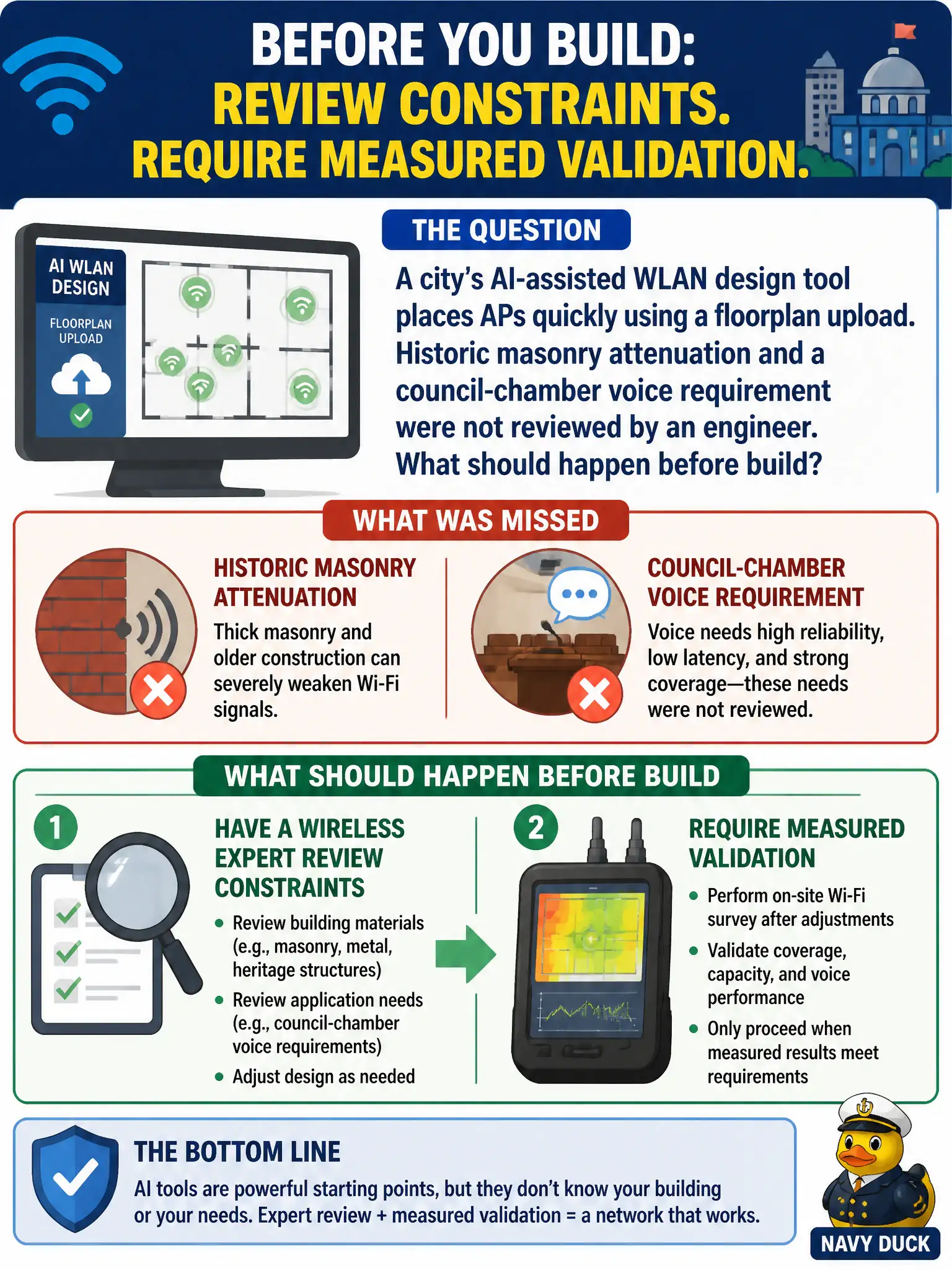
A city's AI-assisted WLAN design tool places APs quickly using a floorplan upload. Historic masonry attenuation and a council-chamber voice requirement were not reviewed by an engineer. What should happen before build?
Select an answer to reveal the explanation.
Short Explanation
AI can draft a layout in minutes and still miss brick walls and voice SNR. A human expert has to check constraints and insist on measured validation before the city buys steel and cable.
Full Explanation
AI-assisted placement can accelerate drafts but does not replace expert constraint review or measured validation. When a city's tool places APs quickly yet historic masonry attenuation and a council-chamber voice requirement were not engineer-reviewed, a wireless expert must review constraints and require measured validation rather than accepting the AI layout uncritically. Automation without domain review risks missing attenuation and voice SNR reality that civic spaces routinely present.
Approving the AI placement automatically because automation always beats human survey judgment fails by concept: tools inherit incomplete inputs and miss specialty constraints. Skipping attenuation checks and doubling every AP's power in software fails by concept: power inflation increases CCI and does not calibrate masonry loss. Ignoring voice SNR targets if the AI heatmap is green fails by concept: color alone may not encode voice-grade SNR in the chamber.
Exam caveat: CWNE judgment treats AI layouts as drafts subject to expert RF review and measurement before municipal build.
Operational check: Peer-review the AI plan against masonry and voice requirements, adjust AP count and placement, and mandate AP-on-a-stick or post-deploy validation in the council chamber before build sign-off.