
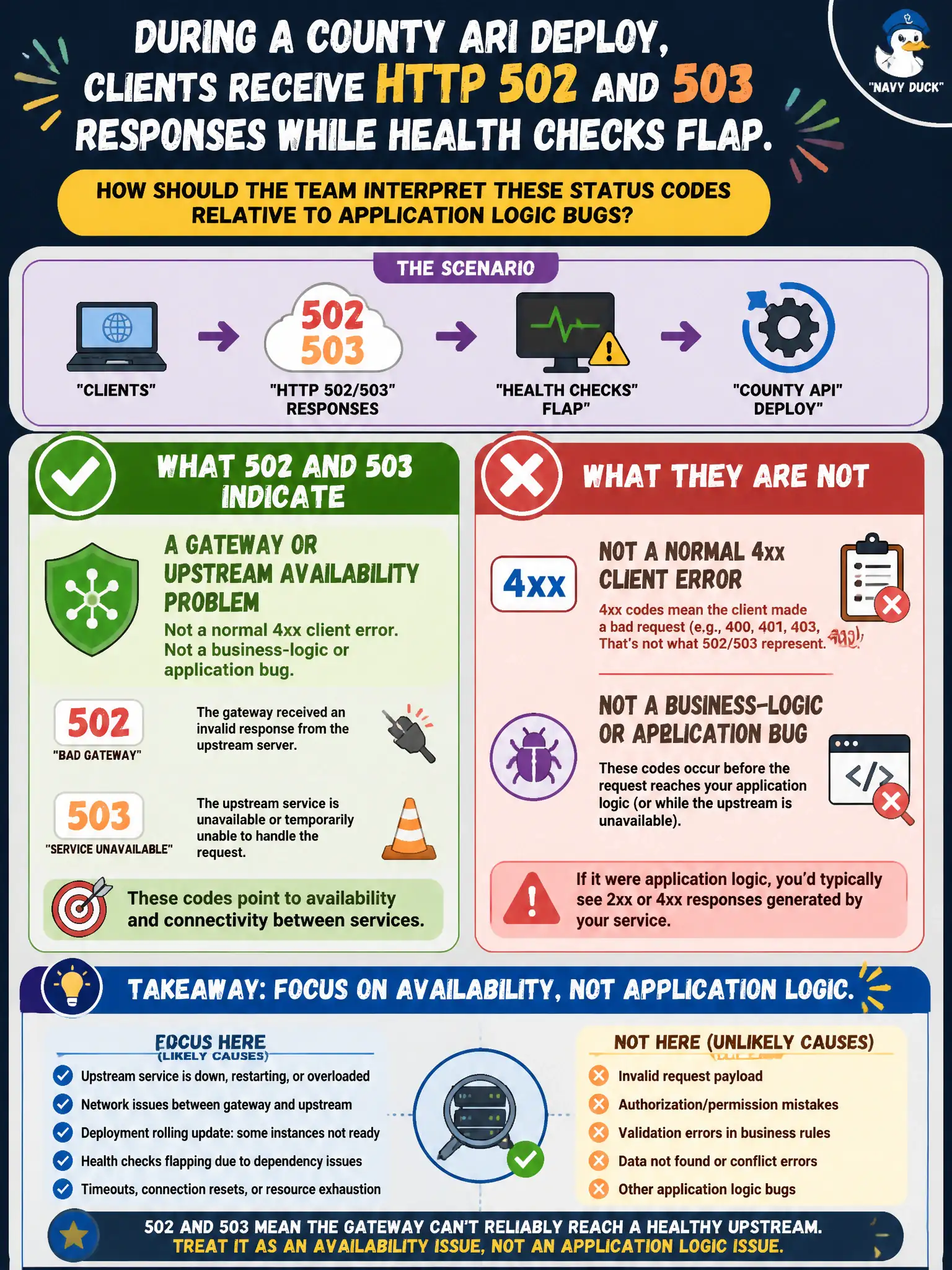
During a county API deploy, clients receive HTTP 502 and 503 responses while health checks flap. How should the team interpret these status codes relative to application logic bugs?
Select an answer to reveal the explanation.
Short Explanation
Five-oh-two and five-oh-three are the 'middleman is unhappy' lights—gateway can't reach a healthy upstream or capacity is gone. Don't assume the app threw a NullPointer just because the edge returned those codes.
Full Explanation
During a county API deploy, clients receiving HTTP 502 and 503 responses while health checks flap should interpret these status codes as indicating a gateway or upstream availability problem rather than a normal 4xx client or business-logic error. 502/503 point at bad gateways, unavailable upstreams, or overloaded intermediaries in municipal edge paths. They do not prove the application code threw an uncaught NullPointerException—that might yield 500 from the app itself, depending on design. They do not confirm DNS TTL values are too high. They do not mean the TLS certificate expired on the client device, which usually presents as client trust errors rather than gateway 502/503. Exam caveat: map status classes—4xx client, 5xx server/gateway—before diving into application business logic during civic incidents. Operational check: inspect load balancer/API gateway health and target status, correlate with deploy events, roll back or fix unhealthy targets, confirm 502/503 rates drop, and capture gateway logs in the incident record. In municipal cloud operations, record the chosen control and the rejected alternatives in the change or incident ticket so future on-call staff understand which failure modes were avoided for city services. Re-validate after the next maintenance window that the same decision still holds under current provider limits, identity bindings, and application versions used by the civic platform team.