
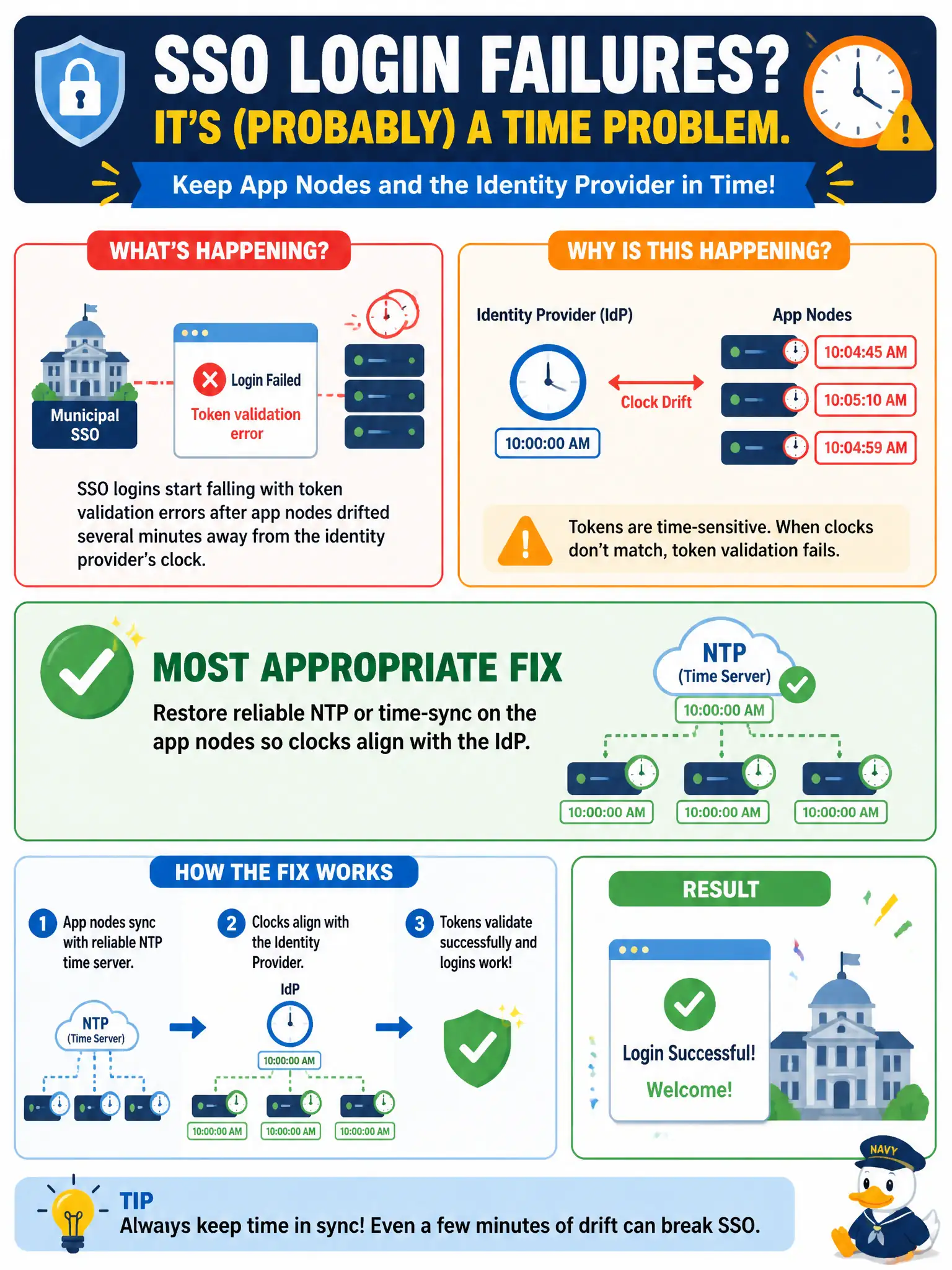
Municipal SSO logins start failing with token validation errors after app nodes drifted several minutes away from the identity provider's clock. What is the most appropriate fix?
Select an answer to reveal the explanation.
Short Explanation
Auth tokens are picky about time—like tickets that expire if your watch is wrong. When app servers drift from the IdP, sync their clocks with NTP and the handshakes usually calm down.
Full Explanation
Municipal SSO logins failing with token validation errors after app nodes drifted several minutes away from the identity provider's clock should be fixed by restoring reliable NTP or time-sync on the app nodes so clocks align with the IdP. SAML/OIDC tokens are time-bounded; skew breaks validation for city users. Disabling MFA for all citizen accounts until the outage ends increases account-takeover risk and does not fix skew. Widening every security group to allow all outbound traffic is unrelated to token time validation. Switching the IdP from SAML to basic authentication permanently weakens the municipal identity design. Exam caveat: monitor clock skew as a first-class dependency for federated SSO—treat NTP failure as a Sev-impacting civic identity incident. Operational check: compare app node time to the IdP, restore chrony/NTP or cloud time sync, confirm skew is within tolerance, retest SSO, alert on future skew, and document time-sync requirements in the identity runbook. In municipal cloud operations, record the chosen control and the rejected alternatives in the change or incident ticket so future on-call staff understand which failure modes were avoided for city services. Re-validate after the next maintenance window that the same decision still holds under current provider limits, identity bindings, and application versions used by the civic platform team.