
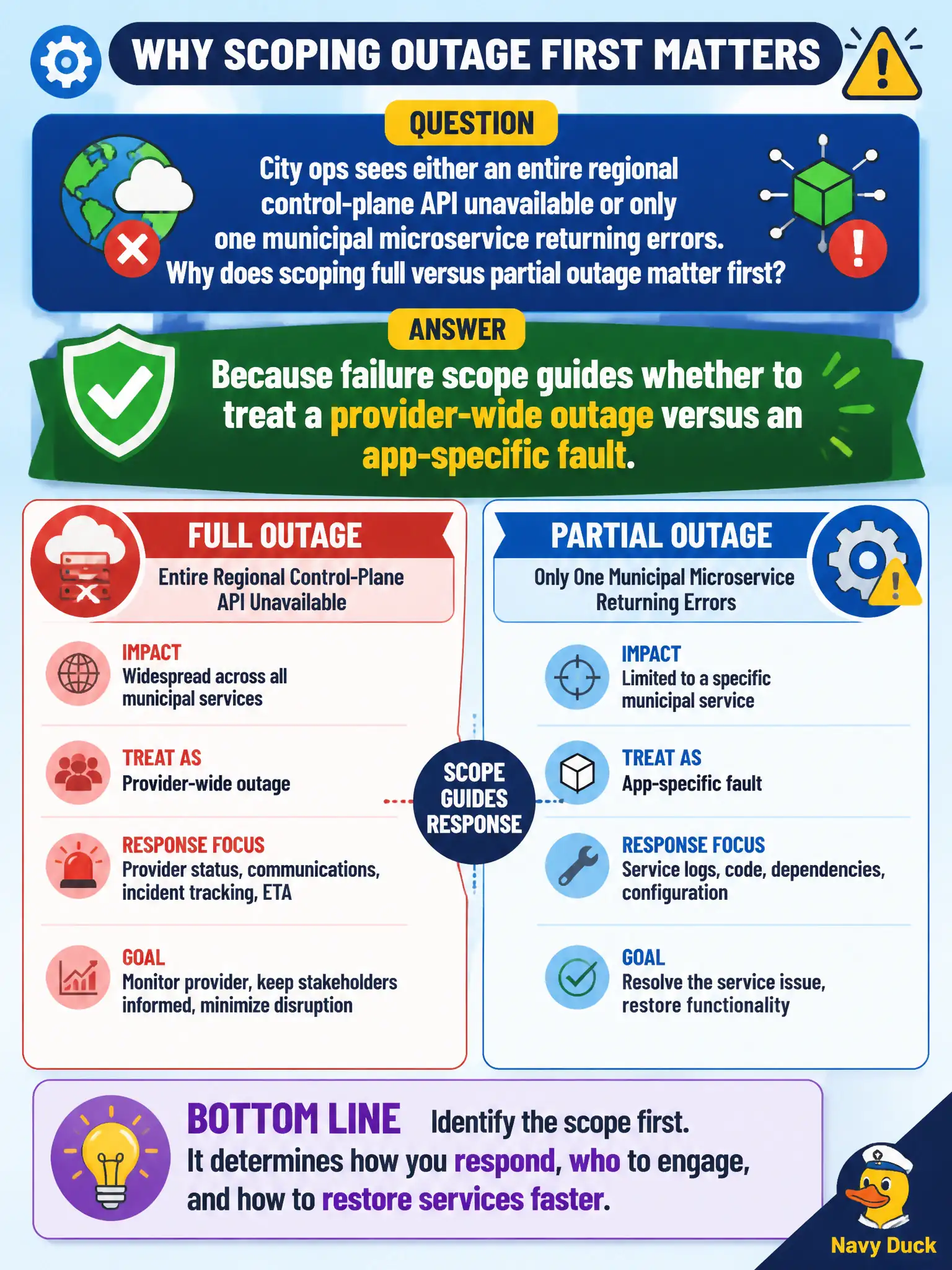
City ops sees either an entire regional control-plane API unavailable or only one municipal microservice returning errors. Why does scoping full versus partial outage matter first?
Select an answer to reveal the explanation.
Short Explanation
Is the whole region’s API dark, or just one service whining? That scope check tells you whether to watch the provider status board or dig into your microservice. Jumping to DNS for every symptom wastes the first critical minutes.
Full Explanation
City ops seeing either an entire regional control-plane API unavailable or only one municipal microservice returning errors must scope full versus partial outage first because failure scope guides whether to treat a provider-wide outage versus an app-specific fault. Scope drives communications, rollback, and whether to wait on the provider status page or debug the civic service graph. Not every error must be a DNS misconfiguration with no other possibilities—premature narrowing wastes incident time. Provider status pages are often useful during incidents and should be checked, not dismissed. Partial and full outages do not always share identical remediation steps; provider outages and app bugs diverge quickly. Exam caveat: establish blast radius early—region, account, service, or single deployment—before changing multiple municipal systems at once. Operational check: compare provider status and control-plane health with synthetic checks to the microservice, decide outage class within the first triage minutes, communicate scope to stakeholders, and log the classification in the incident timeline. In municipal cloud operations, record the chosen control and the rejected alternatives in the change or incident ticket so future on-call staff understand which failure modes were avoided for city services. Re-validate after the next maintenance window that the same decision still holds under current provider limits, identity bindings, and application versions used by the civic platform team.