
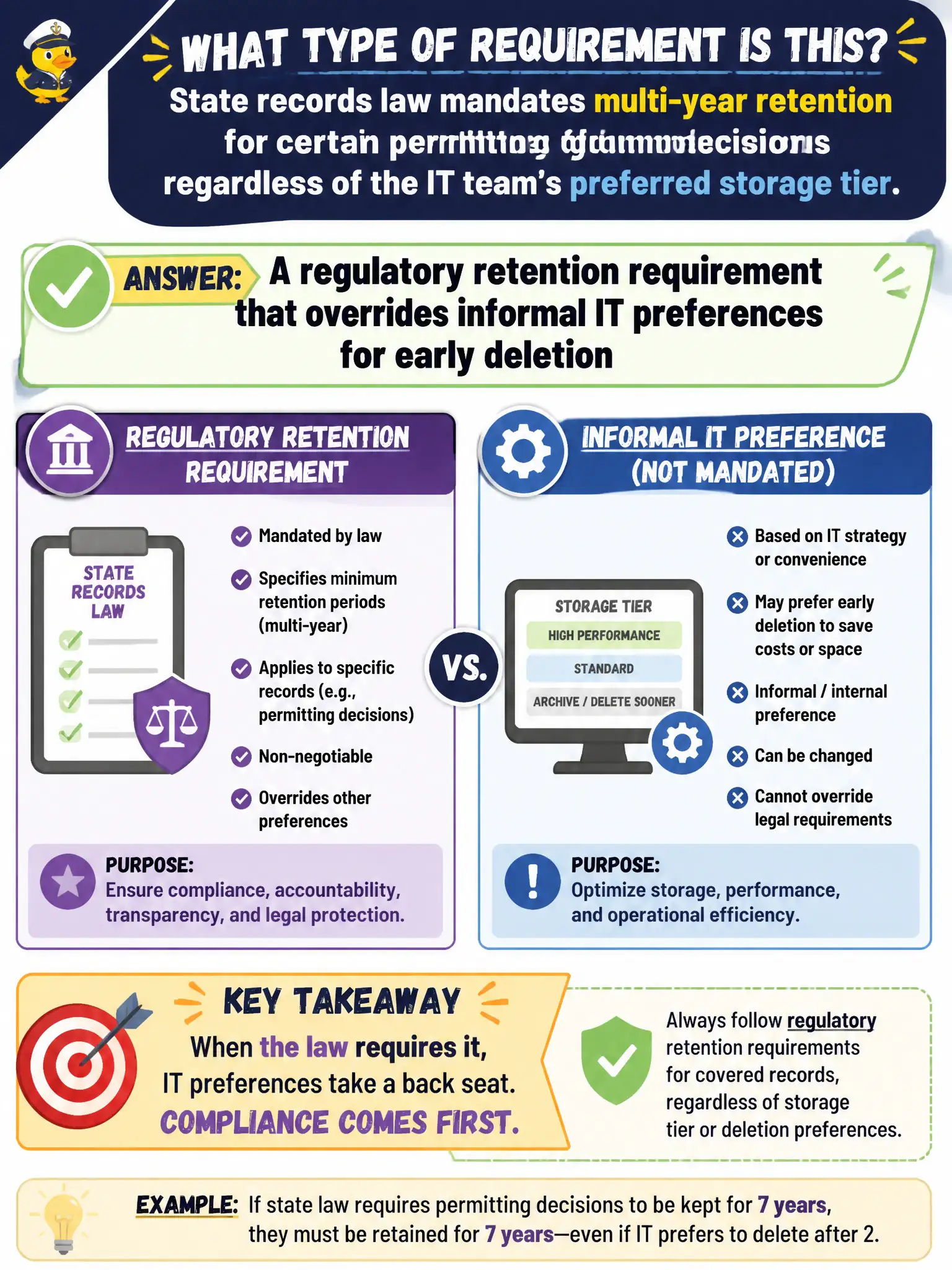
State records law mandates multi-year retention for certain permitting decisions regardless of the IT team's preferred storage tier. What type of requirement is that?
Select an answer to reveal the explanation.
Short Explanation
When the statute says keep the permit decisions, IT's favorite cheap delete-after-ninety-days tier does not win. Regulatory retention is the law's calendar, not the ops team's preference.
Full Explanation
Regulatory retention requirements come from law or regulation and override informal IT preferences for early deletion or cheaper tiers when those preferences conflict. If state records law mandates multi-year retention for certain permitting decisions, the city must retain them accordingly regardless of the IT team’s preferred storage tier. Compliance beats convenience for official civic records.
Calling the mandate an optional marketing guideline understates legal force. Treating it as a hypervisor tuning setting misunderstands records law entirely. Storing permitting decisions only in volatile memory guarantees loss and noncompliance.
Exam caveat: distinguish regulatory vs contractual vs internal policy retention. Storage tier (hot/cool/archive) may change cost but must still meet retention and retrieval requirements.
Operational check: map permitting decision records to the legal retention period, place them on durable storage with delete protections, document tiering that still meets retrieval SLAs, and involve records managers before any purge automation. Audit annually for premature deletion attempts.
Coordinate with the municipal records officer before any permitting-decision purge job runs, and configure object-lock or deny-delete guards where the platform supports them so informal IT cleanup cannot defeat state retention law.