
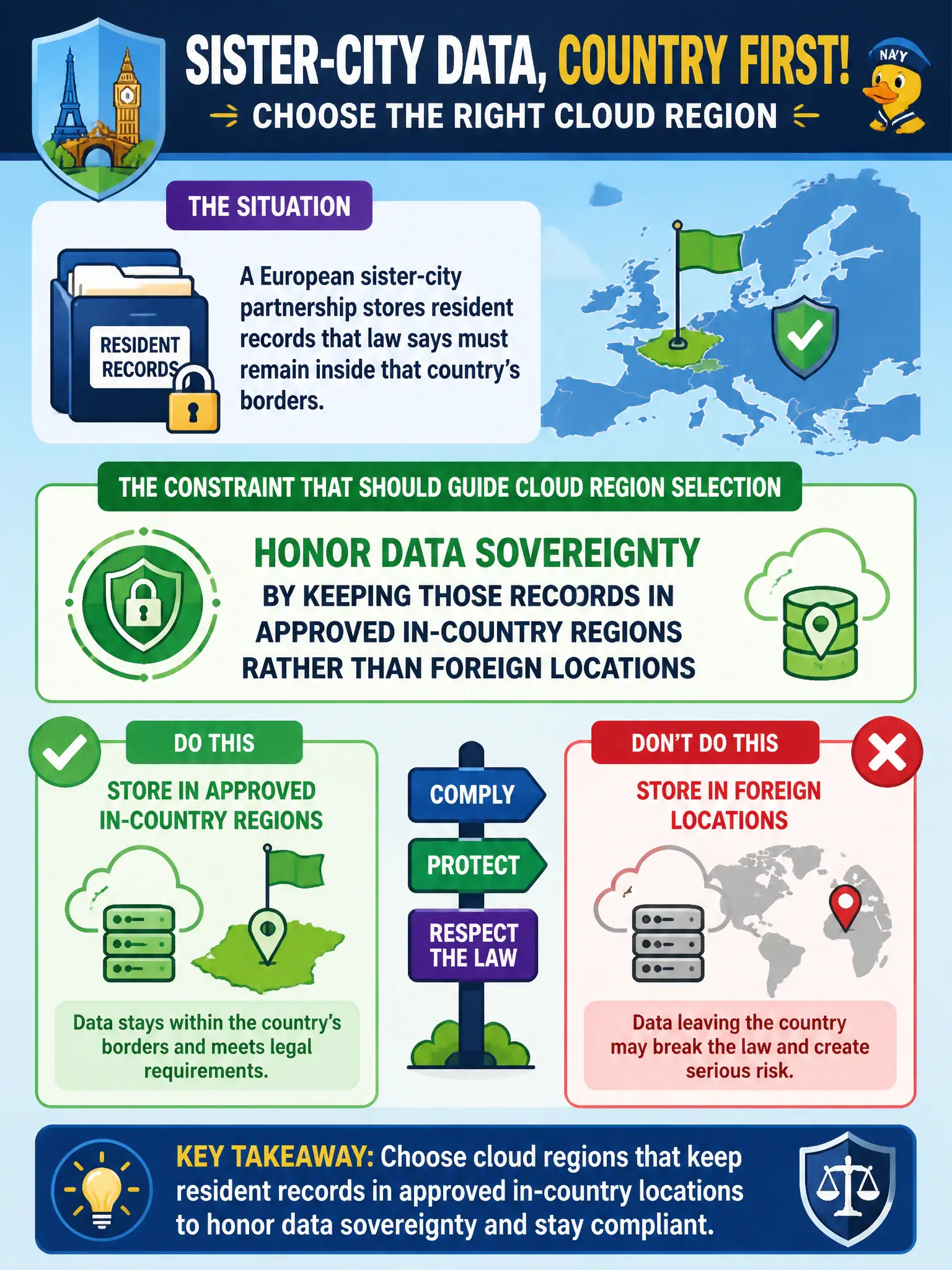
A European sister-city partnership stores resident records that law says must remain inside that country's borders. What constraint should guide cloud region selection?
Select an answer to reveal the explanation.
Short Explanation
Some citizen files have a passport stamp: they are not allowed to leave the country. Data sovereignty means picking cloud regions that keep those records inside approved borders—not wherever storage is cheapest.
Full Explanation
Data sovereignty constraints require that regulated resident records remain in approved geographic/political boundaries—typically in-country regions—rather than arbitrary foreign locations chosen only for price. For a European sister-city partnership whose law keeps records inside that country’s borders, cloud region selection must honor those rules so municipal cooperation does not violate residency mandates.
Picking the cheapest global region regardless of national boundaries can breach sovereignty. Mirroring all citizen records to every public region for durability may violate residency even if it helps DR. Claiming sovereignty applies only to paper archives, not cloud object storage, is incorrect.
Exam caveat: sovereignty (legal/political boundary) is related to but distinct from locality (performance/contractual placement) and residency clauses in contracts. DR designs must still respect allowed regions.
Operational check: map data classes to allowed regions in architecture standards, configure storage and processing only in approved regions, block unintended cross-region replication with SCP/policy, and evidence region placement for auditors. Review after provider region expansions so new defaults do not drift out of compliance.