
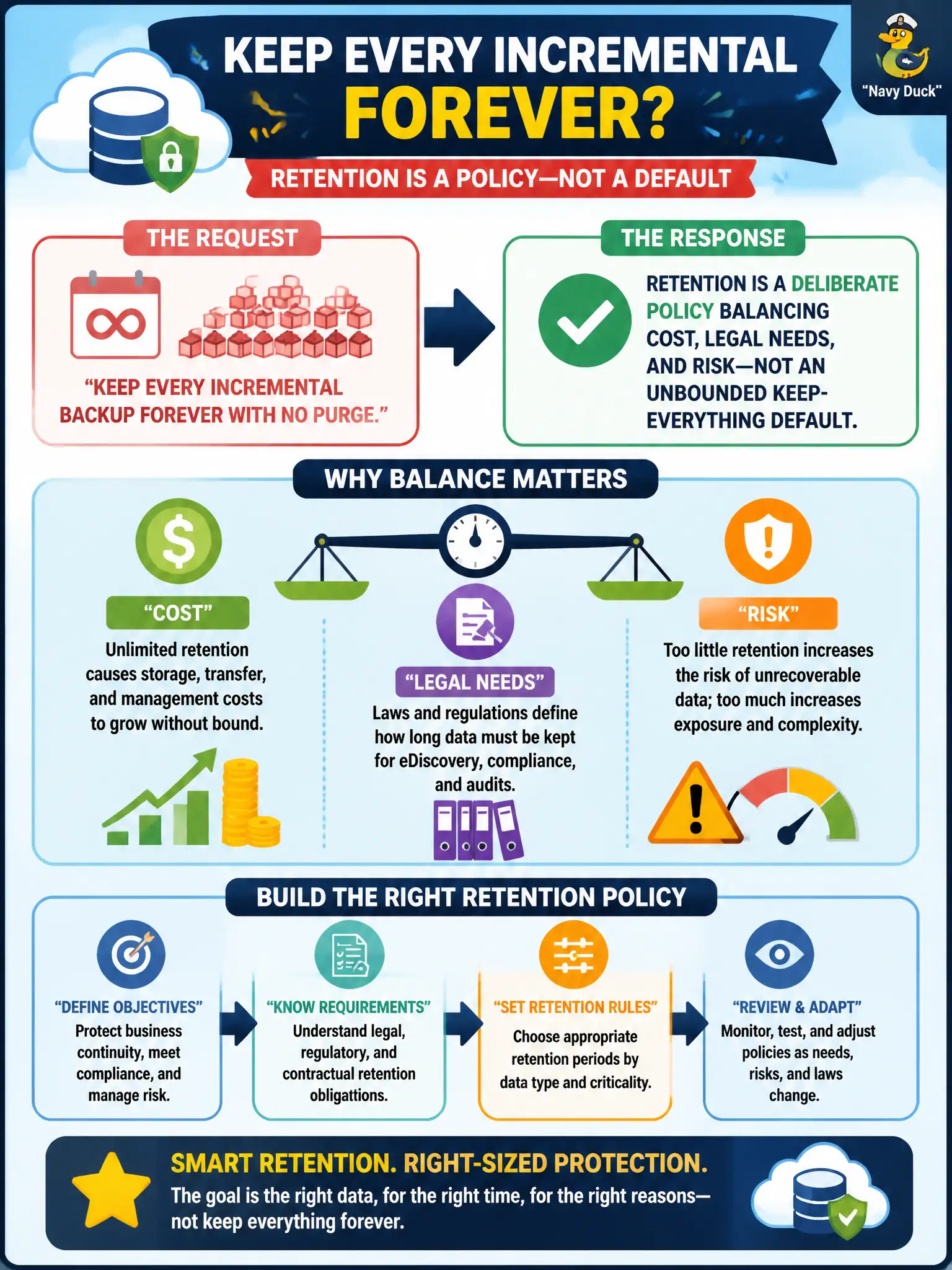
A planning department asks cloud operations to keep every incremental backup forever with no purge. What should the response emphasize about retention?
Select an answer to reveal the explanation.
Short Explanation
Keeping every receipt forever fills the attic and can even create legal headaches. Retention is a planned shelf-life, not 'never throw anything away.'
Full Explanation
Retention policies define how long backup copies remain based on business, legal, and cost constraints. When a planning department asks to keep every incremental forever with no purge, operations should emphasize that retention is a deliberate policy balancing storage cost, legal needs, privacy minimization, and risk—not an unbounded keep-everything default that silently balloons taxpayer spend and expands breach blast radius.
Claiming infinite retention is always required for any public-sector workload overgeneralizes; many datasets have defined schedules. Asserting that deleting any backup older than one day violates every compliance regime is false and dangerous. Saying incrementals must never expire because full backups are illegal to store invents a nonexistent rule and misunderstands backup sets.
Exam caveat: retention is policy-driven and may be extended by legal holds, but "forever" is rarely the default. Distinguish backup retention from records-management retention for official documents.
Operational check: draft a retention matrix with planning stakeholders and counsel (per data class), configure purge jobs to match, estimate monthly storage cost of "keep forever," and present the tradeoff. Revisit after major projects so temporary high-retention sets do not become accidental permanent archives.