
Nightly county payroll backups must include every change since last Sunday’s full backup, not merely changes since last night’s job. Which backup type fits?
Select an answer to reveal the explanation.
Short Explanation
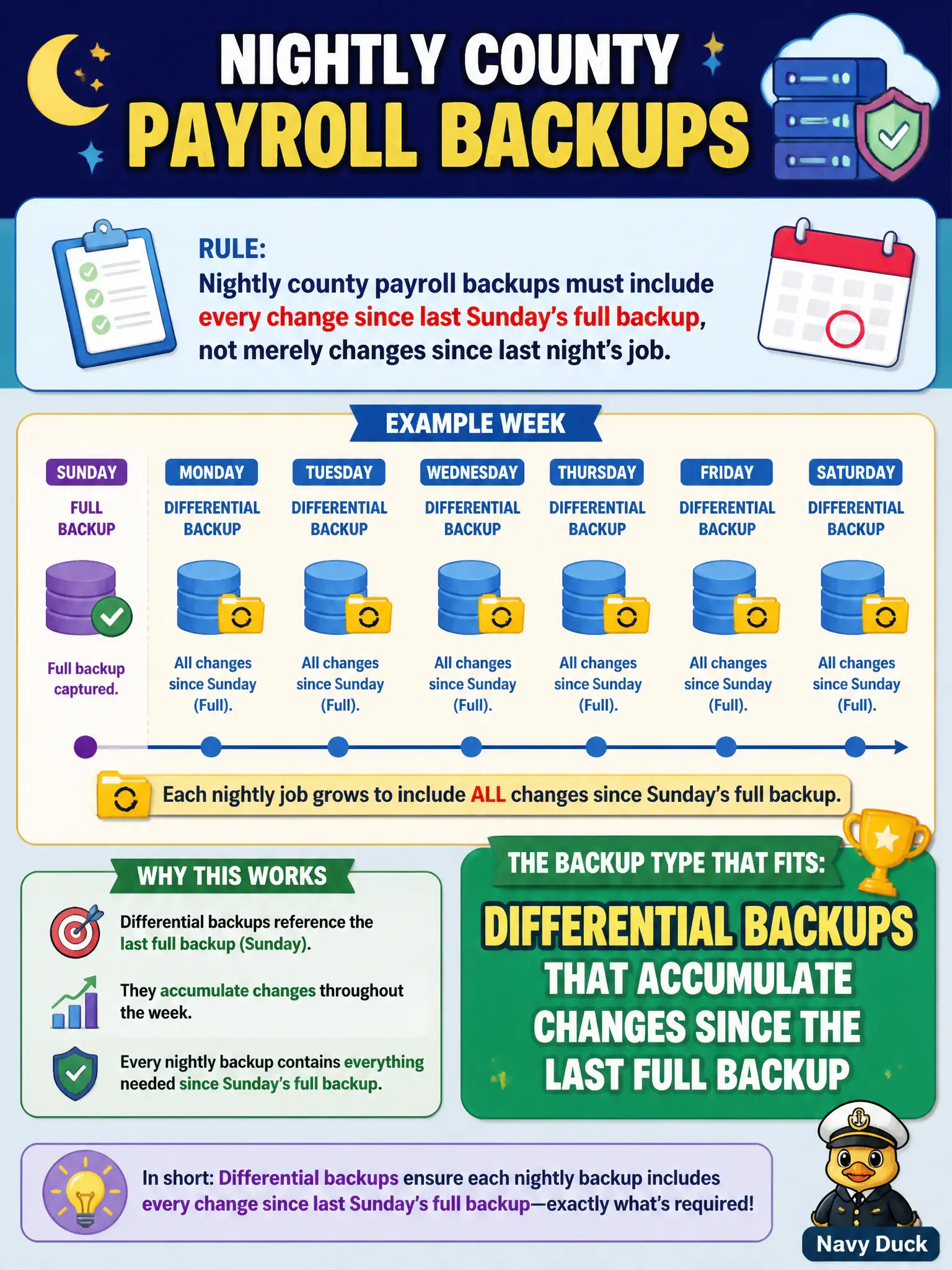
Differentials keep stacking everything since the big Sunday backup, like a growing pile of receipts since payday. They are not limited to what changed since last night. That is the key contrast with incrementals.
Full Explanation
Differential backups capture all changes since the last full backup, so each nightly differential for county payroll stands relative to last Sunday’s full rather than only to last night’s incremental. That pattern matches the requirement that nightly jobs include every change since Sunday, not merely changes since the previous nightly job, and it simplifies restore to "last full plus latest differential" without replaying an entire incremental chain.
Incremental backups that chain only to the previous incremental deliberately limit each job to changes since the last backup of any type, which fails the "since last Sunday’s full" accumulation requirement. Synthetic full backups built only from transaction logs without a baseline full misstate how synthetic fulls are normally constructed and do not describe classic differential behavior. File-level copies limited to the most recently modified single table under-scope payroll recovery needs across the broader dataset.
Exam caveat: differentials grow until the next full; they are not "smaller incrementals." After a new full, differentials reset their baseline. Do not confuse differential with continuous replication.
Operational check: verify backup software job types label Sunday as full and weeknights as differential, restore last Sunday’s full plus Wednesday’s differential into an isolated payroll test instance, and compare restored row counts or checksums to production as of the differential timestamp. Document the restore recipe in the county payroll continuity runbook for fiscal close periods.