
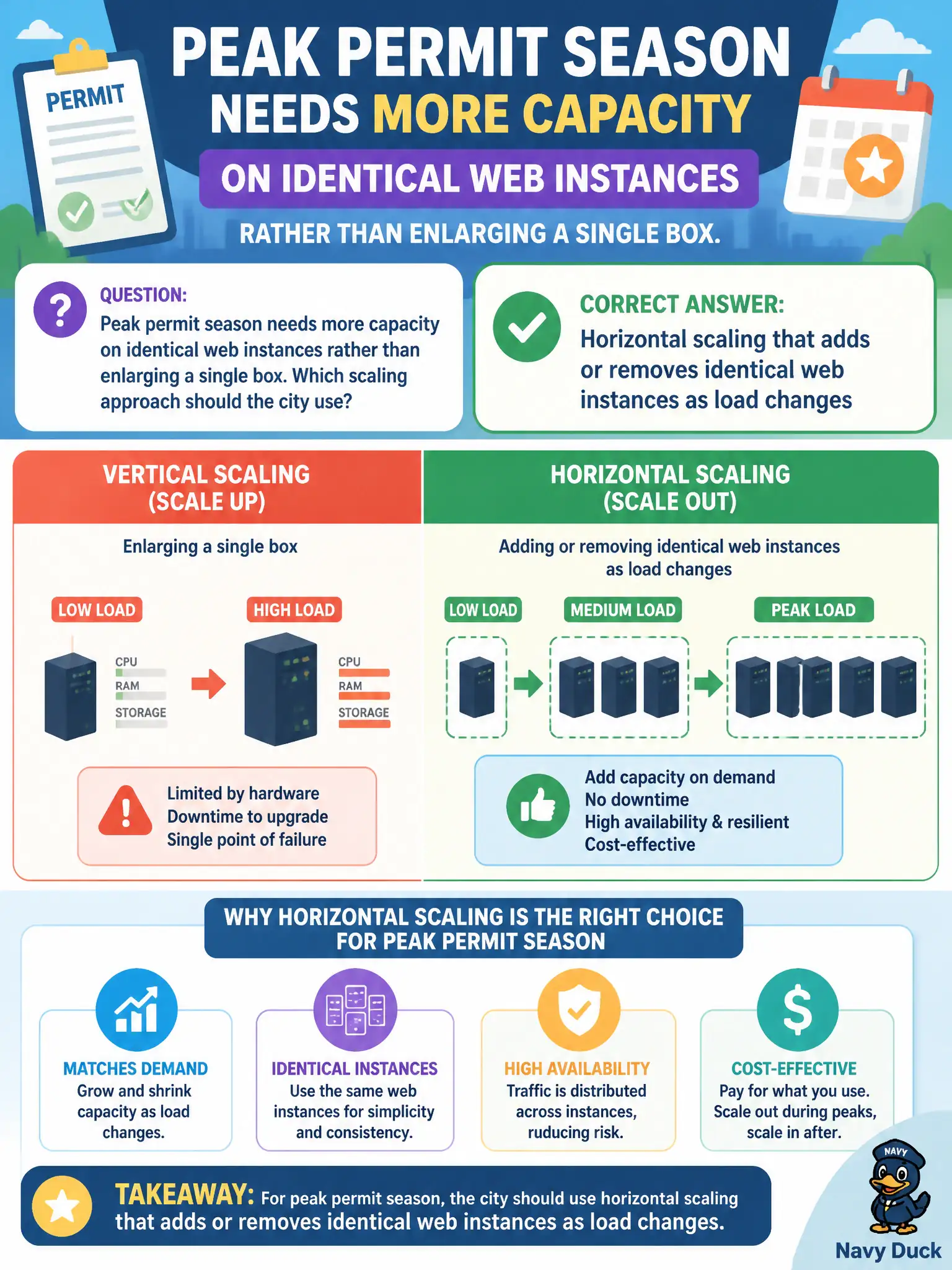
Peak permit season needs more capacity on identical web instances rather than enlarging a single box. Which scaling approach should the city use?
Select an answer to reveal the explanation.
Short Explanation
Horizontal scaling is opening more checkout lanes instead of making one cashier eight feet tall. Add identical web instances when permits flood in, then shed them when quiet returns. Same shape, more copies—that’s the web-tier playbook.
Full Explanation
Horizontal scaling adds or removes identical web instances as load changes, which fits peak permit season when the city needs more capacity on like nodes rather than enlarging a single box. Replacing the load balancer with a single oversized desktop workstation destroys HA and scale-out design. Vertical scaling only, permanently maximizing one VM with no instance count changes, contradicts the identical-instances requirement. Deleting autoscaling groups and relying on citizens to retry later fails service capacity management. Exam caveat: horizontal = scale out/in instance count; vertical = bigger box—read which the stem asks. Operational check: place instances behind a load balancer, configure autoscaling policies for permit peaks, and verify session handling during scale events. In municipal platform operations, record the chosen control and the rejected alternatives in the change record so future on-call engineers understand the failure modes avoided for citizen services. Re-check the decision after the next provider feature change or compliance update to ensure the same answer still holds for the city's estate. Confirm monitoring, access reviews, and backup coverage still align with the selected approach before closing the civic hypercare period.